


The effect of cardiac shock wave therapy on myocardial function and perfusion in the randomized, triple-blind, sham-procedure controlled study
- PMID: 31272465
- PMCID: PMC6610956
- DOI: 10.1186/s12947-019-0163-1
The effect of cardiac shock wave therapy on myocardial function and perfusion in the randomized, triple-blind, sham-procedure controlled study
Abstract
Background: Recent triple-blind sham procedure-controlled study revealed neutral effects of the cardiac shock wave therapy (CSWT) on exercise tolerance and symptoms in patients with stable angina. Current data about the effects of CSWT on global and regional myocardial contractility and perfusion is limited. Hereby we report the results of an imaging sub-study that evaluated the capacity of CSWT to ameliorate myocardial ischemia induced during dobutamine stress echocardiography (DSE) and cardiac single photon emission computed tomography (SPECT).
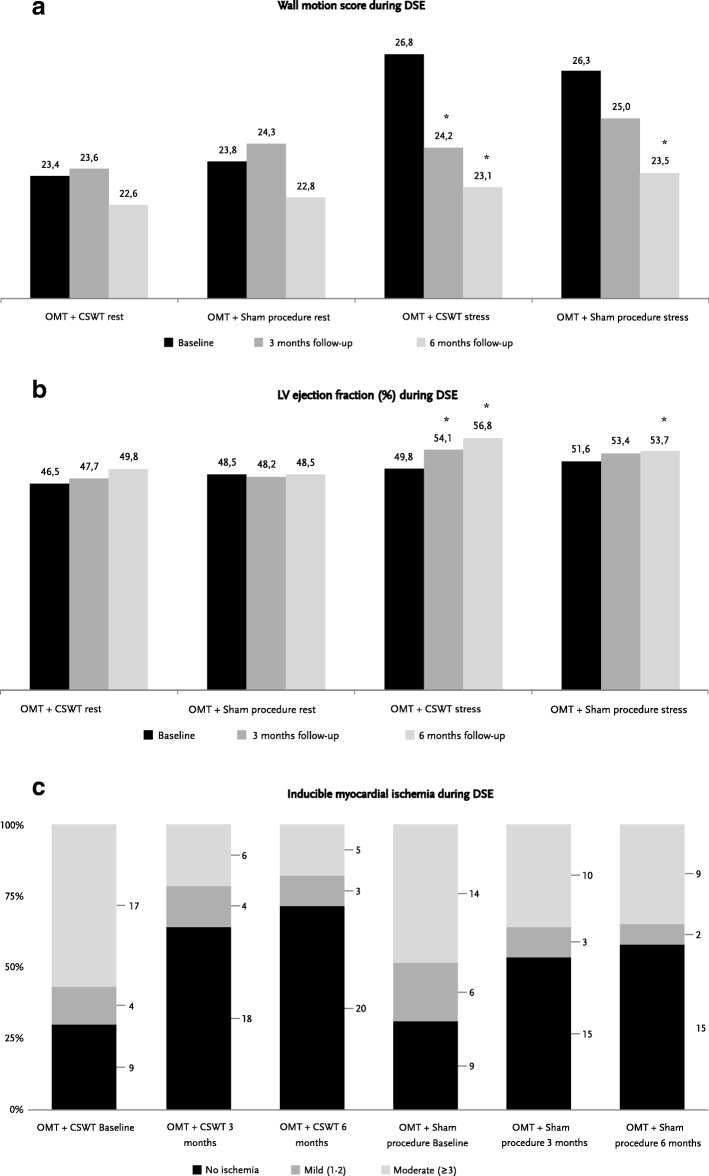
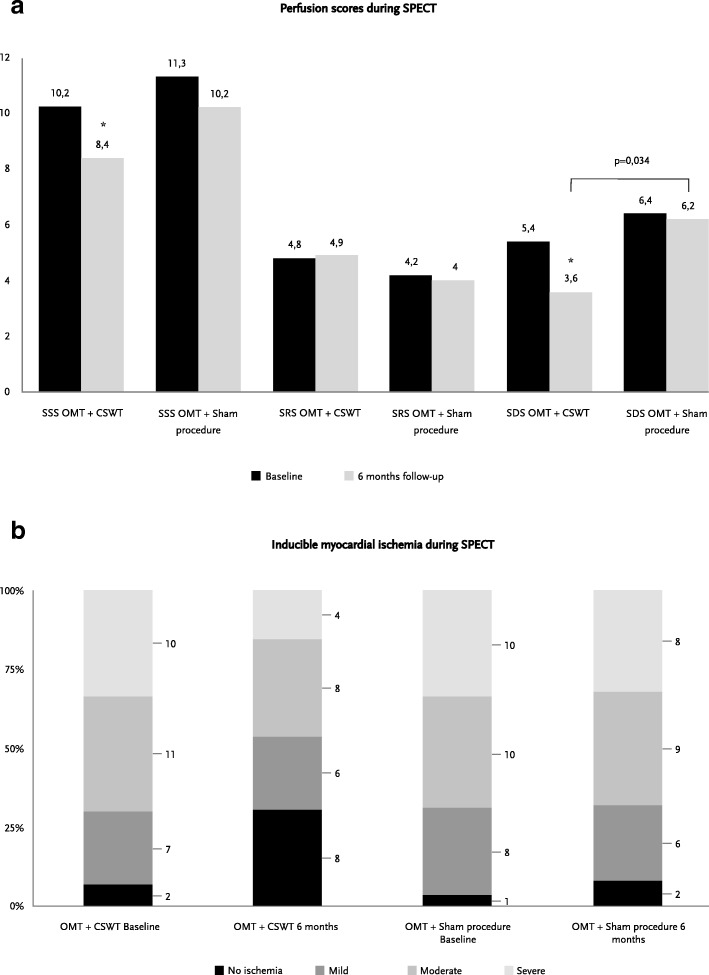
Methods: Prospective, randomized, triple-blind, sham procedure-controlled study enrolled 72 adult subjects who complied with defined inclusion criteria. The subjects were assigned to the OMT + CSWT and the OMT + sham procedure study groups with 1:1 ratio. Application of the CSWT covered all segments of the left ventricle. Imaging ischemia tests were performed in 59 study patients: DSE and SPECT before the CSWT treatment and after 6 months, with DSE carried out additionally at 3 months after randomization. Co-primary endpoints of the study were: change in wall motion score index (WMSI), representing the stress-induced impairment of regional myocardial function, and change in summed difference score (SDS), representing the amount of perfusion defect.
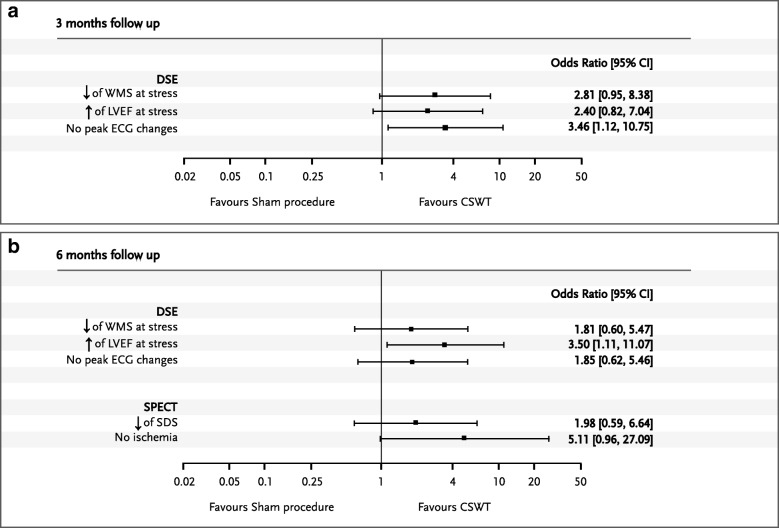
Results: OMT + CSWT and OMT + sham procedure study groups included 30 and 29 patients, respectively. Regional myocardial contractility during DSE significantly improved at 3 months follow-up in OMT + CSWT group compared to baseline as shown by WMSI at stress (1.4 ± 0.4 vs 1.6 ± 0.4, p = 0.001), but not in OMT + sham procedure group (1.5 ± 0.3 vs 1.6 ± 0.4, p = 0.136). The difference in stress DSE results between both study groups disappeared after 6 months. SPECT results demonstrated a significant reduction of inducible ischemia in OMT + CSWT group compared to OMT + sham procedure group at 6 months follow-up (SDS dropped from 5.4 ± 3.7 to 3.6 ± 3.8 vs 6.4 ± 5.9 to 6.2 ± 5 respectively, p = 0.034).
Conclusions: Cardiac shock wave treatment showed the ability to reduce stress-induced myocardial ischemia, as assessed by wall motion abnormalities and perfusion defects, compared to sham procedure.
Trial registration: Clinicaltrials.gov ( NCT02339454 ). The trial was registered retrospectively on 12 January 2015.
Keywords: Cardiac shock wave therapy; Coronary artery disease; Dobutamine stress echocardiography; Myocardial perfusion; Single photon emission computed tomography; Stable angina.
Conflict of interest statement
GB has received investigator fees from Sanofi, Janssen Research, and Daichii Sankyo; has received research support from Medispec (applicators for this study). ES has received consulting fee and research support from Medispec (applicators for this study); has received investigator fees from Servier and Bayer. GZ has received research support from Medispec for Cardiac Shock wave study. BP is a member of steering committee for Novartis and Janssen Research; has received speaker fees from Remedica, Astra Zeneca, Pfizer, Bayer and Boehringer -Ingelheim. JC is a member of advisory board for Novartis; has received investigator fees from Amgen, Sanofi and Servier; has received research support from Medispec (applicators for this study). GJ, DV, KČ, RK, IB, RS, JM, and AL have no competing interest.
Figures
References
-
- Williams B, Menon M, Satran D, Hayward D, Hodges JS, Burke N, et al. Patients with coronary artery disease not amenable to traditional revascularization: prevalence and 3-year mortality. Catheter Cardiovasc Interv. 2010;75(6):886–891. - PubMed
Publication types
MeSH terms
Associated data
LinkOut - more resources
Full Text Sources
Medical
