. 2019 Jun 18:10:1261.
doi: 10.3389/fpsyg.2019.01261. eCollection 2019.

New Technologies for the Understanding, Assessment, and Intervention of Emotion Regulation

Affiliations

New Technologies for the Understanding, Assessment, and Intervention of Emotion Regulation

Desirée Colombo et al. Front Psychol. .

Abstract

In the last decades, emotion regulation (ER) received increasing attention and became one of the most studied topics within the psychological field. Nevertheless, this construct has not been fully updated with the latest technological advancements. In this perspective, we will show how diverse technologies, such as virtual reality (VR), wearable biosensors, smartphones, or biofeedback techniques, can be applied to the understanding, assessment, and intervention of ER. After providing a brief overview of the currently available technological developments, we will discuss the benefits of incorporating new technologies in ER field, including ecological validity, intervention personalization, and the integration of understudied facets of ER, such as the implicit and interpersonal dimension.

Keywords: biofeedback; emotion regulation; internet interventions; serious games; smartphones; virtual reality.


Figures
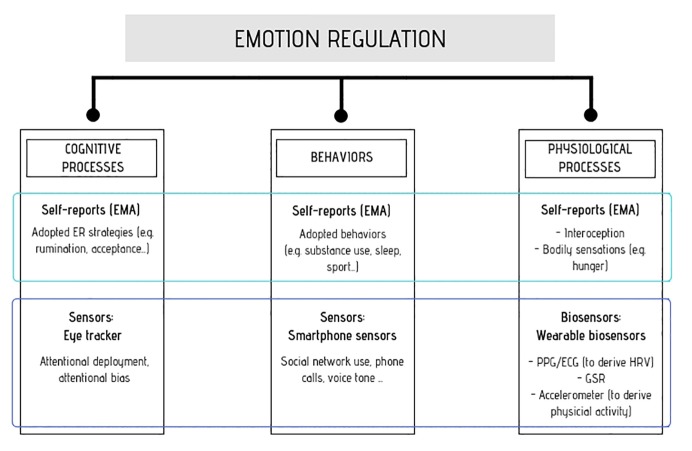
Figure 1
Figure 1
ER is composed of different facets: Cognitive mechanisms, behavioral aspects and physiological processes. The integration of different technologies could grasp all these facets, leading to a more comprehensive understanding of ER. On the one hand, the use of self-reports by means of EMA could assess the three dimensions, i.e., by asking people to report them on a mobile device. On the other hand, the use of embedded-sensors and biosensors could further increase the quantity and objectivity of this information. Cognitive processes, such as attentional deployment or attentional bias, could be investigated using an eye-tracker or other implicit measures like Go/No Go Tasks. Behaviours could be assessed using data gathered from embedded sensors, like number of calls/messages or use of social networks. Finally, the underlying physiological processes could be grasped thanks to wearable biosensors, such as wrist-watches that monitor HRV or GSR parameters. ER, emotion regulation; EMA, ecological momentary assessment; PPG, photoplethysmography; ECG, electrocardiogram; HRV, heart rate variability; GSR, galvanic skin response.
Figure 2
Figure 2
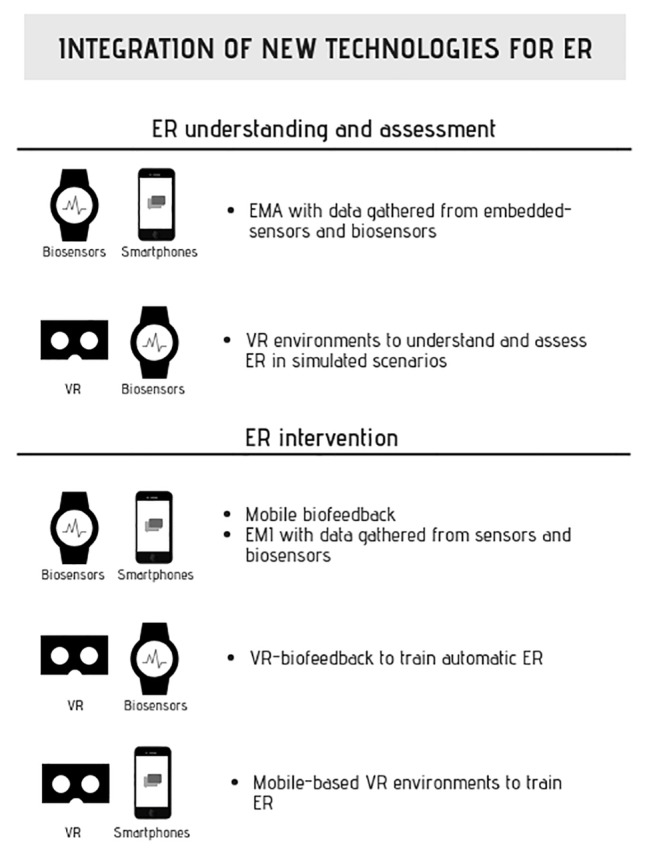
Examples of the complementary and integrative role f new technologies for the understanding assessment and intervention of ER. ER, emotion regulation; EMA, ecological momentary assessment; VR, virtual reality; EMI, ecological momentary intervention.

References

    1. Alcañiz M., Parra E., Giglioli I. A. C. (2018). Virtual reality as an emerging methodology for leadership assessment and training. Front. Psychol. 9. 10.3389/fpsyg.2018.01658, PMID: - DOI - PMC - PubMed
    1. Aldao A. (2013). The future of emotion regulation research: capturing context. Perspect. Psychol. Sci. 8, 155–172. 10.1177/1745691612459518, PMID: - DOI - PubMed
    1. Aldao A., Gee D. G., De Los Reyes A., Seager I. (2016). Emotion regulation as a transdiagnostic factor in the development of internalizing and externalizing psychopathology: current and future directions. Dev. Psychopathol. 28, 927–946. 10.1017/S0954579416000638, PMID: - DOI - PubMed
    1. Aldao A., Nolen-Hoeksema S. (2012). When are adaptive strategies most predictive of psychopathology? J. Abnorm. Psychol. 121, 276–281. 10.1037/a0023598, PMID: - DOI - PubMed
    1. Aldao A., Nolen-Hoeksema S., Schweizer S. (2010). Emotion-regulation strategies across psychopathology: a meta-analytic review. Clin. Psychol. Rev. 30, 217–237. 10.1016/j.cpr.2009.11.004, PMID: - DOI - PubMed