Review
. 2019 Jun 19:10:747.
doi: 10.3389/fpls.2019.00747. eCollection 2019.

Chloroplast Protein Degradation in Senescing Leaves: Proteases and Lytic Compartments

Affiliations
Review

Chloroplast Protein Degradation in Senescing Leaves: Proteases and Lytic Compartments

Agustina Buet et al. Front Plant Sci. .

Abstract

Leaf senescence is characterized by massive degradation of chloroplast proteins, yet the protease(s) involved is(are) not completely known. Increased expression and/or activities of serine, cysteine, aspartic, and metalloproteases were detected in senescing leaves, but these studies have not provided information on the identities of the proteases responsible for chloroplast protein breakdown. Silencing some senescence-associated proteases has delayed progression of senescence symptoms, yet it is still unclear if these proteases are directly involved in chloroplast protein breakdown. At least four cellular pathways involved in the traffic of chloroplast proteins for degradation outside the chloroplast have been described (i.e., "Rubisco-containing bodies," "senescence-associated vacuoles," "ATI1-plastid associated bodies," and "CV-containing vesicles"), which differ in their dependence on the autophagic machinery, and the identity of the proteins transported and/or degraded. Finding out the proteases involved in, for example, the degradation of Rubisco, may require piling up mutations in several senescence-associated proteases. Alternatively, targeting a proteinaceous protein inhibitor to chloroplasts may allow the inhibitor to reach "Rubisco-containing bodies," "senescence-associated vacuoles," "ATI1-plastid associated bodies," and "CV-containing vesicles" in essentially the way as chloroplast-targeted fluorescent proteins re-localize to these vesicular structures. This might help to reduce proteolytic activity, thereby reducing or slowing down plastid protein degradation during senescence.

Keywords: SAG12; chloroplast protein degradation; leaf senescence; protease; senescence-associated vacuoles; vacuole.


Figures
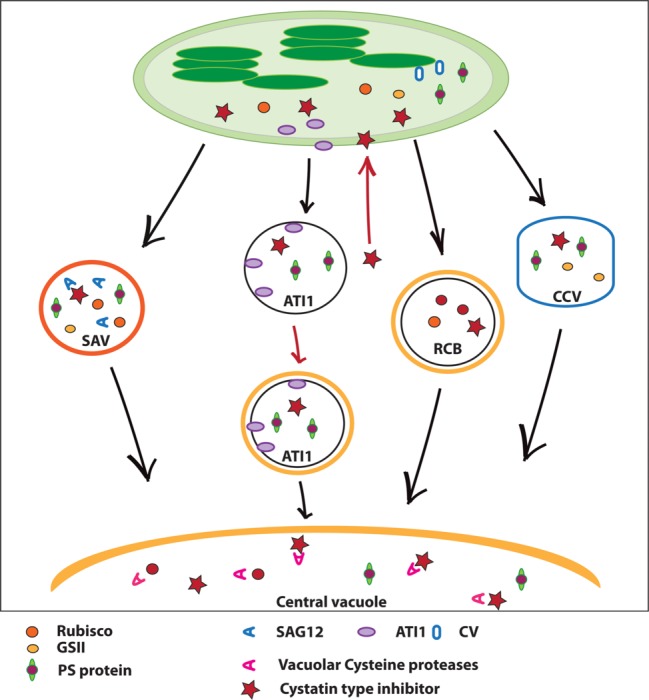
Figure 1
Figure 1
A schematic representation of cellular pathways delivering chloroplast proteins to lytic compartments and a proposed strategy to inhibit plastid protein degradation in crop species. Chloroplast proteins traffic to “senescence-associated vacuoles” (SAVs) and/or to the central vacuole via “ATI1-plastid associated bodies” (ATI1-PS), “Rubisco-containing bodies” (RCBs), or “CV-containing vesicles” (CCVs). Each of these vesicles apparently transports specific proteins (Rubisco for SAVs and RCBs, certain thylakoid proteins for ATI1-PS and CCV), which may be degraded by cysteine proteases either in SAVs or the central vacuole. SAVs might also be internalized into the central vacuole, although this is hypothetical. A proposed strategy to reduce/slow down chloroplast protein degradation during senescence in crop plants is the use of targeted protease inhibitors. A proteinaceous protease inhibitor (e.g., a phytocystatin, or a Kunitz-type inhibitor such as WSCP, represented by a red star in the cytosol) fused to a chloroplast transit peptide is expressed under control of a senescence-induced promoter. The chloroplast-located inhibitor would then be redirected to RCBs, ATI1-PS, CCV, and/or SAVs by the same mechanism which directs chloroplast-targeted fluorescent proteins to these vesicular structures. Once in the central vacuole or in SAVs, the inhibitor binds proteases, thus reducing proteolytic activity and preserving protein levels.

References

    1. Acharya B. R., Jeon B. W., Zhang W., Assmann S. M. (2013). Open Stomata 1 (OST1) is limiting in abscisic acid responses of Arabidopsis guard cells. New Phytol. 200, 1049–1063. 10.1111/nph.12469, PMID: - DOI - PubMed
    1. Aro E. M., Virgin I., Andersson B. (1993). Photoinhibition of photosystem II. Inactivation, protein damage and turnover. Biochim. Biophys. Acta 1143, 113–134. - PubMed
    1. Avila-Ospina L., Moison M., Yoshimoto K., Masclaux-Daubresse C. (2014). Autophagy, plant senescence, and nutrient recycling. J. Exp. Bot. 65, 3799–3811. 10.1093/jxb/eru039, PMID: - DOI - PubMed
    1. Beyenne G., Foyer C. H., Kunert K. J. (2006). Two new cysteine proteinases with specific expression patterns in mature and senescent tobacco (Nicotiana tabacum L.) leaves. J. Exp. Bot. 57, 1431–1443. 10.1093/jxb/erj123, PMID: - DOI - PubMed
    1. Boex-Fontvieille E., Rustgi S., Reinbothe S., Reinbothe C. (2015). A Kunitz-type protease inhibitor regulates programmed cell death during flower development in Arabidopsis thaliana. J. Exp. Bot. 66, 6119–6135. 10.1093/jxb/erv327, PMID: - DOI - PubMed

LinkOut - more resources
