Review
. 2019 Jun 18:7:147.
doi: 10.3389/fbioe.2019.00147. eCollection 2019.

Cell Cytometry: Review and Perspective on Biotechnological Advances

Affiliations
Review

Cell Cytometry: Review and Perspective on Biotechnological Advances

Abhishek Vembadi et al. Front Bioeng Biotechnol. .

Abstract

Cell identification and enumeration are essential procedures within clinical and research laboratories. For over 150 years, quantitative investigation of body fluids such as counts of various blood cells has been an important tool for diagnostic analysis. With the current evolution of point-of-care diagnostics and precision medicine, cheap and precise cell counting technologies are in demand. This article reviews the timeline and recent notable advancements in cell counting that have occurred as a result of improvements in sensing including optical and electrical technology, enhancements in image processing capabilities, and contributions of micro and nanotechnologies. Cell enumeration methods have evolved from the use of manual counting using a hemocytometer to automated cell counters capable of providing reliable counts with high precision and throughput. These developments have been enabled by the use of precision engineering, micro and nanotechnology approaches, automation and multivariate data analysis. Commercially available automated cell counters can be broadly classified into three categories based on the principle of detection namely, electrical impedance, optical analysis and image analysis. These technologies have many common scientific uses, such as hematological analysis, urine analysis and bacterial enumeration. In addition to commercially available technologies, future technological trends using lab-on-a-chip devices have been discussed in detail. Lab-on-a-chip platforms utilize the existing three detection technologies with innovative design changes utilizing advanced nano/microfabrication to produce customized devices suited to specific applications.

Keywords: biotechnology; cytometry; enumeration; microfabrication; microfluidics.


Figures

Figure 1
Figure 1
Evolution of various cell counting and detection technologies.
Figure 2
Figure 2
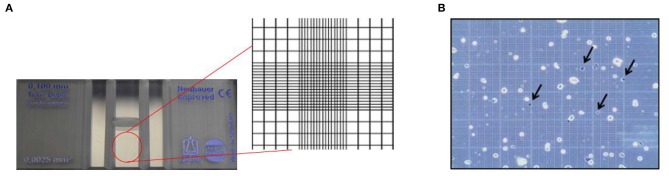
Principle of hemocytometer for cell counting. (A) Zoomed inset of a hemocytometer showing the Neubauer chamber with counting grid. (B) Stained colon carcinoma CT-26 cells using trypan blue dye where the arrows indicate dead cells (Hong et al., 2011). This work is licensed under the Creative Commons Attribution 4.0 International License.
Figure 3
Figure 3
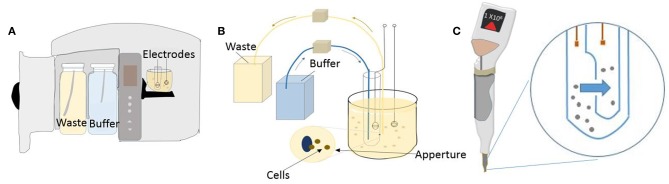
Coulter counter technology used in a benchtop and handheld device. (A) Schematic of a standard benchtop coulter counter. (B) Illustration of the mechanism of detection used in benchtop coulter counter. (C) Illustration showing Scepter handheld coulter counter and its working principle.
Figure 4
Figure 4
Microfluidic impedance cytometers for cell detection. (A) A micro-Coulter system employing two Ag/AgCl electrodes through a salt bridge (Chun et al., 2005). Reprinted with permission from Analytical chemistry. (B) A Microfluidic platform lysing RBCs from whole blood before performing a cell count (Hassan et al., 2015). This work is licensed under the Creative Commons Attribution 4.0 International License.
Figure 5
Figure 5
Different electrode geometry configuration. (A) Cell flowing through co-planar electrodes. (B) Illustration of a cell flowing through a parallel electrode configuration inside a microfluidic channel. (C) Schematic diagram of needle electrodes (Mansor et al., 2017). This work is licensed under the Creative Commons Attribution 4.0 International License. (D) Liquid electrodes made of Ag/Agcl (Tang et al., 2017). Reprinted with permission from Analytical Chemistry.
Figure 6
Figure 6
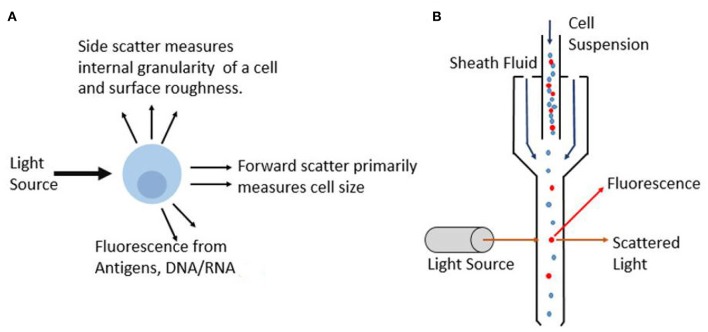
Principle of optical flow cytometry. (A) As incident light beam hits the cell, different parameters such as extinction, scatter and fluorescence are measured and this interaction provides information on optical properties and composition of the cell. (B) Schematic showing the particles lined in a single stream using sheath fluid as they interact with the laser light which gets collected by detectors.
Figure 7
Figure 7
Microfluidic optical flow cytometers. (A) A microscopic image indicating hydrodynamic focusing and the arrangement of the optical fibers in a flow cytometry chip (Mao et al., 2012). FL, FSC, and SSC stand for fluorescence light, forward scatter, and side scatter, respectively. Reprinted with permission from Biomicrofluidics. (B) Schematic configuration of a microfluidic flow cytometer using an optofluidic lens (Song et al., 2011). This work is licensed under the Creative Commons Attribution 4.0 International License. (C) System showing integrated optics comprising of fibers and microlens in PDMS (Zhao et al., 2016). Reprinted with permission from Biomicrofluidics. (D) Schematic of a fiber-based micro-flow cytometer with an integrated detection micro-chamber encased in a double clad fiber (DCF) (Etcheverry et al., 2017). This work is licensed under the Creative Commons Attribution 4.0 International License.
Figure 8
Figure 8
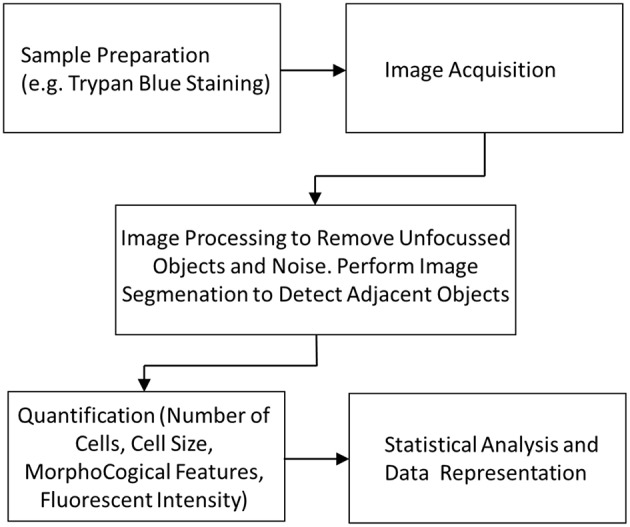
Image cytometry workflow showing the different stages from sample preparation to data analysis.

References

    1. Absher M. (1973). Tissue Culture: Methods and Applications. Massachusetts, MA: Elsevier Inc.
    1. Adan A., Alizada G., Kiraz Y., Baran Y., Nalbant A. (2016). Flow cytometry: basic principles and applications. Crit Rev Biotechnol. 37, 163–176. 10.3109/07388551.2015.1128876 - DOI - PubMed
    1. Ayliffe H. E., Frazier A. B., Rabbitt R. D. (1999). Electric impedance spectroscopy using microchannels with integrated metal electrodes. Microelectromech. Syst. 8, 50–57. 10.1109/84.749402 - DOI
    1. Bagnaninchi P. O., Drummond N. (2011). Real-time label-free monitoring of adipose-derived stem cell differentiation with electric cell-substrate impedance sensing. Proc. Nat. Acad. Sci. U.S.A. 108, 6462–6467. 10.1073/pnas.1018260108 - DOI - PMC - PubMed
    1. Bard J. (1974). Tissue culture, methods and applications. Cell 2, 120–121. 10.1016/0092-8674(74)90102-0 - DOI