


Relationship of serum leptin concentration with pituitary-dependent hyperadrenocorticism and cholestatic disease in dogs
- PMID: 31276206
- PMCID: PMC6852161
- DOI: 10.1111/jsap.13044
Relationship of serum leptin concentration with pituitary-dependent hyperadrenocorticism and cholestatic disease in dogs
Abstract
Objectives: To measure serum leptin concentration in dogs with pituitary-dependent hyperadrenocorticism and varying degrees of cholestatic disease and determine whether serum levels differed between dogs with pituitary-dependent hyperadrenocorticism and those with gall bladder mucocoele.
Materials and methods: Client-owned healthy dogs (n=20), dogs diagnosed with gall bladder mucocoele (n=20) and dogs diagnosed with pituitary-dependent hyperadrenocorticism (n=60) were enrolled. Only dogs of normal body condition score were included. Dogs with pituitary-dependent hyperadrenocorticism were divided into three groups according to the severity of cholestatic disease: normal gall bladder (n=20), cholestasis (n=20) and gall bladder mucocoele (n=20). Serum leptin levels were measured using sandwich enzyme-linked immunosorbent assay.
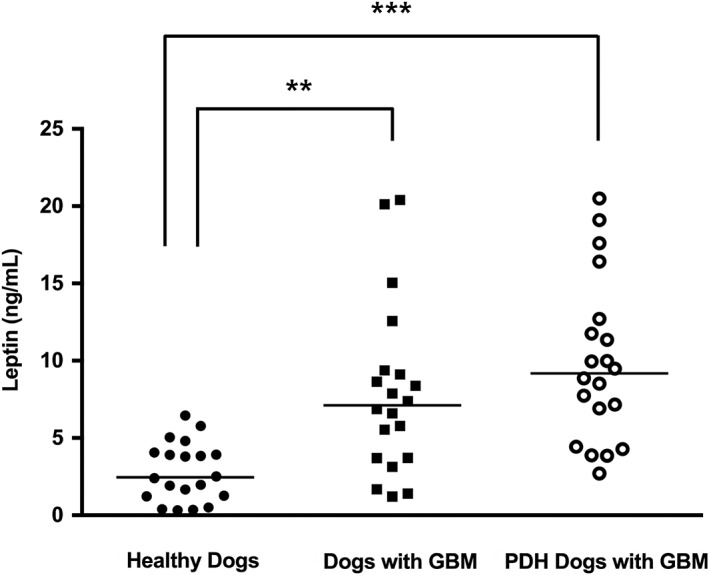
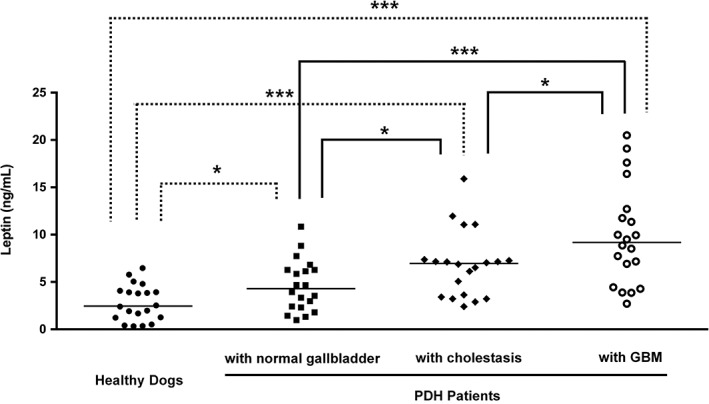
Results: Serum concentrations of leptin were similar between dogs with gall bladder mucocoele and those with pituitary-dependent hyperadrenocorticism accompanied by gall bladder mucocoele; these concentrations were significantly higher than those in healthy control dogs. In dogs with pituitary-dependent hyperadrenocorticism, circulating leptin concentration significantly increased with the severity of cholestasis: higher in the cholestasis group than the normal gall bladder group and higher in the gall bladder mucocoele group than the cholestasis group.
Clinical significance: Elevated circulating leptin concentration was associated with canine pituitary-dependent hyperadrenocorticism and gall bladder mucocoele. Homeostatic imbalance of leptin concentration might be associated with severity of cholestatic disease in pituitary-dependent hyperadrenocorticism.
© 2019 The Authors Journal of Small Animal Practice published by John Wiley & Sons Ltd on behalf of British Small Animal Veterinary Association.
Conflict of interest statement
No conflict of interest has been declared.
Figures
References
-
- Barahona, M. J. , Sucunza, N. , Resmini, E. , et al (2009) Persistent body fat mass and inflammatory marker increases after long‐term cure of Cushing's syndrome. The Journal of Clinical Endocrinology & Metabolism 94, 3365‐3371 - PubMed
-
- Behrend, E. , Kooistra, H. , Nelson, R. , et al (2013) Diagnosis of spontaneous canine hyperadrenocorticism: 2012 ACVIM consensus statement (small animal). Journal of Veterinary Internal Medicine 27, 1292‐1304 - PubMed
-
- Bernhoft, R. A. , Pellegrini, C. A. , Broderick, W. C. , et al (1983) Pigment sludge and stone formation in the acutely ligated dog gallbladder. Gastroenterology 85, 1166‐1171 - PubMed
-
- Besso, J. , Wrigley, R. , Gliatto, J. , et al (2000) Ultrasonographic appearance and clinical findings in 14 dogs with gallbladder mucocele. Veterinary Radiology & Ultrasound 41, 261‐271 - PubMed
MeSH terms
Substances
Grants and funding
LinkOut - more resources
Full Text Sources
