


Multilayered Microfluidic Paper-Based Devices: Characterization, Modeling, and Perspectives
- PMID: 31276368
- PMCID: PMC7653499
- DOI: 10.1021/acs.analchem.9b01112
Multilayered Microfluidic Paper-Based Devices: Characterization, Modeling, and Perspectives
Abstract
Microfluidic paper-based analytical devices (μPADs) are simple but powerful analytical tools that are gaining significant recent attention due to their many advantages over more traditional monitoring tools. These include being inexpensive, portable, pump-free, and having the ability to store reagents. One major limitation of these devices is slow flow rates, which are controlled by capillary action in the hydrophilic pores of cellulosic paper. Recent investigations have advanced the flow rates in μPADs through the generation of a gap or channel between two closely spaced paper sheets. This multilayered format has opened up μPADs to new applications and detection schemes, where large gap sizes (>300 μm) provide at least 169× faster flow rates than single-layer μPADs, but do not conform to established mathematical models for fluid transport in porous materials, such as the classic Lucas-Washburn equation. In the present study, experimental investigations and analytical modeling are applied to elucidate the driving forces behind the rapid flow rates in these devices. We investigate a range of hypotheses for the systems fluid dynamics and establish a theoretical model to predict the flow rate in multilayered μPADs that takes into account viscous dissipation within the paper. Device orientation, sample addition method, and the gap height are found to be critical concerns when modeling the imbibition in multilayered devices.
Figures
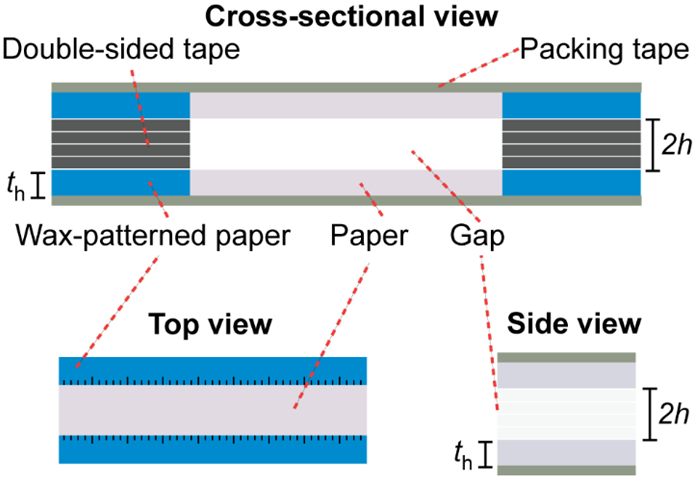
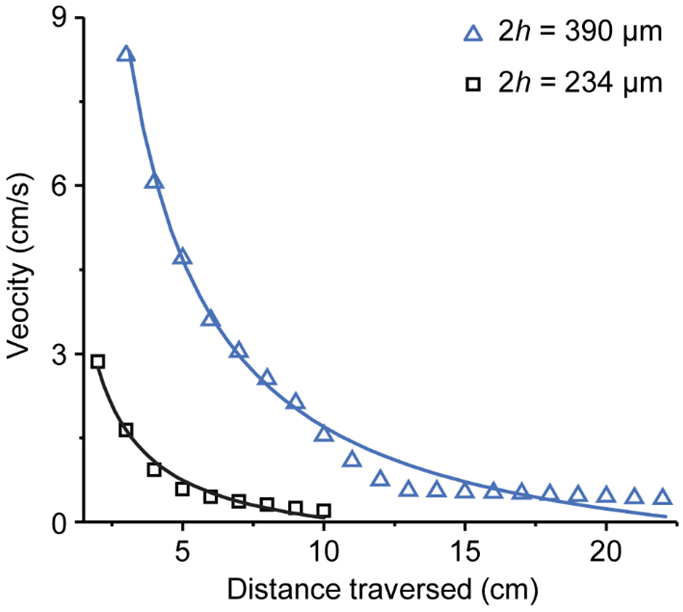
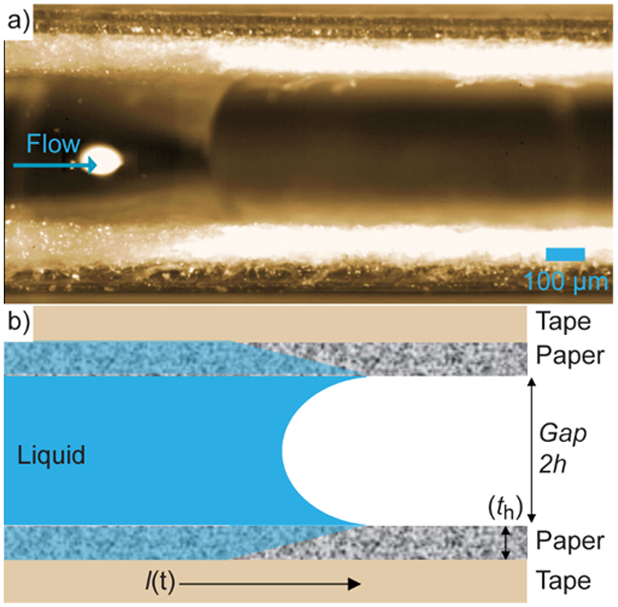
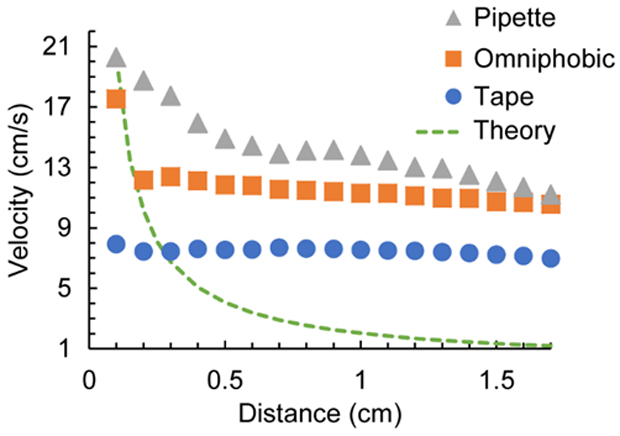
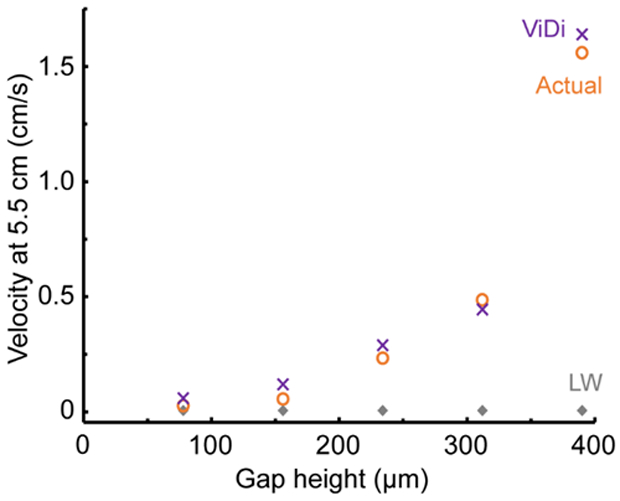
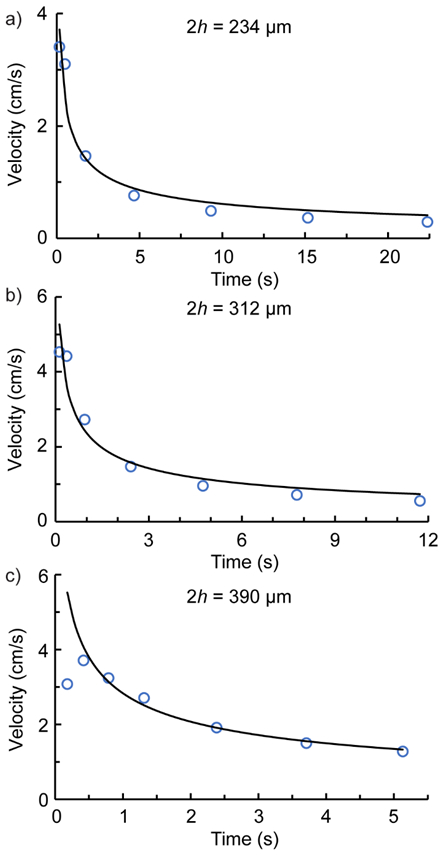
 ) correspond to the experimental values while the black line represents the model predictionl. The gap heights are (a) 234 μm, (b) 312 μm, and (c) 390 μm.
References
-
- Organization, W. H. World Health Organization Model List of Essential In Vitro Diagnostics; 16-20 April 2018, 2018.
-
- Gong MM; Sinton D, Turning the Page: Advancing Paper-Based Microfluidics for Broad Diagnostic Application. Chem. Rev 2017, 117 (12), 8447–8480. - PubMed
-
- Yang Y; Noviana E; Nguyen MP; Geiss BJ; Dandy DS; Henry CS, Paper-Based Microfluidic Devices: Emerging Themes and Applications. Anal. Chem 2017, 89 (1), 71–91. - PubMed
-
- Yamada K; Shibata H; Suzuki K; Citterio D, Toward practical application of paper-based microfluidics for medical diagnostics: state-of-the-art and challenges. Lab Chip 2017, 17 (7), 1206–1249. - PubMed
Publication types
MeSH terms
Grants and funding
LinkOut - more resources
Full Text Sources
Miscellaneous
