


Long-term status of predicted body fat percentage, body mass index and other anthropometric factors with risk of colorectal carcinoma: Two large prospective cohort studies in the US
- PMID: 31276608
- PMCID: PMC7282530
- DOI: 10.1002/ijc.32553
Long-term status of predicted body fat percentage, body mass index and other anthropometric factors with risk of colorectal carcinoma: Two large prospective cohort studies in the US
Abstract
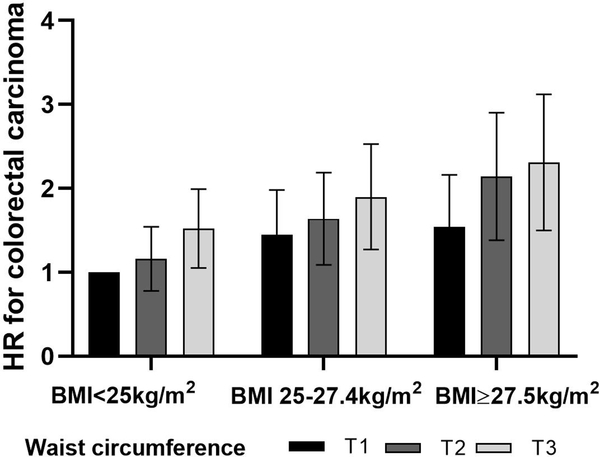
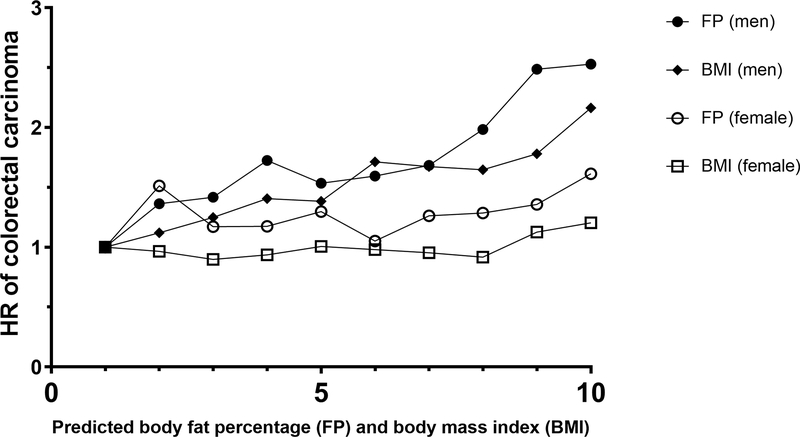
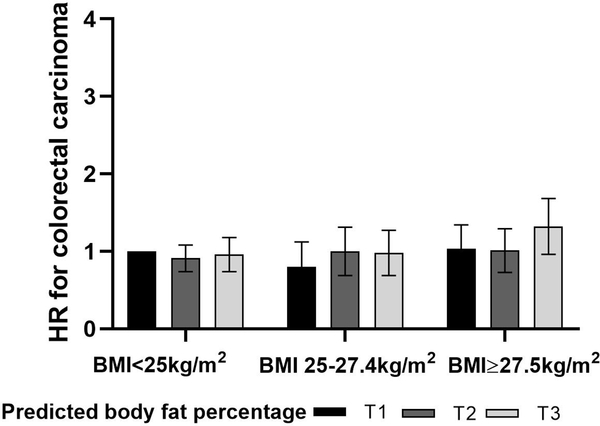
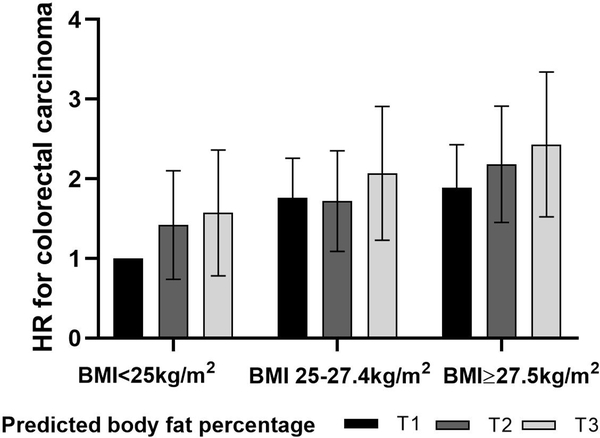
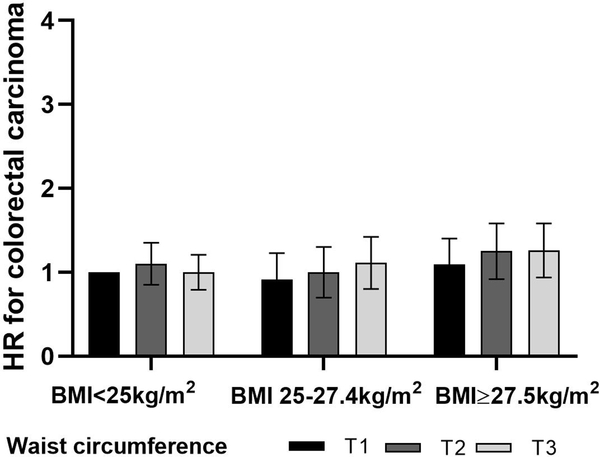
Anthropometric measurements, such as body mass index (BMI), waist circumference, and body fat percentage, have been used as indicators of obesity. Despite evidence that excess body fat is a risk factor for colorectal carcinoma (CRC), the magnitude of the association of BMI and other obesity indicators with the long-term risk of CRC remains unclear. Utilizing a Cox proportional hazards regression model, we examined differential associations between predicted body fat percentage and BMI with the risk of CRC (n = 2,017). The associations between CRC incidence and different adiposity measurements were also assessed. Predicted body fat percentage had a similar increased risk of CRC risk as BMI. In multivariable-adjusted analyses, the hazard ratio for CRC in the second to fifth quintiles (compared to the first quintile) of predicted body fat percentage were 1.32, 1.31, 1.53 and 2.09 for men (ptrend < 0.001) and 0.91, 0.90, 0.98 and 1.15 for women (ptrend = 0.03). Among various anthropometric measurements, predicted fat mass and waist circumference were slightly more strongly associated with CRC risk than BMI. In conclusion, the novel anthropometric prediction equations provided further evidence that a greater amount of body fat might contribute to CRC risk in both sexes. An innovative approach enabled us to estimate the susceptibilities of specific body composition with CRC risk, in an inexpensive and minimally invasive manner. Furthermore, the typically used measures of BMI and waist circumference are robust measures of adiposity to predict cancer risk in a relatively healthy population.
Keywords: body composition; body fat percentage; colorectal cancer; obesity; visceral adiposity.
© 2019 UICC.
Conflict of interest statement
Figures
References
-
- Flegal KM, Carroll MD, Kuczmarski RJ, Johnson CL. Overweight and obesity in the United States: prevalence and trends, 1960–1994. Int J Obes Relat Metab Disord 1998;22:39–47. - PubMed
-
- Flegal KM, Carroll MD, Kit BK, Ogden CL. Prevalence of obesity and trends in the distribution of body mass index among US adults, 1999–2010. JAMA 2012;307:491–7. - PubMed
-
- Roberto CA, Swinburn B, Hawkes C, Huang TT-K, Costa SA, Ashe M, Zwicker L, Cawley JH, Brownell KD. Patchy progress on obesity prevention: emerging examples, entrenched barriers, and new thinking. Lancet (London, England) 2015;385:2400–9. - PubMed
-
- Renehan AG, Tyson M, Egger M, Heller RF, Zwahlen M. Body-mass index and incidence of cancer: a systematic review and meta-analysis of prospective observational studies. Lancet 2008;371:569–78. - PubMed
Publication types
MeSH terms
Grants and funding
LinkOut - more resources
Full Text Sources
Medical
