Review
. 2019 Jul 3;55(7):335.
doi: 10.3390/medicina55070335.

Current Approaches to the Treatment of Gastric Varices: Glue, Coil Application, TIPS, and BRTO

Affiliations
Review

Current Approaches to the Treatment of Gastric Varices: Glue, Coil Application, TIPS, and BRTO

Vedat Goral et al. Medicina (Kaunas). .

Abstract

Gastric varices are less common than esophageal varices, and their treatment is quite challenging. Gastric varix bleedings (GVB) occur less frequently than esophageal varix (EV) bleedings and represent 10% to 30% of all variceal bleedings. They are; however, more severe and are associated with high mortality. Re-bleeding may occur in 35% to 90% of cases after spontaneous hemostasis. GV bleedings represent a serious clinical problem compared with esophageal varices due to their location. Sclerotherapy and band ligation, in particular, are less effective. Based on the anatomic site and location, treatment differs from EV and is categorized into two groups (i.e., endoscopic or radiologic treatment). Surgical management is used less frequently. Balloon-occluded retrograde transvenous obliteration (BRTO) and cyanoacrylate are safe but there is a high risk of re-bleeding. Portal pressure elevates following BRTO and leads to worsening of esophageal varix pressure. Other significant complications may include hemoglobinuria, abdominal pain, fever, and pleural effusion. Shock and atrial fibrillation are major complications. New and efficient treatment modalities will be possible in the future.

Keywords: BRTO; bleeding; gastric varices; glue and coil application.


Conflict of interest statement

There are no conflicts of interest.

Figures
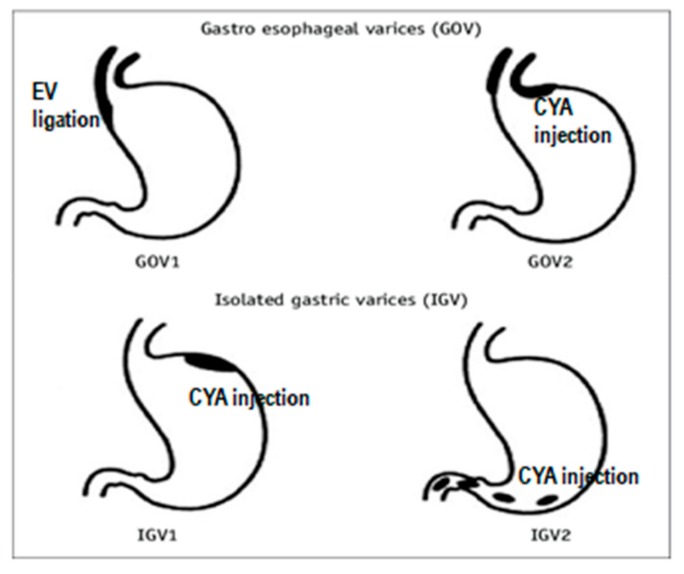
Figure 1
Figure 1
Treatments recommended for gastric varices according to Sarin classification; EVL—endoscopic variceal ligation, CYA—α-cyanoacryrate glue, GOV—gastroesophageal varices, IGV—isolated gastric varices.
Figure 2
Figure 2
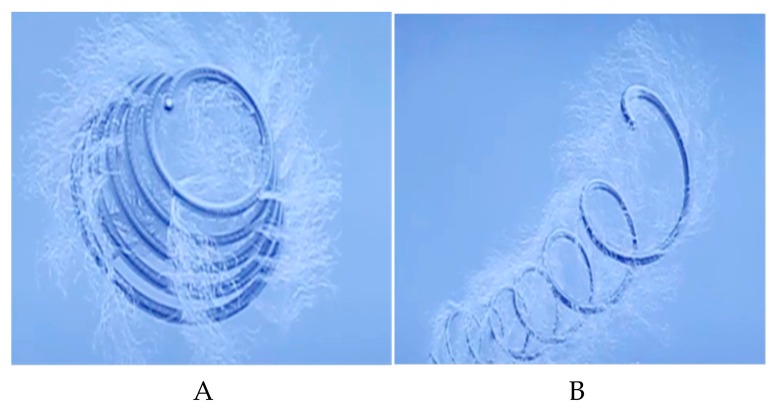
The type of coils used for EUS guıded coil application for varix obliteration. (A) Tornado-type coil. (B) Nester-type coil.
Figure 3
Figure 3
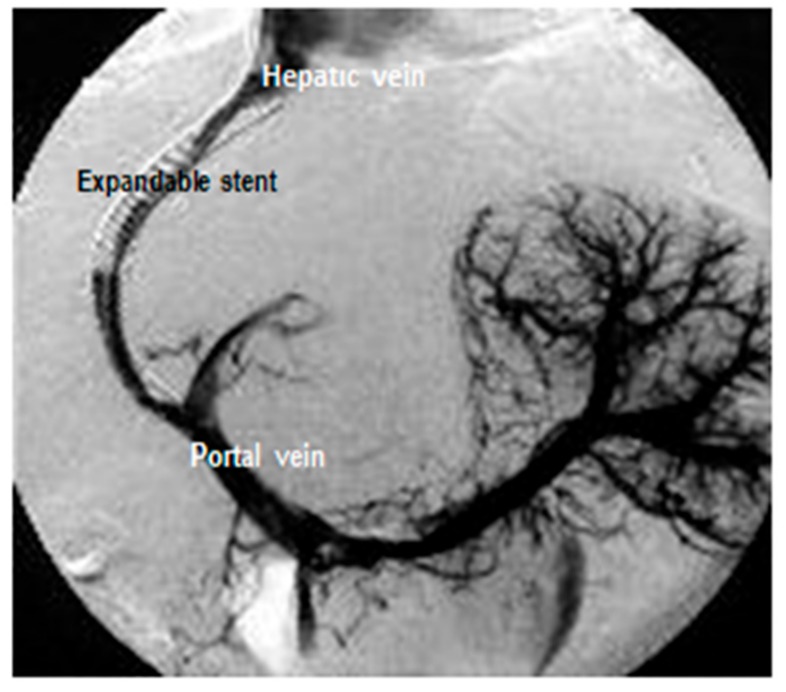
TIPS application.
Figure 4
Figure 4
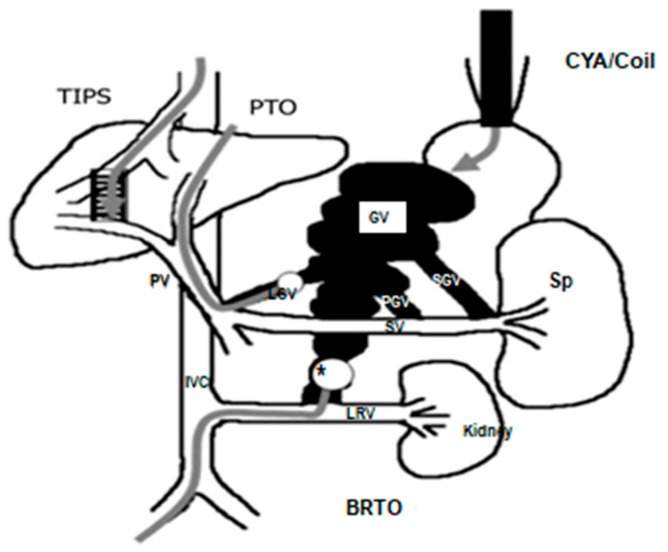
Basic porto-systemic venous anatomy of GV with the shunts and treatment modalities; CYA—α-cyanoacryrate glue, TIPS—transjugular intrahepatic portosystemic shunt, PTO—percutaneous transhepatic obliteration, BRTO—balloon-occluded retrograde transvenous obliteration, IVC—inferior venacava, LGV—left gastric vein, SGV—short gastric vein, PGV—posterior gastric vein, LRV—left renal vein, PV—main portal vein, SV—splenic vein, GV—gastric varices; Sp—spleen. *Conventional BRTO procedure through transfemoral approach with a balloon in the gastrorenal shunt. Modified from [26].

References

    1. Garcia-Pagán J.C., Barrufet M., Cardenas A., Escorsell A. Management of gastric varices. Clin. Gastroenterol. Hepatol. 2014;12:919–928. doi: 10.1016/j.cgh.2013.07.015. - DOI - PubMed
    1. Wani Z.A., Bhat R.A., Bhadoria A.S., Maiwall R., Choudhury A. Gastric varices: Classification, endoscopic and ultrasonographic management. J. Res. Med. Sci. 2015;20:1200–1207. - PMC - PubMed
    1. Lo G.H. Endoscopic treatments for portal hypertension. Hepatol. Int. 2018;12:91–101. doi: 10.1007/s12072-017-9828-8. - DOI - PubMed
    1. Ibrahim M., Mostafa I., Devière J. New Developments in Managing Variceal Bleeding. Gastroenterology. 2018;154:1964–1969. doi: 10.1053/j.gastro.2018.02.023. - DOI - PubMed
    1. Chang C.-J., Hou M.-C., Liao W.-C., Chen P.-H., Lin H.-C., Lee F.-Y., Lee S.-D. Management of acute gastric varices bleeding. J. Chin. Med Assoc. 2013;76:539–546. doi: 10.1016/j.jcma.2013.06.011. - DOI - PubMed

MeSH terms

LinkOut - more resources