


The Unsolved Puzzle of c-Rel in B Cell Lymphoma
- PMID: 31277480
- PMCID: PMC6678315
- DOI: 10.3390/cancers11070941
The Unsolved Puzzle of c-Rel in B Cell Lymphoma
Abstract
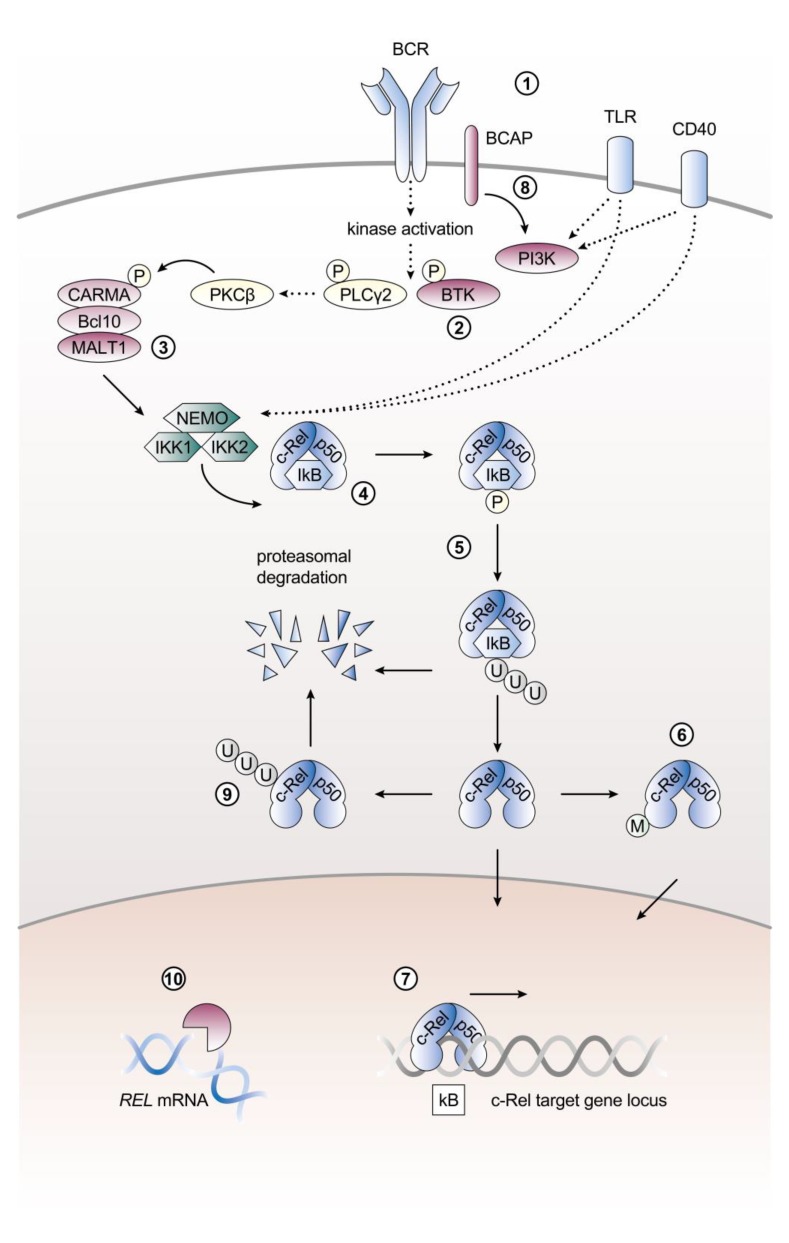
Aberrant constitutive activation of Rel/NF-κB transcription factors is a hallmark of numerous cancers. Of the five Rel family members, c-Rel has the strongest direct links to tumorigenesis. c-Rel is the only member that can malignantly transform lymphoid cells in vitro. Furthermore, c-Rel is implicated in human B cell lymphoma through the frequent occurrence of REL gene locus gains and amplifications. In normal physiology, high c-Rel expression predominates in the hematopoietic lineage and a diverse range of stimuli can trigger enhanced expression and activation of c-Rel. Both expression and activation of c-Rel are tightly regulated on multiple levels, indicating the necessity to keep its functions under control. In this review we meta-analyze and integrate studies reporting gene locus aberrations to provide an overview on the frequency of REL gains in human B cell lymphoma subtypes, namely follicular lymphoma, diffuse large B cell lymphoma, primary mediastinal B cell lymphoma, and classical Hodgkin lymphoma. We also summarize current knowledge on c-Rel expression and protein localization in these human B cell lymphomas and discuss the co-amplification of BCL11A with REL. In addition, we highlight and illustrate key pathways of c-Rel activation and regulation with a specific focus on B cell biology.
Keywords: B cells; DLBCL; FL; NF-κB; PMBCL; REL gene locus amplification; c-Rel; cHL; lymphoma.
Conflict of interest statement
The authors declare no conflict of interest.
Figures

References
-
- Carrasco D., Weih F., Bravo R. Developmental expression of the mouse c-rel proto-oncogene in hematopoietic organs. Development. 1994;120:2991–3004. - PubMed
-
- Harling-McNabb L., Deliyannis G., Jackson D.C., Gerondakis S., Grigoriadis G., Brown L.E. Mice lacking the transcription factor subunit Rel can clear an influenza infection and have functional anti-viral cytotoxic T cells but do not develop an optimal antibody response. Int. Immunol. 1999;11:1431–1439. doi: 10.1093/intimm/11.9.1431. - DOI - PubMed
Publication types
Grants and funding
LinkOut - more resources
Full Text Sources
