. 2019 Jul 5;17(1):80.
doi: 10.1186/s12951-019-0515-x.

Photothermal and gene therapy combined with immunotherapy to gastric cancer by the gold nanoshell-based system

Affiliations

Photothermal and gene therapy combined with immunotherapy to gastric cancer by the gold nanoshell-based system

Jiayu Zhang et al. J Nanobiotechnology. .

Abstract

Background: The gastric cancer is the second most malignant tumor in the world. HER-2 is one of the key targets for the gastric cancer therapy. Anti-HER-2 antibodies like trastuzumab, exhibits the satisfactory therapeutic effect in clinical. However, the drug resistance problem limits its application.

Method: In this study, we develop a gold nanoshell (Gold Nanoshell) drug carrier for delivery and selective photo-thermal release of genes which target HER-2 and immunologic adjuvant CPG sequence in gastric tumor cells. The drug delivery system generated a multidimensional treatment strategy which includes gene-, immune- and photothermal-therapy.

Results: The whole gold nanoshell drug delivery system exhibits the well gene transduction ability and combined treatment effect. Both in vitro and in vivo results demonstrate the multiple therapeutic effects of the drug delivery system is better than the monotherapy.

Conclusions: This study indicates the multiple combined therapy based on the gold nanoshell system would be a promising translational treatment for gastric cancer.


Conflict of interest statement

The authors declare that they have no competing interests.

Figures
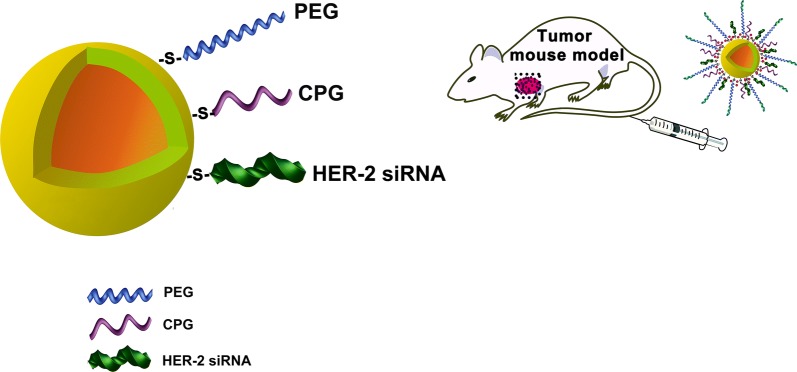
Scheme 1
Scheme 1
Schematic illustration of the Gold Nanoshell drug carrier system design
Fig. 1
Fig. 1
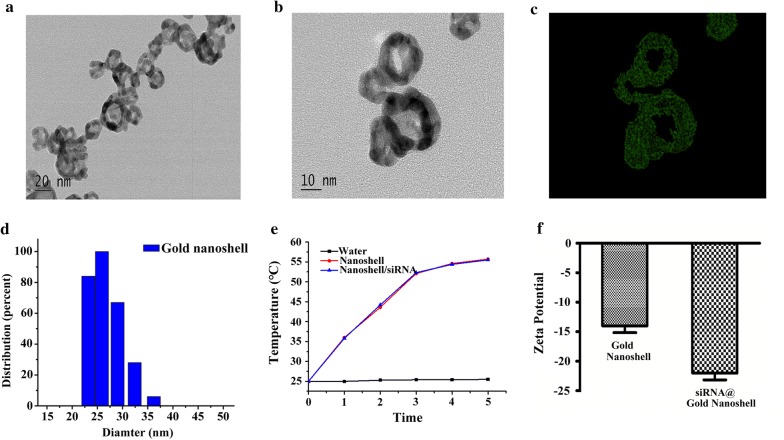
Charaterization of siRNA@CPG@Gold Nanoshell system. a Transmission electron microscope (TEM) image of siRNA@CPG@Gold Nanoshell system. b, c Elemental mapping of Gold nanoshell. d The dynamic light scattering (DLS) of siRNA@CPG@Gold Nanoshell system. e The photothermal conversion of Gold Nanoshell and siRNA@Gold Nanoshell with laser irradiation. f Zeta potential of Gold Nanoshell and siRNA@Gold Nanoshell. Data are given as mean ± SD (n = 5). *, P < 0.05
Fig. 2
Fig. 2
Drug releasing and stability of siRNA@CPG@Gold Nanoshell system. a, b Gold Nanoshell stability in different pH and ion strength solution. cf siRNA release from siRNA@Gold Nanoshell in different pH situation, different NaCl concentration, in different temperature, in serum with different time and irradiated by laser with different time. Data are given as mean ± SD (n = 5). *P < 0.05
Fig. 3
Fig. 3
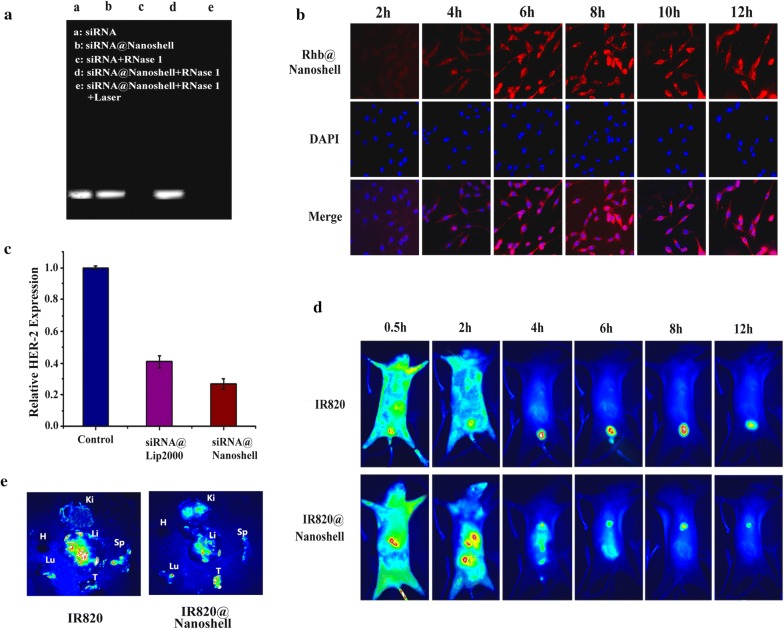
The character of siRNA@CPG@Gold Nanoshell system. a The nucleic acid electrophore diagram with the above conditions’ treatment. b The laser confocal microscopy image of siRNA@CPG@Gold Nanoshell cell uptake with different incubation time. c Transfection efficiency of lip2000 and Gold nanoshell with HER-2-siRNA. Data are given as mean ± SD (n = 5). *P < 0.05. d NIR images of IR-820 and IR-820-siRNA@CPG@Gold Nanoshell dynamics in MFC tumor-bearing mice at different times after intravenous injection. e The main organ distribution of IR-820 and IR-820-siRNA@CPG@Gold Nanoshell after 8 h injection
Fig. 4
Fig. 4
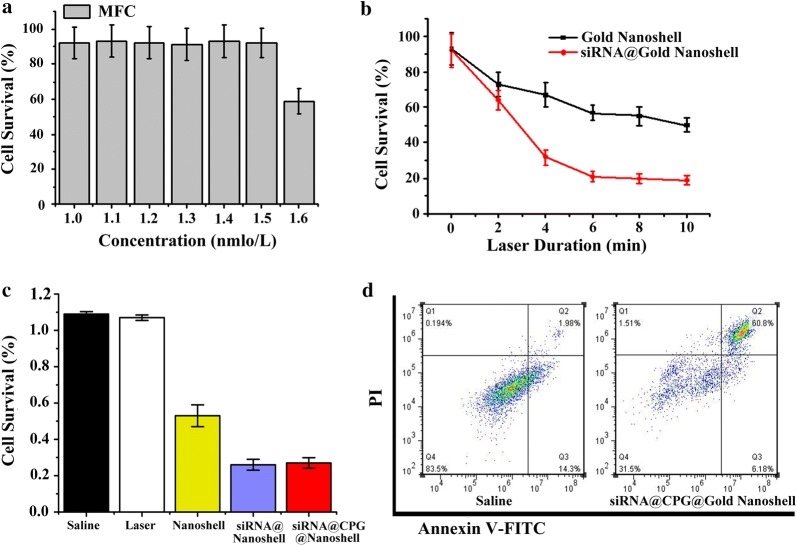
Treatment efficacy of siRNA@CPG@Gold Nanoshell in vitro. a Survival rate of MFC cells after incubating with different concentration of Gold Nanoshell solution. b Survival rate of MFC cells after incubating with Gold Nanoshell and siRNA@Gold Nanoshell with different laser irradiation time. c Survival rate of MFC cells treated with the above conditions. d Flow cytometry assay of MFC cells apoptosis rate after siRNA@Gold Nanoshell irradiation. Data are given as mean ± SD (n = 5). *P < 0.05
Fig. 5
Fig. 5
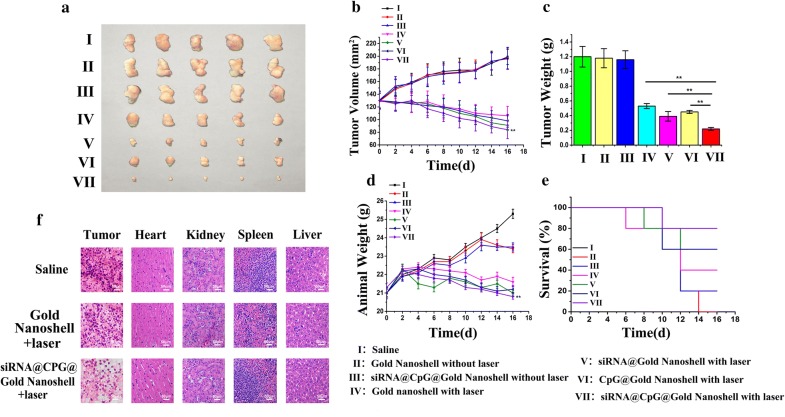
Antitumor therapeutic efficacy of siRNA@CPG@Gold Nanoshell in vivo. a The images of mice tumors treated with different ways as above description. b Tumor volume of mice-bearing MFC tumors under different treatments as above described. c Tumor weights of mice-bearing MFC tumors in different groups on the 16th day after injection. d Body weights of mice bearing MFC tumors in different groups. e The 16-day survival rates of mice after different administration. f H&E stained images of tumor, heart, liver, spleen and kidney sections collected from different treatment groups. Data are given as mean ± SD (n = 5). *P < 0.05
Fig. 6
Fig. 6
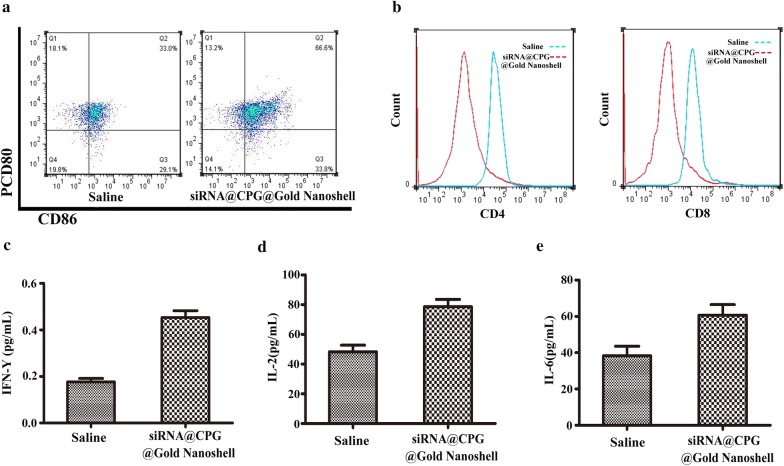
Immune responses after siRNA@CPG@Gold Nanoshell-based PTT. a DC maturation induced by siRNA@CPG@Gold Nanoshell-based PTT on mice-bearing MFC tumors. Cells in the tumor-draining lymph nodes were collected 72 h after various treatments for assessment by flow cytometry after staining with CD80 and CD86. b Flow cytometry assay of CD4 + and CD8 + T cells in the tumor-draining lymph nodes after siRNA@CPG@Gold Nanoshell-based PTT. C,D,E, Cytokine levels (IFN-γ, IL-2, IL-6) in sera from mice isolated at 72 h post different treatments siRNA@CPG@Gold Nanoshell-based PTT. Data are given as mean ± SD (n = 5). *P < 0.05

References

    1. Bou Kheir T, Futoma-Kazmierczak E, Jacobsen A, Krogh A, Bardram L, Hother C, Grønbæk K, Federspiel B, Lund AH, Friis-Hansen L. miR-449 inhibits cell proliferation and is down-regulated in gastric cancer. Mol Cancer. 2011;29:10–29. - PMC - PubMed
    1. Russo AE, Strong VE. Gastric cancer etiology and management in Asia and the West. Annu Rev Med. 2018;24:353–367. - PubMed
    1. Huang LY, Zhao J, Chen H, Wan L, Inuzuka H, Guo J, Fu X, Zhai Y, Lu Z, Wang X, Han ZG, Sun Y, Wei W. SCFFBW7-mediated degradation of Brg1 suppresses gastric cancer metastasis. Nat Commun. 2018;03:3569. doi: 10.1038/s41467-018-06038-y. - DOI - PMC - PubMed
    1. Choi YJ, Kim N. Gastric cancer and family history. Korean J Intern Med. 2016;31:1042–1053. doi: 10.3904/kjim.2016.147. - DOI - PMC - PubMed
    1. Liang X, Shi H, Yang L, Qiu C, Lin S, Qi Y, Li J, Zhao A, Liu J. Inhibition of polypyrimidine tract-binding protein 3 induces apoptosis and cell cycle arrest, and enhances the cytotoxicity of 5- fluorouracil in gastric cancer cells. Br J Cancer. 2017;116:903–911. doi: 10.1038/bjc.2017.32. - DOI - PMC - PubMed