Review
. 2019 Sep:82:102050.
doi: 10.1016/j.ceca.2019.06.004. Epub 2019 Jun 14.

The multifaceted role of TMEM16A in cancer

Affiliations
Review

The multifaceted role of TMEM16A in cancer

David Crottès et al. Cell Calcium. 2019 Sep.

Abstract

The calcium-activated chloride channel TMEM16A is intimately linked to cancers. Over decades, TMEM16A over-expression and contribution to prognosis have been widely studied for multiple cancers strengthening the idea that TMEM16A could be a valuable biomarker and a promising therapeutic target. Surprisingly, from the survey of the literature, it appears that TMEM16A has been involved in multiple cancer-related functions and a large number of molecular targets of TMEM16A have been proposed. Thus, TMEM16A appears to be an ion channel with a multifaceted role in cancers. In this review, we summarize the latest development regarding TMEM16A contribution to cancers. We will survey TMEM16A contribution in cancer prognosis, the origins of its over-expression in cancer cells, the multiple biological functions and molecular pathways regulated by TMEM16A. Then, we will consider the question regarding the molecular mechanism of TMEM16A in cancers and the possible basis for the multifaceted role of TMEM16A in cancers.

Keywords: Anoctamin-1; Calcium-activated chloride channels; Cancer; TMEM16A.


Conflict of interest statement

Conflict of Interest:

No conflict of interest to declare

Figures
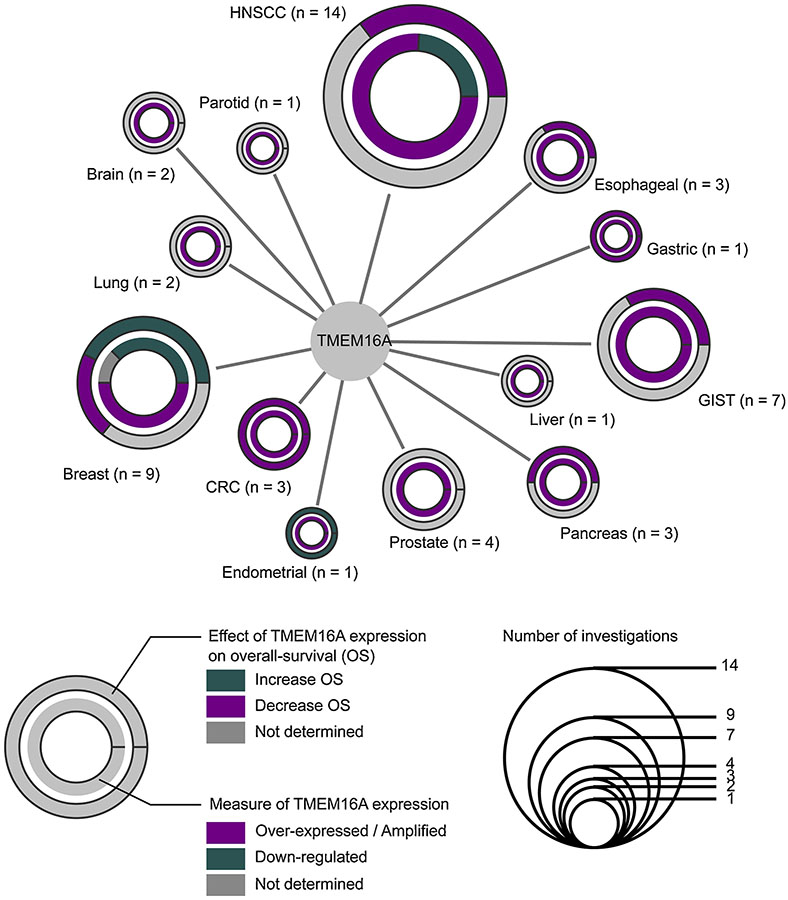
Figure 1.
Figure 1.. Expression and contribution to the overall survival of TMEM16A in cancers.
Node size is defined by the number of different articles investigating TMEM16A expression or amplification and/or TMEM16A contribution to the overall survival. The number of different articles per cancer is noted in parenthesis. Inner circle represents the distribution of results obtained from the literature per cancer types regarding TMEM16A expression. TMEM16A is either over-expressed or amplified (magenta), down-regulated (green) or not affected (grey). Outer circle represents the distribution of results obtained from the literature per cancer types regarding the contribution of a high TMEM16A expression to the overall survival (OS). A high TMEM16A expression could either reduce the OS (magenta), increase the OS (green) or have no effect or have not been determined (grey).
Figure 2.
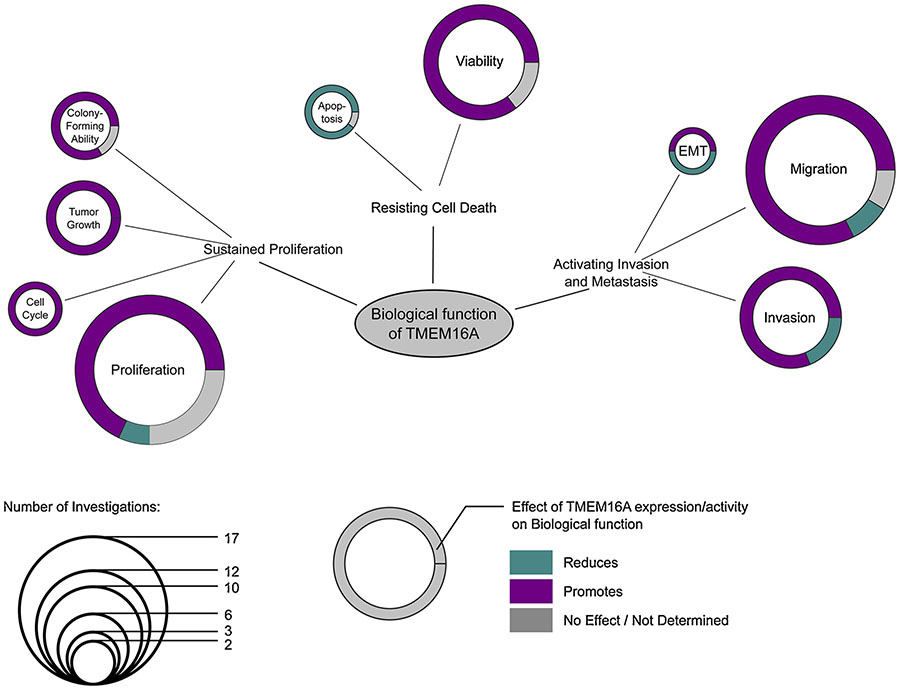
Figure 2.. Association of TMEM16A expression/activity with hallmarks of cancer
For each hallmark of cancer as defined by Hanahan et al. [62], we associated biological functions reported in the literature to be modulated by TMEM16A expression/activity. Node size of each biological function is relative to the number of different cancer cell lines for which the contribution of TMEM16A expression/activity has been reported. The outer colored circle represents the distribution of conclusions obtained for each biological functions. TMEM16A expression/activity could either promotes (magenta), reduces (green) or have no effect (grey) on the biological function.
Figure 3.
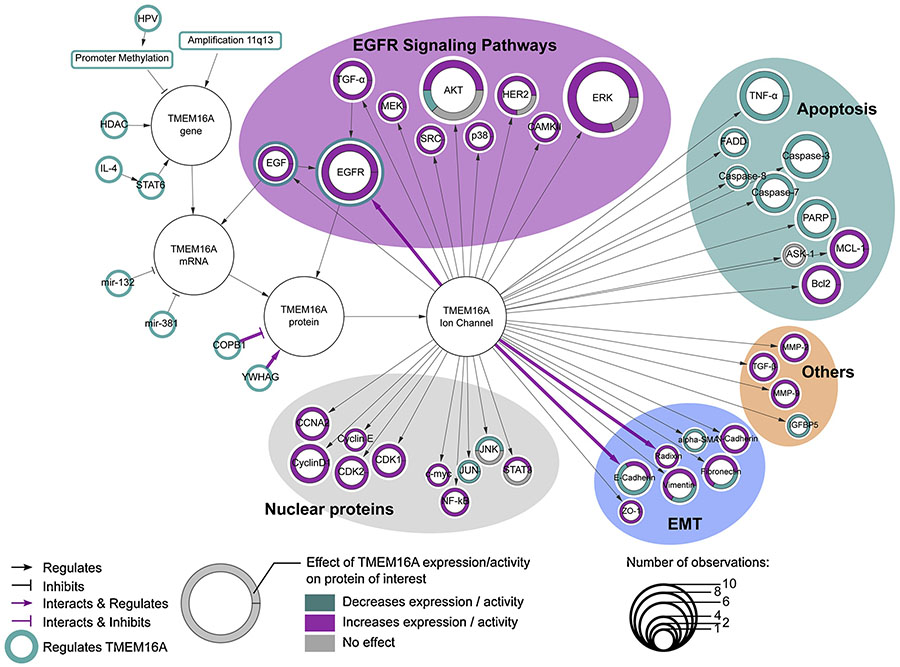
Figure 3.. Regulation of TMEM16A and its molecular targets in cancers.
Each node correspond to a protein described as either a regulator or a downstream target of TMEM16A expression/activity in cancers. Proteins represented with a thin green bordered node have been described as regulators of TMEM16A expression or activity. Proteins represented as a node with a thick colored border have been described as molecular targets of TMEM16A expression/activity. The node size of target proteins is relative to the number of different cell lines in which the contribution of TMEM16A on the expression/activity of the protein of interest has been investigated. The thick outer colored circle represents the distribution of conclusions made for each targets of TMEM16A. TMEM16A expression/activity could either promotes (magenta), inhibits (green) or has no effect (grey) on the protein expression/activity.
Figure 4.
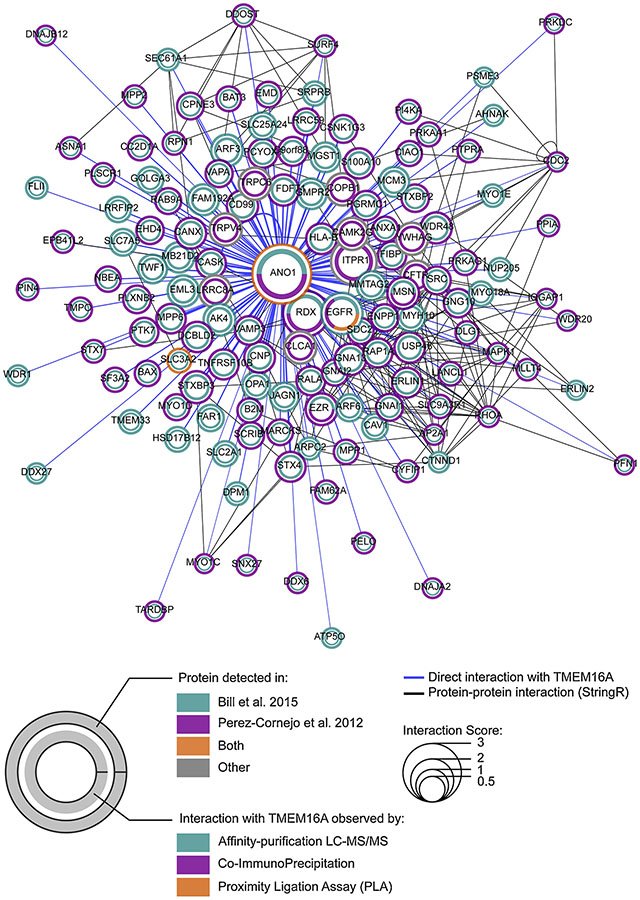
Figure 4.. TMEM16A-interacting partners
Each TMEM16A interacting partner found in the literature has been represented as a single node connected to TMEM16A by a blue edge. The node size and edge width are relative to the interaction score calculated as the relative ascending rank order obtained in each of interactome published [61,92] + 1 for each data demonstrating a direct interaction between TMEM16A and the partner of interest by either co-immunoprecipitation (co-IP) or proximity-ligation-assay (PLA). Network obtained has been enriched for high confident protein-protein interaction (PPI) (confidency = 0.8, additional interactors = 0) using StringApp (version 1.4.2) integrated in Cytoscape 3.7.0. Then, the network layout have been obtained by using the integrated prefuse-direct force layout algorithm. The outer circle of each node represents the detection of TMEM16A-interacting protein in the interactome published by Bill et al. (green), the one published by Perez et al. (magenta), both (orange) or neither of them (grey). The inner circle represent the method used to demonstrate the interaction between TMEM16A and the protein of interest (proteomic approaches = green, co-IP = magenta or PLA =orange).

References

    1. Prevarskaya N, Skryma R, Shuba Y, Ion Channels in Cancer: Are Cancer Hallmarks Oncochannelopathies?, Physiol. Rev 98 (2018) 559–621. doi:10.1152/physrev.00044.2016. - DOI - PubMed
    1. Prevarskaya N, Skryma R, Shuba Y, Ion channels and the hallmarks of cancer, Trends Mol Med. 16 (2010) 107–121. doi:10.1016/j.molmed.2010.01.005. - DOI - PubMed
    1. Caputo A, Caci E, Ferrera L, Pedemonte N, Barsanti C, Sondo E, Pfeffer U, Ravazzolo R, Zegarra-Moran O, Galietta LJV, TMEM16A, a membrane protein associated with calcium-dependent chloride channel activity, Science. 322 (2008) 590–594. doi:10.1126/science.1163518. - DOI - PubMed
    1. Schroeder BC, Cheng T, Jan YN, Jan LY, Expression Cloning of TMEM16A as a Calcium-Activated Chloride Channel Subunit, Cell. 134 (2008) 1019–1029. doi:10.1016/j.cell.2008.09.003. - DOI - PMC - PubMed
    1. Yang YD, Cho H, Koo JY, Tak MH, Cho Y, Shim W-S, Park SP, Lee J, Lee B, Kim B-M, Raouf R, Shin YK, Oh U, TMEM16A confers receptor-activated calcium-dependent chloride conductance, Nature. 455 (2008) 1210–1215. doi:10.1038/nature07313. - DOI - PubMed

Publication types