


Understanding and Managing Large B Cell Lymphoma Relapses after Chimeric Antigen Receptor T Cell Therapy
- PMID: 31279751
- PMCID: PMC7800228
- DOI: 10.1016/j.bbmt.2019.06.036
Understanding and Managing Large B Cell Lymphoma Relapses after Chimeric Antigen Receptor T Cell Therapy
Abstract
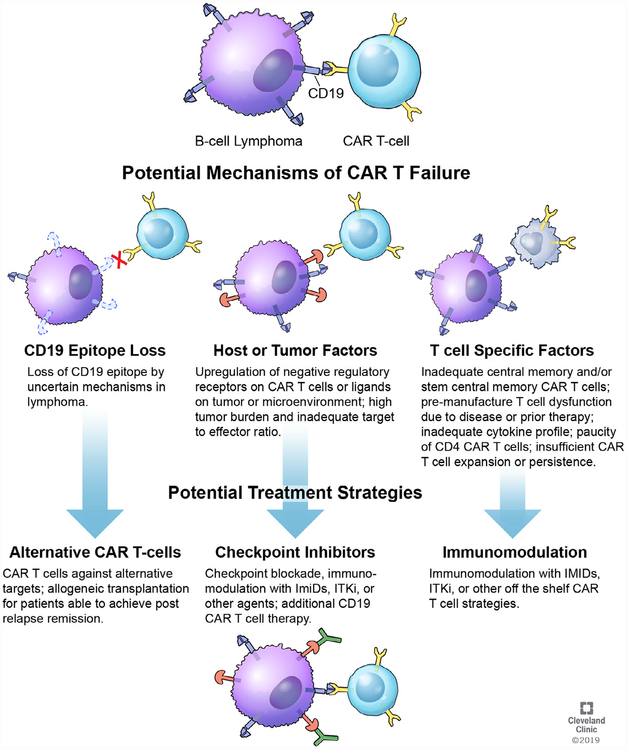
Most patients with large cell lymphoma are cured with frontline chemoimmunotherapy. For individuals with refractory disease and those who relapse after conventional therapies, chimeric antigen receptor (CAR) T cells are an important treatment option and have led to remissions in otherwise refractory patients. In the pivotal trials, durable responses were achieved in approximately 40% to 50% of patients treated with axicabtagene ciloleucel, tisagenlecleucel, or lisocabtagene maraleucel, indicating that many patients will require subsequent treatment. Failure after CAR T cell therapy is caused by a variety of factors that can be divided into 3 broad categories: tumor intrinsic factors, other host factors, and inadequacies of the CAR T cells. Within this framework, this article reviews possible mechanisms of treatment failures and, based on the timing of relapse, considers potential salvage therapies and opportunities for future clinical studies.
Keywords: CAR T cell; Diffuse large B cell lymphoma; Relapse.
Copyright © 2019 American Society for Transplantation and Cellular Therapy. Published by Elsevier Inc. All rights reserved.
Conflict of interest statement
References
-
- Hamlin PA, Zelenetz AD, Kewalramani T, et al. Age-adjusted International Prognostic Index predicts autologous stem cell transplantation outcome for patients with relapsed or primary refractory diffuse large B-cell lymphoma. Blood. 2003;102:1989–1996. - PubMed
-
- Vose JM, Zhang MJ, Rowlings PA, et al. Autologous transplantation for diffuse aggressive non-Hodgkin’s lymphoma in patients never achieving remission: a report from the Autologous Blood and Marrow Transplant Registry. J Clin Oncol. 2001;19:406–413. - PubMed
-
- Philip T, Guglielmi C, Hagenbeek A, et al. Autologous bone marrow transplantation as compared with salvage chemotherapy in relapses of chemotherapy-sensitive non-Hodgkin’s lymphoma. N Engl J Med. 1995;333:1540–1545. - PubMed
-
- Van Den Neste E, Schmitz N, Mounier N, et al. Outcome of patients with relapsed diffuse large B-cell lymphoma who fail second-line salvage regimens in the International CORAL study. Bone Marrow Transplant. 2016;51:51–57. - PubMed
Publication types
MeSH terms
Substances
Grants and funding
LinkOut - more resources
Full Text Sources
Other Literature Sources
