Plasma Medicine: A Field of Applied Redox Biology
- PMID: 31280189
- PMCID: PMC6689367
- DOI: 10.21873/invivo.11570
Plasma Medicine: A Field of Applied Redox Biology
Abstract
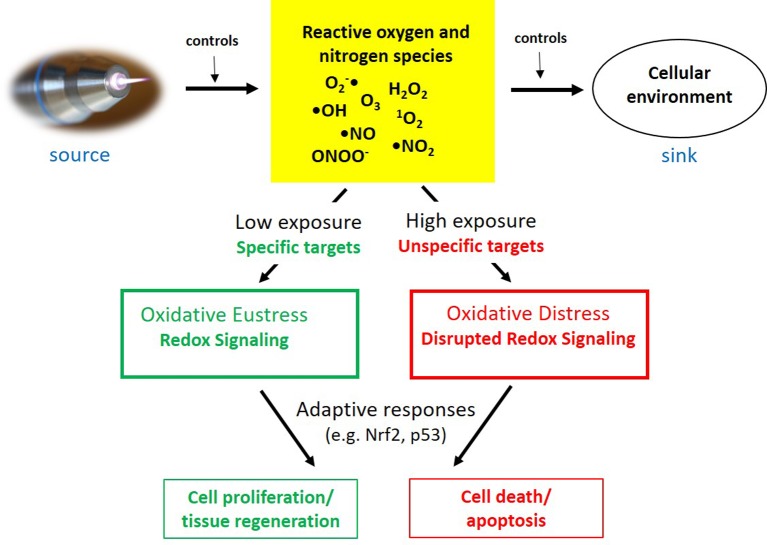
Plasma medicine comprises the application of physical plasma directly on or in the human body for therapeutic purposes. Three most important basic plasma effects are relevant for medical applications: i) inactivation of a broad spectrum of microorganisms, including multidrug-resistant pathogens, ii) stimulation of cell proliferation and angiogenesis with lower plasma treatment intensity, and iii) inactivation of cells by initialization of cell death with higher plasma treatment intensity, above all in cancer cells. Based on own published results as well as on monitoring of relevant literature the aim of this topical review is to summarize the state of the art in plasma medicine and connect it to redox biology. One of the most important results of basic research in plasma medicine is the insight that biological plasma effects are mainly mediated via reactive oxygen and nitrogen species influencing cellular redox-regulated processes. Plasma medicine can be considered a field of applied redox biology.
Keywords: Plasma medicine; cold atmospheric plasma (CAP); redox biology; review.
Copyright© 2019, International Institute of Anticancer Research (Dr. George J. Delinasios), All rights reserved.
Conflict of interest statement
The majority of research work that served as a scientific basis for further development and CE certification of the atmospheric pressure plasma jet kINPen MED as a medical device by neoplas tools GmbH Greifswald, Germany has been realized by INP Greifswald. INP Greifswald is a minority shareholder of neoplas tools GmbH Greifswald, Germany.
Figures
References
-
- Favia P, d’Agostino R. Plasma treatments and plasma deposition of polymers for biomedical application. Surf Coat Technol. 1998;98:1102–1106. DOI: 10.1016/S0257-8972(97) 00285-5.
-
- Ohl A, Schröder K. Plasma-induced chemical micropatterning for cell culturing applications: a brief review. Surf Coat Technol. 1999;116-119:820–830. DOI: 10.1016/S0257-8972(99)00150-4.
-
- d’Agostino R, Favia P, Oehr C, Wertheimer MR. Low-Temperature Plasma Processing of Materials: Past, Present, and Future. Plasma Process Polym. 2005;2:7–15. DOI: 10.1002/ ppap.200400074.
-
- Desmet T, Morent R, De Geyter N, Leys C, Schacht E, Dubruel P. Nonthermal Plasma Technology as a Versatile Strategy for Polymeric Biomaterials Surface Modification: A Review. Biomacromolecules. 2009;10:2351–2378. PMID: 19655722. DOI: 10.1021/bm900186s. - PubMed
-
- Bazaka K, Jacob MV, Crawford RJ, Ivanova EP. Plasma-assisted surface modification of organic biopolymers to prevent bacterial attachment. Acta Biomater. 2011;7:2015–2028. PMID: 21194574. DOI: 10.1016/j.actbio.2010.12.024. - PubMed
Publication types
MeSH terms
Substances
LinkOut - more resources
Full Text Sources
Other Literature Sources
Medical
Miscellaneous