Review
. 2019 Jun 20:10:432.
doi: 10.3389/fpsyt.2019.00432. eCollection 2019.

Consequences of CYP2D6 Copy-Number Variation for Pharmacogenomics in Psychiatry

Affiliations
Review

Consequences of CYP2D6 Copy-Number Variation for Pharmacogenomics in Psychiatry

Joseph P Jarvis et al. Front Psychiatry. .

Abstract

Pharmacogenomics represents a potentially powerful enhancement to the current standard of care for psychiatric patients. However, a variety of biological and technical challenges must be addressed in order to provide adequate clinical decision support for personalized prescribing and dosing based on genomic data. This is particularly true in the case of CYP2D6, a key drug-metabolizing gene, which not only harbors multiple genetic variants known to affect enzyme function but also shows a broad range of copy-number and hybrid alleles in various patient populations. Here, we describe several challenges in the accurate measurement and interpretation of data from the CYP2D6 locus including the clinical consequences of increased copy number. We discuss best practices for overcoming these challenges and then explore various current and future applications of pharmacogenomic analysis of CYP2D6 in psychiatry.

Keywords: copy-number variation; cytochrome P450 CYP2D6; gene deletion; gene duplications; personalized medicine; pharmacogenomics; precision medicine; psychiatry.


Figures
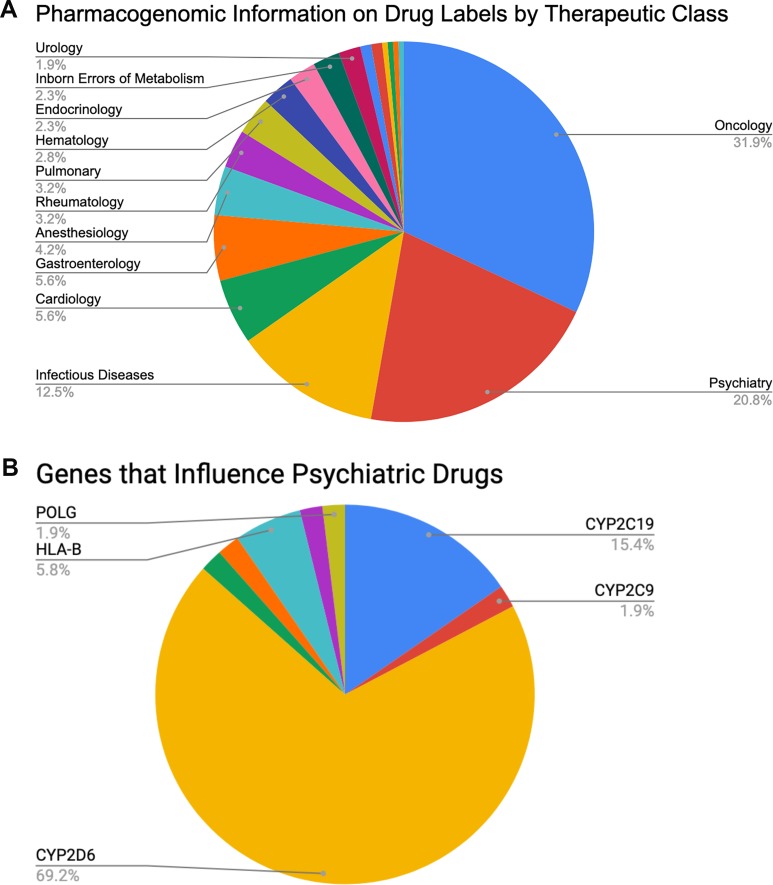
Figure 1
Figure 1
Percentages of (A) FDA-approved drugs with available biomarker information in their labels by therapeutic class (total N = 215) and (B) FDA-approved psychiatric drugs influenced by specific PGx genes of interest (total N = 45, see also Table 2 ).
Figure 2
Figure 2
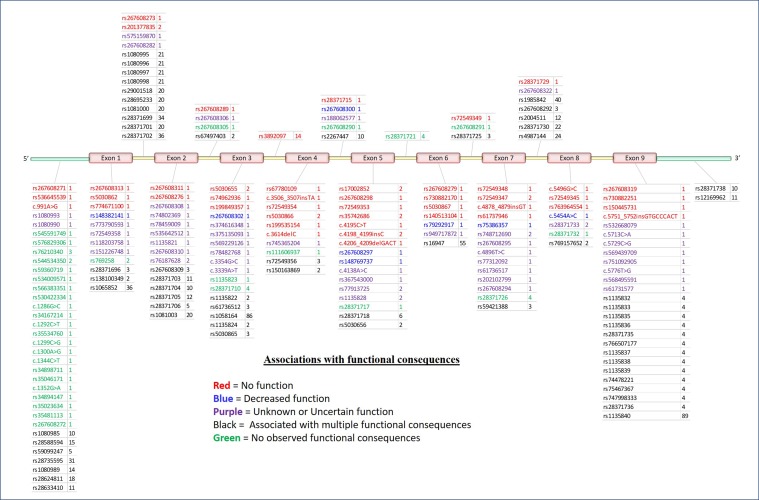
5′ to 3′ structure of the CYP2D6 locus and placement of variants. Physical position of known pharmacogenomics (PGx) variants in CYP2D6 by rsID (total N = 198). Colors indicate putative functional consequences: red = no function, blue = decreased function, purple = unknown or uncertain function, black = single-nucleotide polymorphism (SNPs) with multiple associated functional consequences [e.g., rs1135840 can be found in alleles with normal function, decreased function, and even non-functional (e.g., *35, *17, and *4, respectively)], green = no observed functional consequences to date (normal). Numbers to the right of each rsID indicate the total number of haplotypes (* alleles) on which each variant is known to be found.
Figure 3
Figure 3
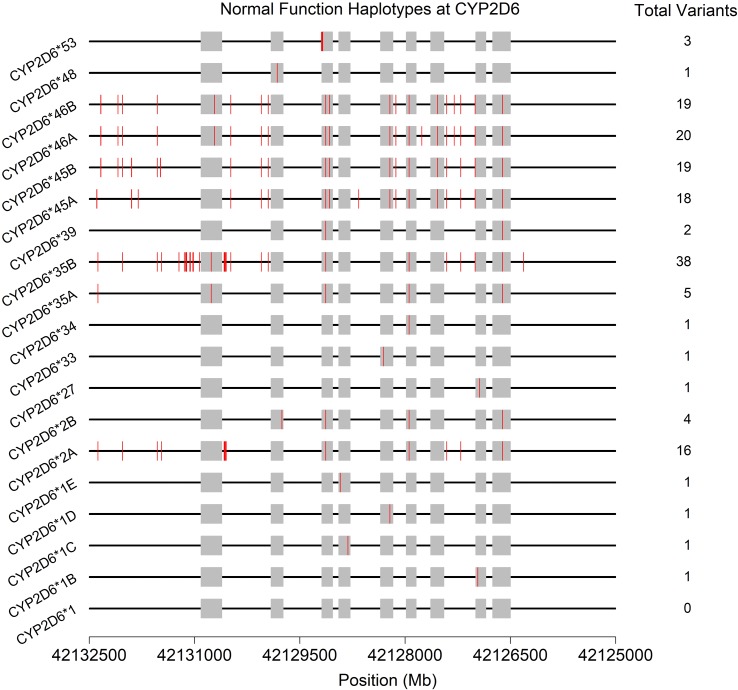
Physical positions (red vertical lines) and total number of variants found on the 19 haplotypes (* alleles) predicted to produce normally functioning enzymes upon transcription/translation. See also Supplemental Figures 1–4 . Gray boxes indicate the exons (genome build 37).
Figure 4
Figure 4
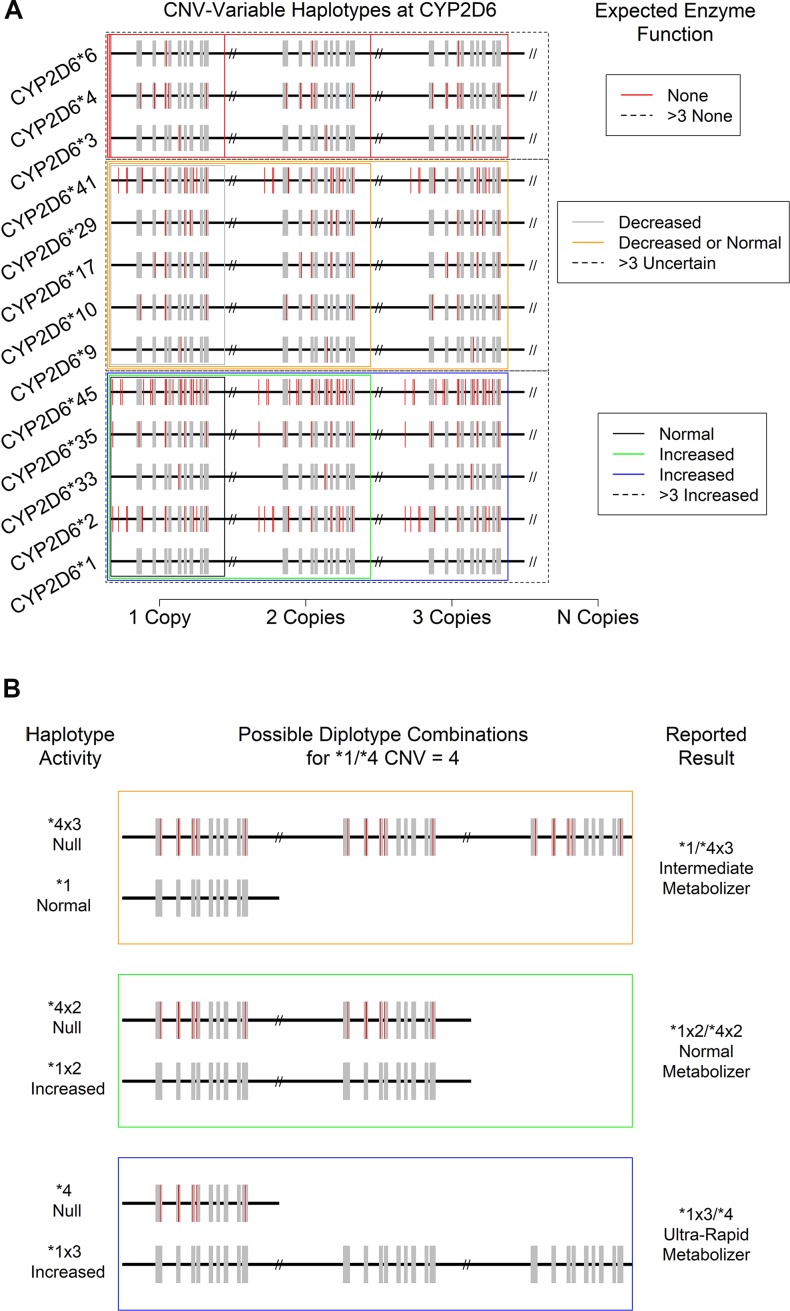
Consequences of CYP2D6 gene duplication for (A) the activity level of 13 expected CNV-variable (duplicated) CYP2D6 alleles with known enzyme function. Not depicted: CYP2D6 *43, which is also known to show duplications with an uncertain phenotype. (B) Individual haplotype (* allele) activity and overall metabolizer status of the “*1/*4, CNV = 4” specific patient result. Note that a copy-number of four introduces ambiguity in the reported metabolizer status due to technical uncertainty regarding which specific allele is duplicated.

References

    1. Relling MV, Evans WE. Pharmacogenomics in the clinic. Nature (2015) 526:343–50. 10.1038/nature15817 - DOI - PMC - PubMed
    1. Iyanagi T. Molecular mechanism of phase I and phase II drug-metabolizing enzymes: implications for detoxification. Int Rev Cytol (2007) 260:35–112. 10.1016/S0074-7696(06)60002-8 - DOI - PubMed
    1. Ventola CL. Pharmacogenomics in clinical practice: reality and expectations. P T (2011) 36:412–50. - PMC - PubMed
    1. Johnson JA. Pharmacogenetics in clinical practice: how far have we come and where are we going? Pharmacogenomics (2013) 14:835–43. 10.2217/pgs.13.52 - DOI - PMC - PubMed
    1. Clinical Pharmacogenetics Implementation Consortium (CPIC) CYP2D6 Genotype to Phenotype Standardization Project. (2019). Accessed May 9, 2019.

LinkOut - more resources