Review
. 2019 Jun 9:2019:1639854.
doi: 10.1155/2019/1639854. eCollection 2019.

Extracellular Vesicles and Their Potential Use in Monitoring Cancer Progression and Therapy: The Contribution of Proteomics

Affiliations
Review

Extracellular Vesicles and Their Potential Use in Monitoring Cancer Progression and Therapy: The Contribution of Proteomics

Maria Concetta Cufaro et al. J Oncol. .

Abstract

Extracellular Vesicles (EVs) are small membrane-enclosed particles released by cells and able to vehiculate information between them. The term EVs categorizes many and different vesicles based on their biogenesis and release pathway, such as exosomes (Exo), ectosomes, or shedding microvesicles (SMVs), apoptotic blebs (ABs), and other EVs subsets, generating a heterogeneous group of components able to redistribute their cargo into the entire organism. Moreover EVs are becoming increasingly important in monitoring cancer progression and therapy, since they are able to carry specific disease biomarkers such as Glypican-1, colon cancer-associated transcript 2, CD63, CD24, and many others. The importance of their biological role together with their heterogeneity prompted researchers to adopt and standardize purification methods able to isolate EVs for characterizing their cargo. In this way, mass spectrometry (MS)-based proteomics approaches are emerging as promising tool for the identification and quantification of EVs protein cargoes, but this technique resulted to be deeply influenced by the low quality of the isolation techniques. This review presents the state-of-the-art of EVs isolation, purification, and characterization for omics studies, with a particular focus to their potential use in monitoring cancer progression and therapy.


Figures
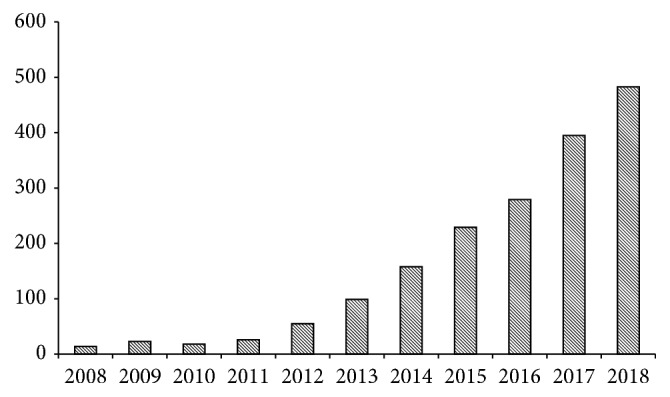
Figure 1
Figure 1
Number of papers published in the last decade in cancer EVs research.
Figure 2
Figure 2
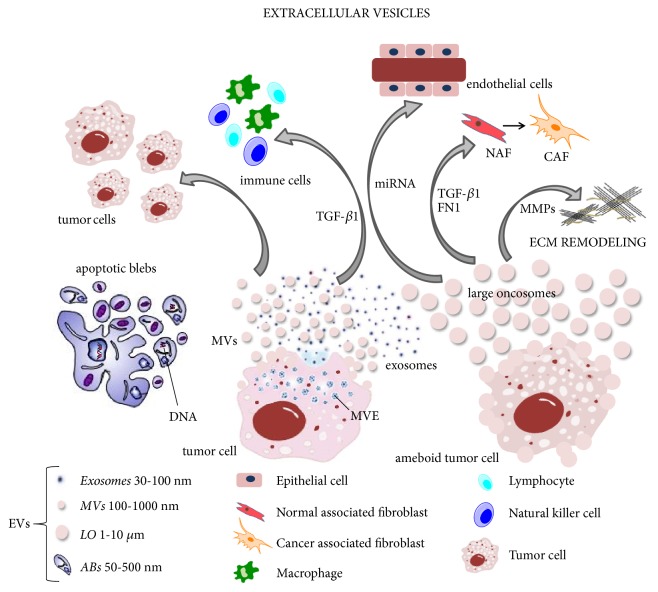
Large oncosomes: the new players in intercellular communication for tumor progression and metastasis. Tumor cells communicate each other and with neighboring normal cells in their microenvironment by sending out biological signals enclosed in EVs. Large Oncosomes are membrane vesicles released from “ameboid” tumor cells that are able to facilitate migration of tumor cells and promoting metastasis. The figure shows how specific tumor-cell EVs are involved in tumor progression by targeting fibroblasts and endothelial and immune cells or by altering the structure and composition of ECM. EVs, Extracellular Vesicles; MVs, microvesicles; LOs, large oncosomes; ABs, apoptotic blebs; MVEs, multivesicular endosomes; ECM, extracellular matrix; TGF-β, transforming growth factor beta; FN1, fibronectin-1.
Figure 3
Figure 3
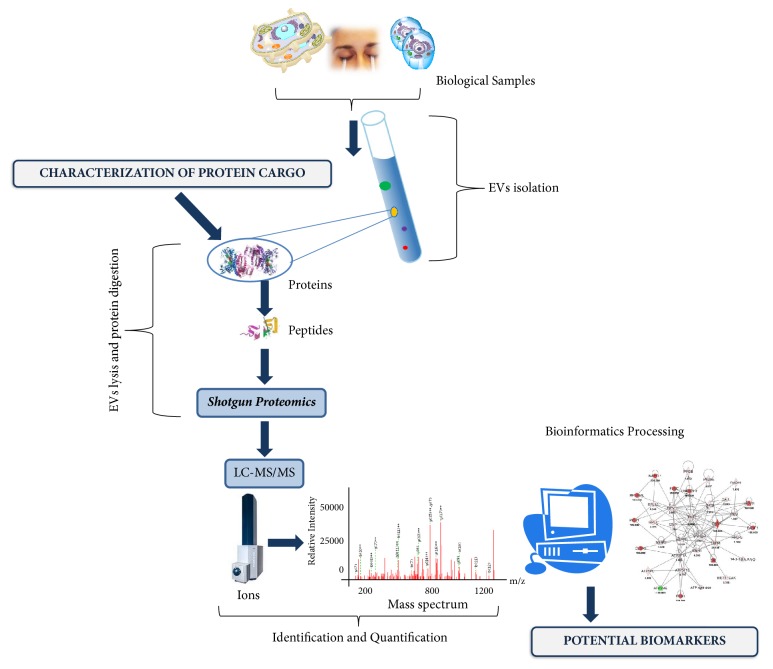
An example of workflow for biomarker discovery process based on purification and proteomics characterization of EVs isolated from various biological samples. After vesicles lysis, protein digestion is performed to separate the peptides that are analyzed through proteomics strategies. High resolution LC-MS instruments allow obtaining a protein list that can be identified and quantified by powerful bioinformatics software. Finally functional enrichment analysis identifies local networks and potential biomarkers. EVs, Extracellular Vesicles; LC-MS/MS, liquid chromatography coupled with online tandem mass spectrometry.

References

    1. van der Pol E., Böing A. N., Harrison P., Sturk A., Nieuwland R. Classification, functions, and clinical relevance of extracellular vesicles. Pharmacological Reviews. 2012;64(3):676–705. doi: 10.1124/pr.112.005983. - DOI - PubMed
    1. Hargett L. A., Bauer N. N. On the origin of microparticles: from ‘platelet dust’ to mediators of intercellular communication. Pulmonary Circulation. 2013;3(2):329–340. doi: 10.4103/2045-8932.114760. - DOI - PMC - PubMed
    1. Wolf P. The nature and significance of platelet products in human plasma. British Journal of Haematology. 1967;13(3):269–288. doi: 10.1111/j.1365-2141.1967.tb08741.x. - DOI - PubMed
    1. Shah R., Patel T., Freedman J. E. Circulating extracellular vesicles in human disease. The New England Journal of Medicine. 2018;379(10):958–966. doi: 10.1056/NEJMra1704286. - DOI - PubMed
    1. Lötvall J., Hill A. F., Hochberg F., et al. Minimal experimental requirements for definition of extracellular vesicles and their functions: a position statement from the International Society for Extracellular Vesicles. Journal of Extracellular Vesicles (JEV) 2014;3 doi: 10.3402/jev.v3.26913.26913 - DOI - PMC - PubMed

LinkOut - more resources