Review
. 2019 Sep 29;6(1):275-296.
doi: 10.1146/annurev-virology-092818-015716. Epub 2019 Jul 5.

Hitchhiking of Viral Genomes on Cellular Chromosomes

Affiliations
Review

Hitchhiking of Viral Genomes on Cellular Chromosomes

Tami L Coursey et al. Annu Rev Virol. .

Abstract

Persistent viral infections require a host cell reservoir that maintains functional copies of the viral genome. To this end, several DNA viruses maintain their genomes as extrachromosomal DNA minichromosomes in actively dividing cells. These viruses typically encode a viral protein that binds specifically to viral DNA genomes and tethers them to host mitotic chromosomes, thus enabling the viral genomes to hitchhike or piggyback into daughter cells. Viruses that use this tethering mechanism include papillomaviruses and the gammaherpesviruses Epstein-Barr virus and Kaposi's sarcoma-associated herpesvirus. This review describes the advantages and consequences of persistent extrachromosomal viral genome replication.

Keywords: DNA replication; Epstein-Barr virus; Kaposi's sarcoma-associated herpesvirus; human papillomavirus; partitioning; persistent infection.


Figures
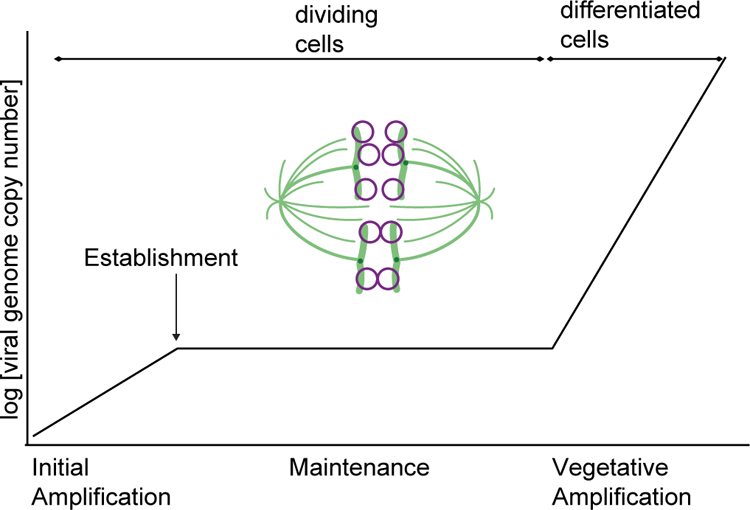
Figure 1
Figure 1
Phases of replication in gammaherpesvirus and papillomavirus infection. Upon infection, the virus undergoes limited DNA synthesis and becomes established as an extrachromosomal plasmid in the host nucleus. As the infected cells divide, viral genomes (purple circles) are maintained as stable copy number plasmids that are partitioned by binding to host chromosomes (green) in mitosis. Changes in the cell environment, such as differentiation, induce the productive or lytic phase, and large amounts of viral progeny genomes are synthesized.
Figure 2
Figure 2
Different models of plasmid partitioning. (a) Viral genomes or extrachromosomal plasmids (purple circles) randomly distributed throughout the mitotic cell (singly or in clusters), (b) attached to the microtubules of the spindle, (c) randomly attached to chromosomes, and (d) attached pairwise to sister chromatids. The pink bar represents a topological or protein link between daughter molecules.
Figure 3
Figure 3
Comparison of cis-elements required for stable genome maintenance. (a) The URRs from two PV types are shown. The consensus E2BSs are indicated by purple circles and the E1BS by a green rectangle. Minimal origins and MMEs are indicated. (b) EBV oriP contains a DS and an FR element. The DS element is required for initiation of replication and contains four EBNA1 BSs (green circles). The FR element contains multiple 30-bp tandem repeats (light purple box), each containing an EBNA1 BS, and is required for genome maintenance and partitioning. (c) Each repeat in the KSHV TR element (light purple box) contains three LANA binding sites (green circles), one of which (darker green) overlaps with an element required for initiation of DNA synthesis (42, 79). Abbreviations: BPV1, Bovine papillomavirus; DS, dyad symmetry; E1BS, E1 binding site; E2BS, E2 binding site; EBNA1 BS, Epstein-Barr virus nuclear antigen 1 binding site; FR, family of repeat; HPV16, human papillomavirus 16; KSHV TR, Kaposi’s sarcoma-associated herpesvirus terminal repeat; LANA, latency-associated nuclear antigen; MME, minichromosome maintenance element; MMEE; minichromosome maintenance enhancer element; oriP, viral replication origin; PV, papillomavirus; URR, upstream regulatory region.
Figure 4
Figure 4
Functional domains of the viral tethering proteins. Although having unrelated sequences, the tethering proteins have a comparable modular organization and the DNA binding dimerization domains (purple) have similar structures. The regions important for host chromatin association are shown in green. These domains are linked by repetitive sequences (light purple). Abbreviations: EBNA1, Epstein-Barr virus nuclear antigen 1; LANA, latency-associated nuclear antigen; PV, papillomavirus.
Figure 5
Figure 5
Variations in the pattern of E2 proteins binding to mitotic chromosomes. Mitotic cells were briefly extracted before fixation to stabilize HPV31 E2 binding. Figure reproduced from Reference 92a and reused with permission under a CC-BY license.

References

    1. Van Doorslaer K 2013. Evolution of the papillomaviridae. Virology 445:11–20 - PubMed
    1. Mariggio G, Koch S, Schulz TF. 2017. Kaposi sarcoma herpesvirus pathogenesis. Philos. Trans. R. Soc. B Biol. Sci 372:20160275 - PMC - PubMed
    1. Stanley MA. 2012. Epithelial cell responses to infection with human papillomavirus. Clin. Microbiol. Rev 25:215–22 - PMC - PubMed
    1. Van Doorslaer K, Li Z, Xirasagar S, Maes P, Kaminsky D, et al. 2017. The Papillomavirus Episteme: a major update to the papillomavirus sequence database. Nucleic Acids Res 45:D499–506 - PMC - PubMed
    1. McBride AA. 2017. Oncogenic human papillomaviruses. Philos. Trans. R. Soc. B Biol. Sci 372:20160273 - PMC - PubMed

Publication types

LinkOut - more resources
