


Association between socioeconomic position and cardiovascular disease risk factors in rural north India: The Solan Surveillance Study
- PMID: 31283784
- PMCID: PMC6613705
- DOI: 10.1371/journal.pone.0217834
Association between socioeconomic position and cardiovascular disease risk factors in rural north India: The Solan Surveillance Study
Abstract
Background: Although most Indians live in rural settings, data on cardiovascular disease risk factors in these groups are limited. We describe the association between socioeconomic position and cardiovascular disease risk factors in a large rural population in north India.
Methods: We performed representative, community-based sampling from 2013 to 2014 of Solan district in Himachal Pradesh. We used education, occupation, household income, and household assets as indicators of socioeconomic position. We used tobacco use, alcohol use, low physical activity, obesity, hypertension, and diabetes as risk factors for cardiovascular disease. We performed hierarchical multivariable logistic regression, adjusting for age, sex and clustering of the health sub-centers, to evaluate the cross-sectional association of socioeconomic position indicators and cardiovascular disease risk factors.
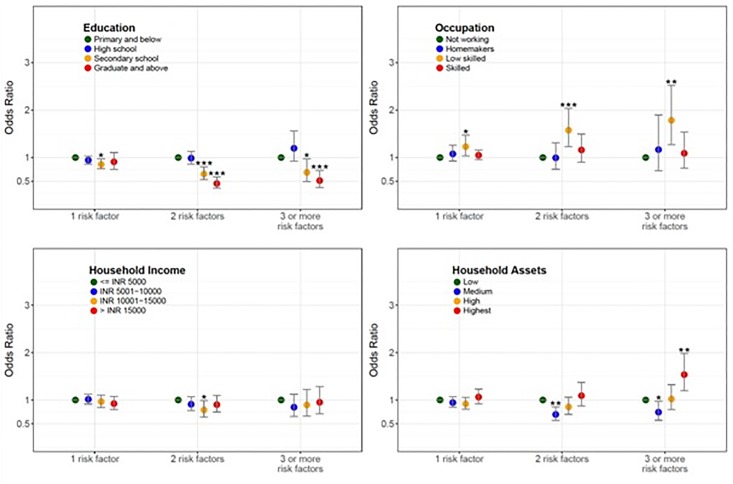
Results: Among 38,457 participants, mean (SD) age was 42.7 (15.9) years, and 57% were women. The odds of tobacco use was lowest in participants with graduate school and above education (adjusted OR 0.11, 95% CI 0.09, 0.13), household income >15,000 INR (adjusted OR 0.35, 95% CI 0.29, 0.43), and highest quartile of assets (adjusted OR 0.28, 95% CI 0.24, 0.34) compared with other groups but not occupation (skilled worker adjusted OR 0.93, 95% CI 0.74, 1.16). Alcohol use was lower among individuals in the higher quartile of income (adjusted OR 0.75, 95% CI 0.64, 0.88) and assets (adjusted OR 0.70, 95% CI 0.59, 0.82). The odds of obesity was highest in participants with graduate school and above education (adjusted OR 2.33, 95% CI 1.85, 2.94), household income > 15,000 Indian rupees (adjusted OR 1.89, 95% CI 1.63, 2.19), and highest quartile of household assets (adjusted OR 2.87, 95% CI 2.39, 3.45). The odds of prevalent hypertension and diabetes were also generally higher among individuals with higher socioeconomic position.
Conclusions: Individuals with lower socioeconomic position in Himachal Pradesh were more likely to have abnormal behavioral risk factors, and individuals with higher socioeconomic position were more likely to have abnormal clinical risk factors.
Conflict of interest statement
MDH received grant funding from the World Heart Federation to serve as its senior program advisor for the Emerging Leaders program, which is supported by Boehringer Ingelheim and Novartis with previous support from BUPA and AstraZeneca. MDH also received grant support from the American Heart Association, Verily, and AstraZeneca for work unrelated to this research and personal fees from the American Medical Association for editorial duties for JAMA Cardiology. There are no patents, products in development, or marketed products to declare. This does not alter the authors’ adherence to all PLOS ONE policies on sharing data and materials.
Figures
References
-
- United Nations, General Assembly. Political declaration of the high-level meeting of the general assembly on the prevention and control of non-communicable diseases, A/66/L.1. http://www.un.org/ga/search/view_doc.asp?symbol=A/66/L.1. Accessed: April 17, 2018.
-
- United Nations, General Assembly. Resolution 70/1. Transforming our world: the 2030 agenda for sustainable development. 2015. http://www.un.org/en/development/desa/population/migration/generalassemb.... Accessed: April 17th, 2018.
Publication types
MeSH terms
Grants and funding
LinkOut - more resources
Full Text Sources
Medical
