


Review
doi: 10.1093/jmcb/mjz067.
Gain-of-function mutant p53: history and speculation
Affiliations
- PMID: 31283823
- PMCID: PMC6735697
- DOI: 10.1093/jmcb/mjz067
Item in Clipboard
Review
Gain-of-function mutant p53: history and speculation
J Mol Cell Biol.
.
No abstract available
Figures
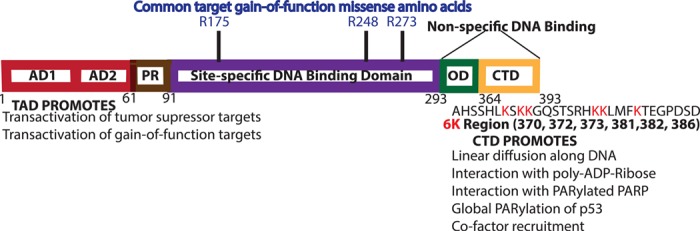
Domain organization of the p53 protein. The domain boundaries corresponding to human p53 protein are shown with amino acid numbers at bottom. The red outlined boxes show transcription activation domains 1 and 2 (AD1, AD2); the brown outlined box indicates the PR domain; the purple outlined box corresponds to the site-specific DNA binding domain; the non-specific DNA binding carboxyl terminal region comprises the green outlined box that indicates the OD followed by the yellow outlined box containing the lysine-rich 6 K region (CTD). The full sequence of the CTD is shown with the six lysine residues in red and listed below. The GOF missense mutations at R175, R248, and R273 are indicated on top of the purple outlined site-specific DNA binding domain. Listed below are some of the key functions that AD1 and AD2 on the left and CTD on the right are known to promote.

Carol Prives, Jill Bargonetti, and Arnold Levine at the 2014 Cold Spring Harbor Laboratories Meeting: Mechanisms and Models of Cancer.
References
-
- Aschauer L., and Muller P.A. (2016). Novel targets and interaction partners of mutant p53 gain-of-function. Biochem. Soc. Trans. 44, 460–466. - PubMed
-
- Baker S.J., Fearon E.R., Nigro J.M., et al. (1989). Chromosome 17 deletions and p53 gene mutations in colorectal carcinoma. Science 244, 217–221. - PubMed
-
- Bargonetti J., Friedman P.N., Kern S.E., et al. (1991). Wild-type but not mutant p53 immunopurified proteins bind to sequences adjacent to the SV40 origin of replication. Cell 65, 1083–1091. - PubMed
Publication types
MeSH terms
Substances
LinkOut - more resources
Full Text Sources
Other Literature Sources
Research Materials
Miscellaneous
