Effects of Nutritional Supplements and Dietary Interventions on Cardiovascular Outcomes: An Umbrella Review and Evidence Map
- PMID: 31284304
- PMCID: PMC7261374
- DOI: 10.7326/M19-0341
Effects of Nutritional Supplements and Dietary Interventions on Cardiovascular Outcomes: An Umbrella Review and Evidence Map
Erratum in
-
Correction: Effects of Nutritional Supplements and Dietary Interventions on Cardiovascular Outcomes.Ann Intern Med. 2020 Jan 7;172(1):75-76. doi: 10.7326/L19-0721. Epub 2019 Dec 17. Ann Intern Med. 2020. PMID: 31842231 No abstract available.
Abstract
Background: The role of nutritional supplements and dietary interventions in preventing mortality and cardiovascular disease (CVD) outcomes is unclear.
Purpose: To examine evidence about the effects of nutritional supplements and dietary interventions on mortality and cardiovascular outcomes in adults.
Data sources: PubMed, CINAHL, and the Cochrane Library from inception until March 2019; ClinicalTrials.gov (10 March 2019); journal Web sites; and reference lists.
Study selection: English-language, randomized controlled trials (RCTs) and meta-analyses of RCTs that assessed the effects of nutritional supplements or dietary interventions on all-cause mortality or cardiovascular outcomes, such as death, myocardial infarction, stroke, and coronary heart disease.
Data extraction: Two independent investigators abstracted data, assessed the quality of evidence, and rated the certainty of evidence.
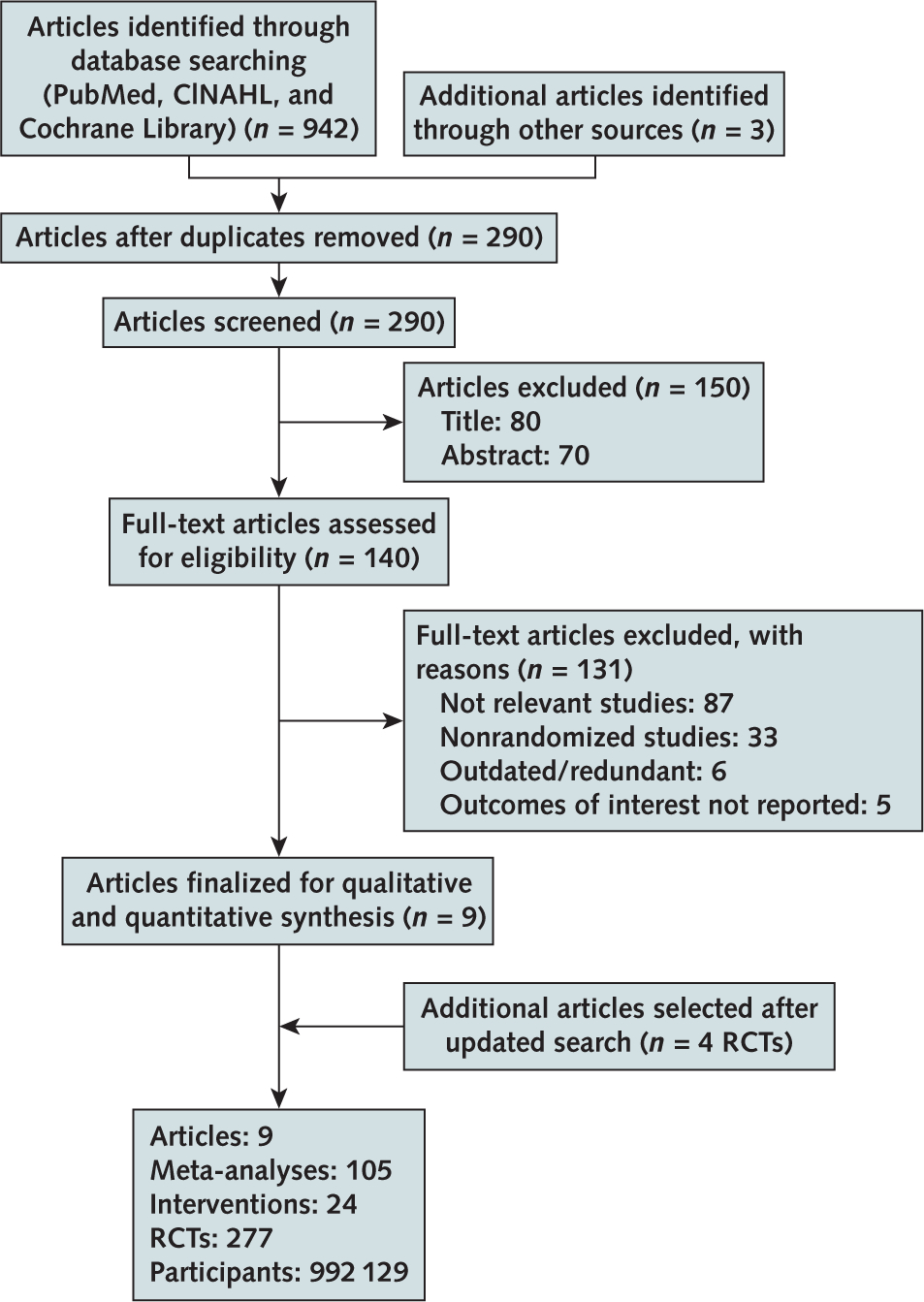
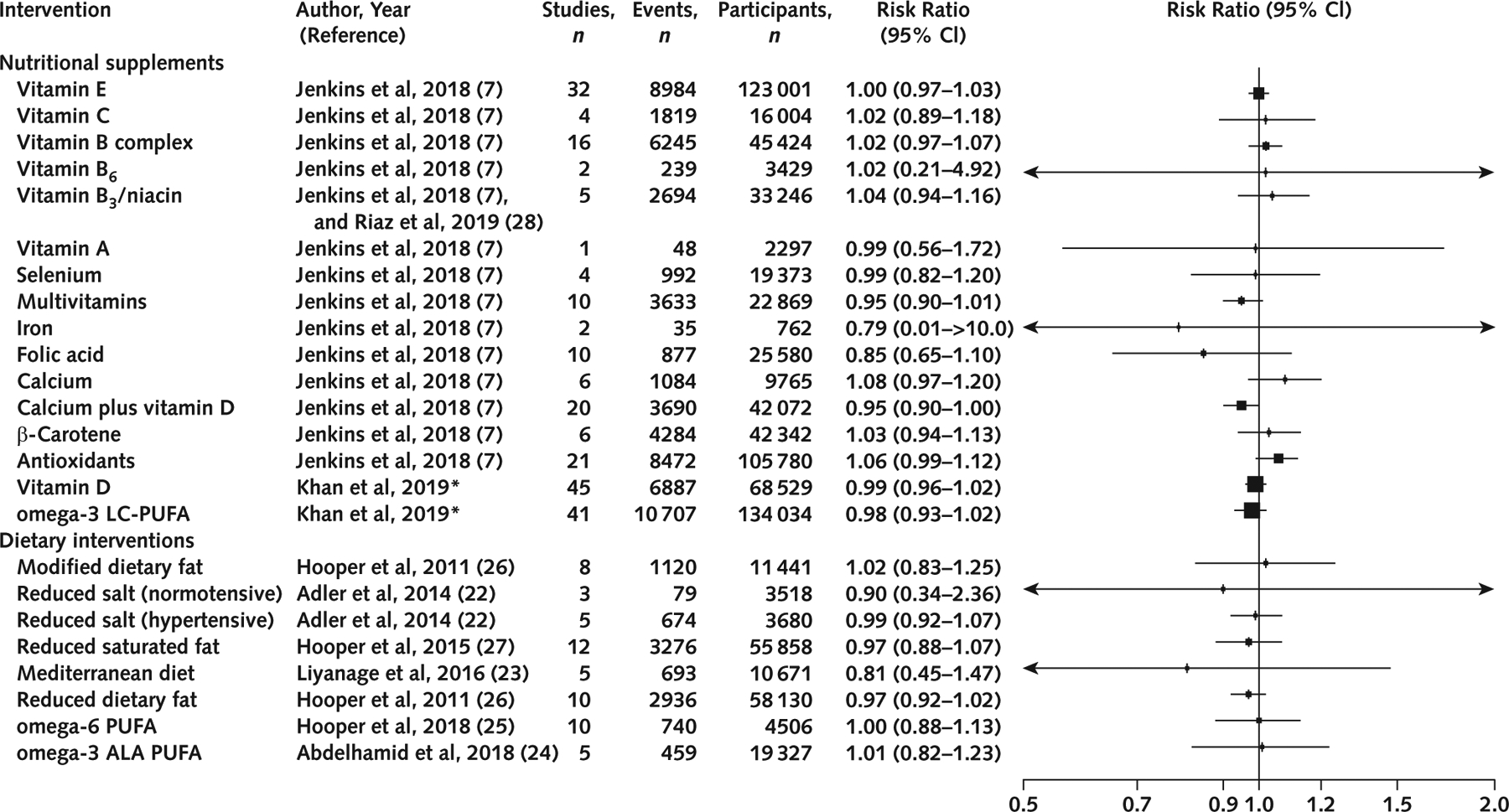
Data synthesis: Nine systematic reviews and 4 new RCTs were selected that encompassed a total of 277 trials, 24 interventions, and 992 129 participants. A total of 105 meta-analyses were generated. There was moderate-certainty evidence that reduced salt intake decreased the risk for all-cause mortality in normotensive participants (risk ratio [RR], 0.90 [95% CI, 0.85 to 0.95]) and cardiovascular mortality in hypertensive participants (RR, 0.67 [CI, 0.46 to 0.99]). Low-certainty evidence showed that omega-3 long-chain polyunsaturated fatty acid (LC-PUFA) was associated with reduced risk for myocardial infarction (RR, 0.92 [CI, 0.85 to 0.99]) and coronary heart disease (RR, 0.93 [CI, 0.89 to 0.98]). Folic acid was associated with lower risk for stroke (RR, 0.80 [CI, 0.67 to 0.96]; low certainty), whereas calcium plus vitamin D increased the risk for stroke (RR, 1.17 [CI, 1.05 to 1.30]; moderate certainty). Other nutritional supplements, such as vitamin B6, vitamin A, multivitamins, antioxidants, and iron and dietary interventions, such as reduced fat intake, had no significant effect on mortality or cardiovascular disease outcomes (very low- to moderate-certainty evidence).
Limitations: Suboptimal quality and certainty of evidence.
Conclusion: Reduced salt intake, omega-3 LC-PUFA use, and folate supplementation could reduce risk for some cardiovascular outcomes in adults. Combined calcium plus vitamin D might increase risk for stroke.
Primary funding source: None.
Figures


Comment in
-
Dispense With Supplements for Improving Heart Outcomes.Ann Intern Med. 2019 Aug 6;171(3):216-217. doi: 10.7326/M19-1498. Epub 2019 Jul 9. Ann Intern Med. 2019. PMID: 31284306 Free PMC article. No abstract available.
-
Review: No high-certainty evidence exists that nutritional supplements or diets affect cardiovascular outcomes.Ann Intern Med. 2019 Nov 19;171(10):JC50. doi: 10.7326/ACPJ201911190-050. Ann Intern Med. 2019. PMID: 31739333 No abstract available.
-
Effects of Nutritional Supplements and Dietary Interventions on Cardiovascular Outcomes.Ann Intern Med. 2020 Jan 7;172(1):73-74. doi: 10.7326/L19-0714. Ann Intern Med. 2020. PMID: 31905389 No abstract available.
-
Effects of Nutritional Supplements and Dietary Interventions on Cardiovascular Outcomes.Ann Intern Med. 2020 Jan 7;172(1):74. doi: 10.7326/L19-0715. Ann Intern Med. 2020. PMID: 31905390 No abstract available.
-
Effects of Nutritional Supplements and Dietary Interventions on Cardiovascular Outcomes.Ann Intern Med. 2020 Jan 7;172(1):75. doi: 10.7326/L19-0716. Ann Intern Med. 2020. PMID: 31905391 No abstract available.
References
Publication types
MeSH terms
Grants and funding
LinkOut - more resources
Full Text Sources
Medical