


Cultural Intelligence and Work-Family Conflict: A Moderated Mediation Model Based on Conservation of Resources Theory
- PMID: 31284604
- PMCID: PMC6651476
- DOI: 10.3390/ijerph16132406
Cultural Intelligence and Work-Family Conflict: A Moderated Mediation Model Based on Conservation of Resources Theory
Abstract
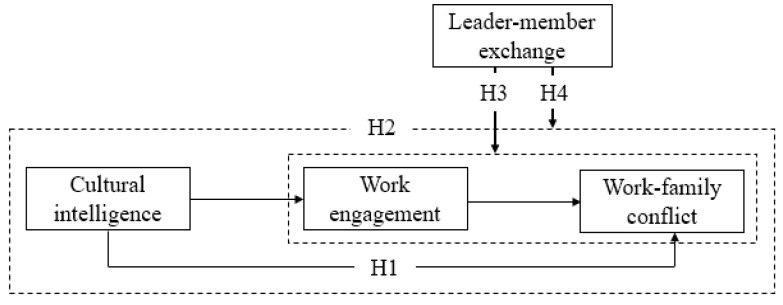
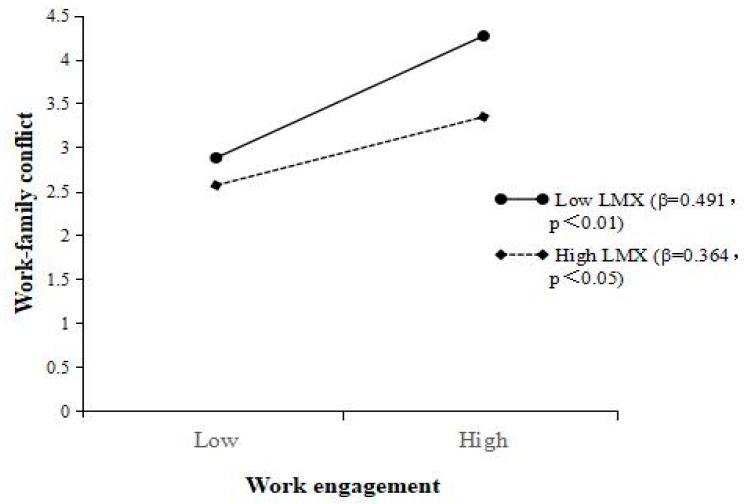
This study aims to explore the influence mechanism of cultural intelligence on work-family conflict for Chinese expatriates in cross-cultural non-profit organizations. Drawing on conservation of resources theory, this longitudinal study (six-month time lag) is the first to examine cultural intelligence as an antecedent of work-family conflict. The study also examines the mediating role of work engagement and the moderating role of leader-member exchange (LMX) in the cultural intelligence and work-family conflict relationship. The sample comprises 206 expatriate Chinese language teachers working at 45 Confucius Institutes in the US, Canada, and Russia. Results show that cultural intelligence not only reduces work-family conflict but also promotes expatriates' work engagement. The higher the work engagement, the higher the work-family conflict experienced by expatriates. LMX moderates not only the positive relationship between work engagement and work-family conflict but also the indirect effect of cultural intelligence on work-family conflict through work engagement. Thus, the indirect effect of cultural intelligence on work-family conflict through work engagement is stronger with low (compared to high) LMX. This study's findings provide implications for managers of cross-cultural non-profit organizations to better understand and solve expatriates' work-family conflict problem.
Keywords: Chinese expatriates; Confucius Institute; conservation of resources; cultural intelligence; work–family conflict.
Conflict of interest statement
The authors declare no conflict of interest.
Figures
References
-
- Altbach P., Reisberg L., Rumbley L.E. Trends in Global Higher Education: Tracking an Academic Revolution. UNESCO Publishing; Paris, France: 2010.
-
- Yang J., Bently J.R., Treadway D.C., Brouer R.L., Wallace A. The role of affective commitment and political skill in the work interfering with family (WIF) conflict-voluntary turnover relationship. Int. J. Hum. Resour. Manag. 2018;29:595–613. doi: 10.1080/09585192.2016.1172656. - DOI
-
- Shang S., O’Driscoll M.P., Roche M. Mechanisms linking acculturation, work–family conflict, and subjective well-being among Chinese immigrants in New Zealand. Hum. Resour. Manag. 2018;57:1097–1109. doi: 10.1002/hrm.21890. - DOI
Publication types
MeSH terms
LinkOut - more resources
Full Text Sources
