. 2019 Jul 23;116(30):15200-15209.
doi: 10.1073/pnas.1900056116. Epub 2019 Jul 8.

Global-level population genomics reveals differential effects of geography and phylogeny on horizontal gene transfer in soil bacteria

Affiliations

Global-level population genomics reveals differential effects of geography and phylogeny on horizontal gene transfer in soil bacteria

Alex Greenlon et al. Proc Natl Acad Sci U S A. .

Abstract

Although microorganisms are known to dominate Earth's biospheres and drive biogeochemical cycling, little is known about the geographic distributions of microbial populations or the environmental factors that pattern those distributions. We used a global-level hierarchical sampling scheme to comprehensively characterize the evolutionary relationships and distributional limitations of the nitrogen-fixing bacterial symbionts of the crop chickpea, generating 1,027 draft whole-genome sequences at the level of bacterial populations, including 14 high-quality PacBio genomes from a phylogenetically representative subset. We find that diverse Mesorhizobium taxa perform symbiosis with chickpea and have largely overlapping global distributions. However, sampled locations cluster based on the phylogenetic diversity of Mesorhizobium populations, and diversity clusters correspond to edaphic and environmental factors, primarily soil type and latitude. Despite long-standing evolutionary divergence and geographic isolation, the diverse taxa observed to nodulate chickpea share a set of integrative conjugative elements (ICEs) that encode the major functions of the symbiosis. This symbiosis ICE takes 2 forms in the bacterial chromosome-tripartite and monopartite-with tripartite ICEs confined to a broadly distributed superspecies clade. The pairwise evolutionary relatedness of these elements is controlled as much by geographic distance as by the evolutionary relatedness of the background genome. In contrast, diversity in the broader gene content of Mesorhizobium genomes follows a tight linear relationship with core genome phylogenetic distance, with little detectable effect of geography. These results illustrate how geography and demography can operate differentially on the evolution of bacterial genomes and offer useful insights for the development of improved technologies for sustainable agriculture.

Keywords: integrative conjugative element; microbial ecology; nitrogen fixation; population genomics; symbiosis.


Conflict of interest statement

The authors declare no conflict of interest.

Figures
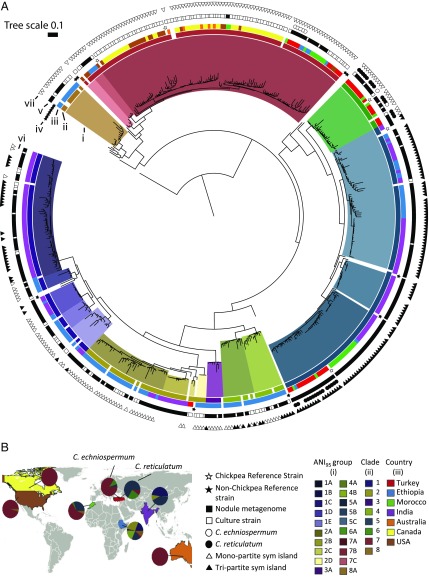
Fig. 1.
Fig. 1.
Phylogenetic relationships, species assignments, and geographic distribution of a global collection of chickpea’s Mesorhizobium symbiont. (A) Phylogenetic tree of Mesorhizobium cultures and root-nodule DNA extracts based on 400 single-copy marker genes (46). Concentric rings are (inner to outer): (i) 95% ANI cluster, (ii) major clade, (iii) country of collection, (iv) reference strain, (v) nodule metagenome or cultured strain, (vi) host of origin, and (vii) sym island structure. All strains originate from Cicer arietinum unless specified in ring (vi). Clades 9 and 10 are immediately basal to clade 6 and shown with greater clarity in SI Appendix, Fig. S1. The most abundant 20 species are shown, with details of 8 less abundant species given in Dataset S1. (B) Taxonomic composition of Mesorhizobium genomes from chickpea nodules for each country.
Fig. 2.
Fig. 2.
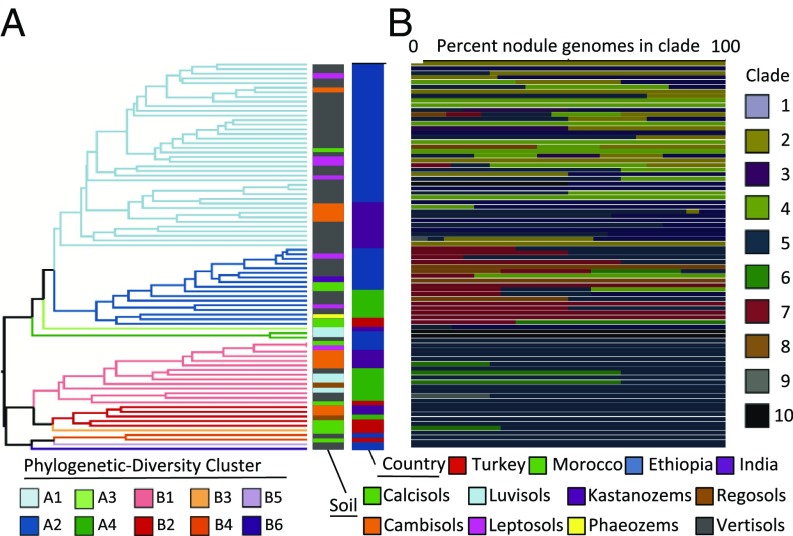
Diversity analysis and soil characteristics within sampled 500-km2 regions. (A) Hierarchical clustering of 0.2° × 0.2° grid cells by Mesorhizobium phylogenetic diversity (57, 58). (B) The horizontal colored bars indicate normalized taxon abundance of taxa within a cell, labeled according to country and predominant soil type. See SI Appendix, Table S17 for geographic coordinates of grids.
Fig. 3.
Fig. 3.
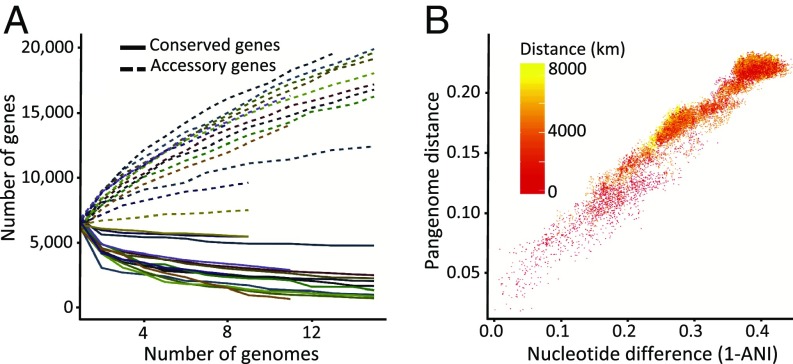
Pangenome relationships in global Mesorhiozbium populations are driven by core genome evolution. (A) Pangenome gene accumulation curves for each 95% ANI group. The lines depict the average number of genes (core or accessory) present across rarefied genomes, with 10 replications, as the number of genomes increases. (B) Scatterplot depicting the portion of the pangenome shared by any 2 strains versus the nucleotide distance between those strains using 400 universal marker genes (Fig. 1A) (49), colored by geographic distance between those same pairs. Data include only nodule genome assemblies >90% complete.
Fig. 4.
Fig. 4.
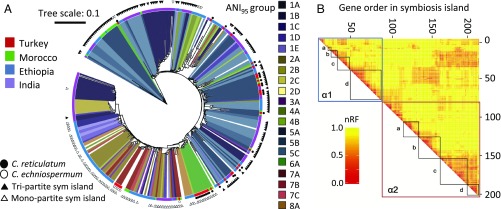
The distribution of symbiosis island phylotypes is driven by ICE structure and geography, with frequent but patterned recombination. (A) Maximum-likelihood phylogenetic tree of genomes assembled from root nodules, inferred from concatenated alignments of 100 genes identified as core to the symbiosis island in all 14 PacBio assemblies (Dataset S6). Annotation rings are the same as in Figs. 1A and 2B (outside to inside: symbiosis island type, Cicer species, country, clade, and ANI95 group). (B) Heatmap of Robinson-Foulds distances calculated from maximum-likelihood phylogenetic tree comparisons using 10-gene sliding windows of 200 genes with >57% presence and syntenic in 14 PacBio symbiosis islands. α1 and α2 are the 2 conserved regions of the symbiosis island, highlighted in SI Appendix, Fig. S11B. Regulons of genes with related functions are noted: α1a, double-stranded DNA break repair; α1b, hypothetical proteins; α1c, genes involved in nod factor synthesis; α2d, genes involved in nitrogen fixation; α2a, type III secretion system and putative effectors; α2b, biofilm formation (including O-antigen, exopolysaccharide production, quorum-sensing genes, and the type II secretion system); α2c, conjugation (type IV secretion system, plasmid-transfer genes); α2d, cytochrome oxidases.

References

    1. Amann R. I., Ludwig W., Schleifer K.-H., Phylogenetic identification and in situ detection of individual microbial cells without cultivation. Microbiol. Rev. 59, 143–169 (1995). - PMC - PubMed
    1. Ladau J., et al. , Global marine bacterial diversity peaks at high latitudes in winter. ISME J. 7, 1669–1677 (2013). - PMC - PubMed
    1. Barberán A., et al. , Continental-scale distributions of dust-associated bacteria and fungi. Proc. Natl. Acad. Sci. U.S.A. 112, 5756–5761 (2015). - PMC - PubMed
    1. Pace N. R., A molecular view of microbial diversity and the biosphere. Science 276, 734–740 (1997). - PubMed

    1. Fierer N., Jackson R. B., The diversity and biogeography of soil bacterial communities. Proc. Natl. Acad. Sci. U.S.A. 103, 626–631 (2006). - PMC - PubMed

Publication types