


Beer? Over here! Examining attentional bias towards alcoholic and appetitive stimuli in a visual search eye-tracking task
- PMID: 31286155
- PMCID: PMC6892770
- DOI: 10.1007/s00213-019-05313-0
Beer? Over here! Examining attentional bias towards alcoholic and appetitive stimuli in a visual search eye-tracking task
Abstract
Rationale: Experimental tasks that demonstrate alcohol-related attentional bias typically expose participants to single-stimulus targets (e.g. addiction Stroop, visual probe, anti-saccade task), which may not correspond fully with real-world contexts where alcoholic and non-alcoholic cues simultaneously compete for attention. Moreover, alcoholic stimuli are rarely matched to other appetitive non-alcoholic stimuli.
Objectives: To address these limitations by utilising a conjunction search eye-tracking task and matched stimuli to examine alcohol-related attentional bias.
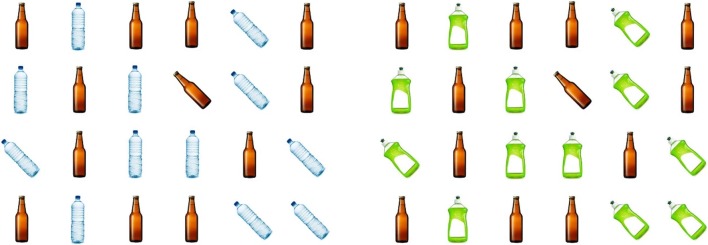
Methods: Thirty social drinkers (Mage = 19.87, SD = 1.74) were asked to detect whether alcoholic (beer), non-alcoholic (water) or non-appetitive (detergent) targets were present or absent amongst a visual array of matching and non-matching distractors. Both behavioural response times and eye-movement dwell time were measured.
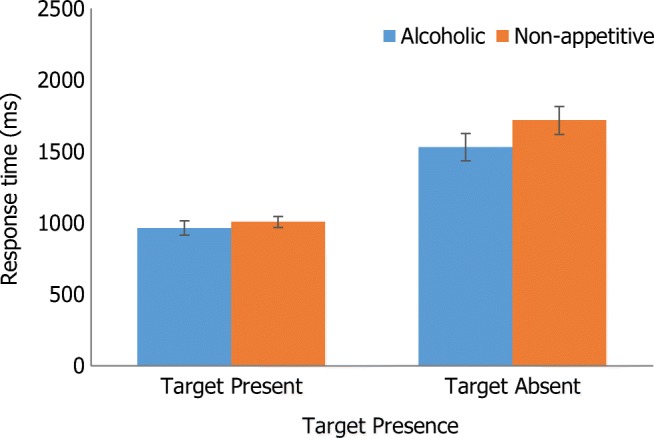
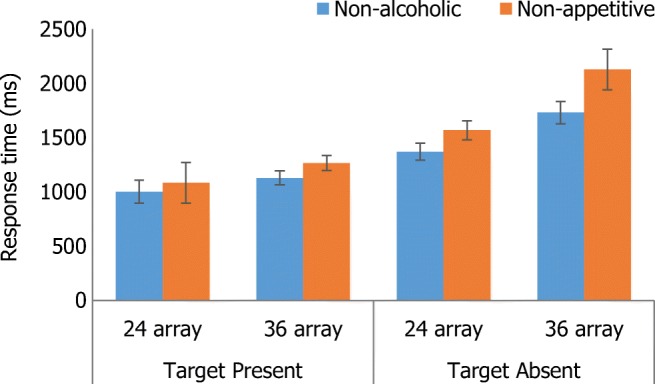
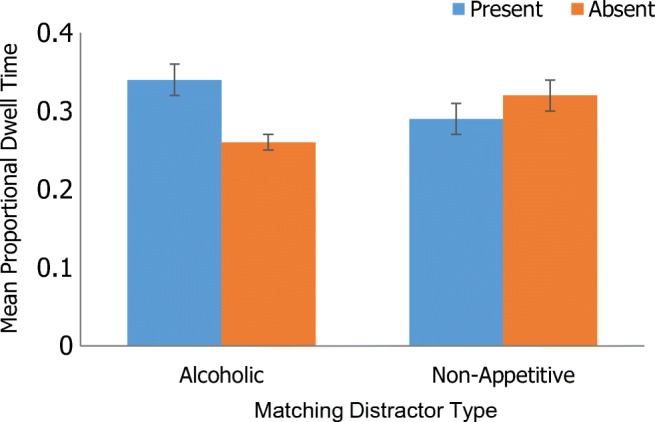
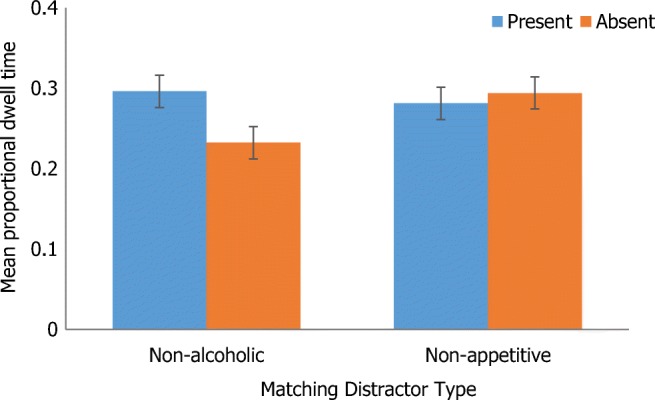
Results: Social drinkers were significantly quicker to detect alcoholic and non-alcoholic appetitive targets relative to non-appetitive targets in an array of matching and mismatching distractors. Similarly, proportional dwell time was lower for both alcoholic and non-alcoholic appetitive distractors relative to non-appetitive distractors, suggesting that appetitive targets were relatively easier to detect.
Conclusions: Social drinkers may exhibit generalised attentional bias towards alcoholic and non-alcoholic appetitive cues. This adds to emergent research suggesting that the mechanisms driving these individual's attention towards alcoholic cues might 'spill over' to other appetitive cues, possibly due to associative learning.
Keywords: Alcohol consumption; Appetitive processing; Attentional bias; Eye-tracking; Visual search.
Conflict of interest statement
The authors declare that they have no conflict of interest.
Figures
References
MeSH terms
LinkOut - more resources
Full Text Sources
Medical
