


Psoriasis treat to target: defining outcomes in psoriasis using data from a real-world, population-based cohort study (the British Association of Dermatologists Biologics and Immunomodulators Register, BADBIR)
- PMID: 31286471
- PMCID: PMC7317460
- DOI: 10.1111/bjd.18333
Psoriasis treat to target: defining outcomes in psoriasis using data from a real-world, population-based cohort study (the British Association of Dermatologists Biologics and Immunomodulators Register, BADBIR)
Abstract
Background: The 'treat to target' paradigm improves outcomes and reduces costs in chronic disease management but is not yet established in psoriasis.
Objectives: To identify treatment targets in psoriasis using two common measures of disease activity: Psoriasis Area and Severity Index (PASI) and Physician's Global Assessment (PGA).
Methods: Data from a multicentre longitudinal U.K. cohort of patients with psoriasis receiving systemic or biologic therapies (British Association of Dermatologists Biologics and Immunomodulators Register, BADBIR) were used to identify absolute PASI thresholds for 90% (PASI 90) and 75% (PASI 75) improvements in baseline disease activity, using receiver operating characteristic curves. The relationship between PGA (clear, almost clear, mild, moderate, moderate-severe, severe) and PASI (range 0-72) was described, and the concordance between absolute and relative definitions of response was determined. The same approach was used to establish treatment response and eligibility definitions based on PGA.
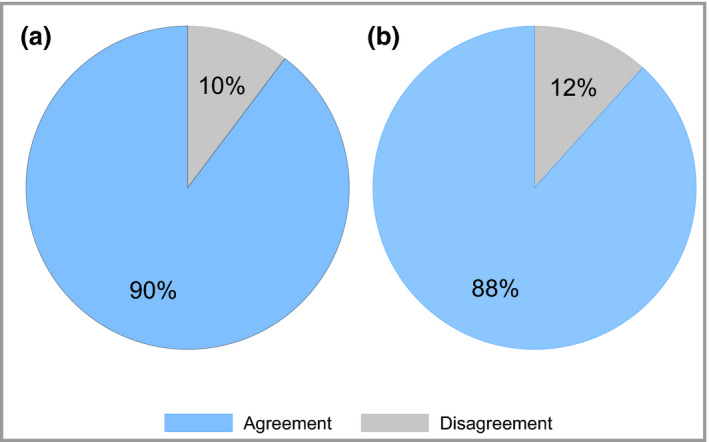
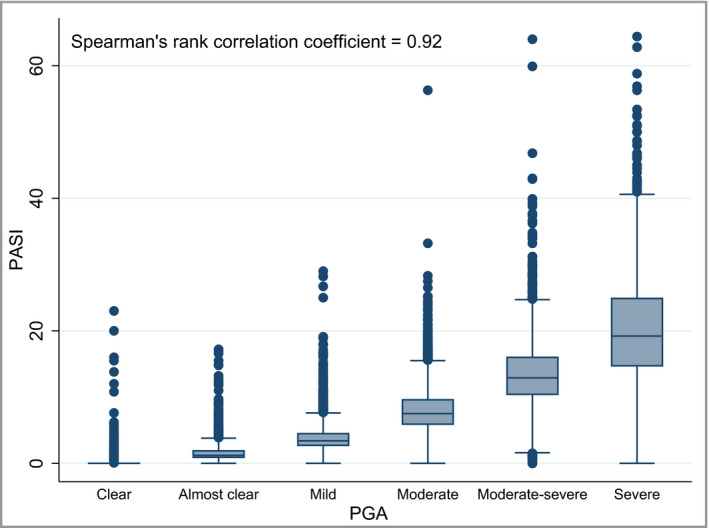
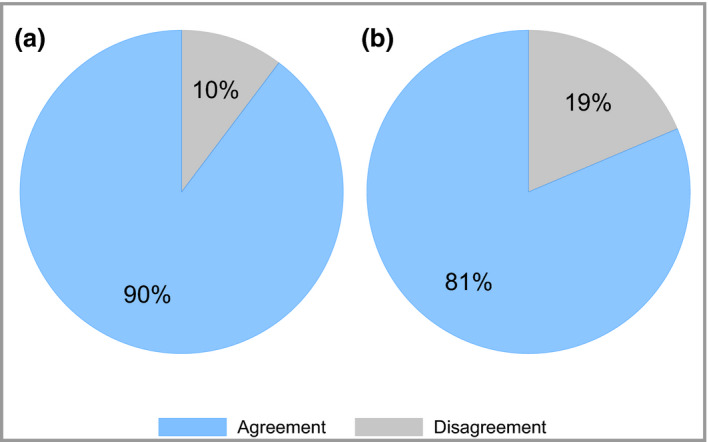
Results: Data from 13 422 patients were available (58% male, 91% white ethnicity, mean age 44·9 years), including over 23 000 longitudinal PASI and PGA scores. An absolute PASI ≤ 2 was concordant with PASI 90 and an absolute PASI ≤ 4 was concordant with PASI 75 in 90% and 88% of cases, respectively. These findings were robust to subgroups of timing of assessment, baseline disease severity and treatment modality. PASI and PGA were strongly correlated (Spearman's rank correlation coefficient 0·92). The median PASI increased from 0 (interquartile range 0-0, range 0-23) to 19 (interquartile range 15-25, range 0-64) for PGA clear to severe, respectively. PGA clear/almost clear was concordant with PASI ≤ 2 in 90% of cases, and PGA moderate-severe severe was concordant with the National Institute for Health and Care Excellence PASI eligibility criteria for biologics in 81% of cases.
Conclusions: An absolute PASI ≤ 2 and PGA clear/almost clear represent relevant disease end points to inform treat-to-target management strategies in psoriasis. What's already known about this topic? The most commonly used relative disease activity measure in psoriasis is ≥ 90% improvement in Psoriasis Area and Severity Index (PASI 90); however, it has several limitations including dependency on a baseline severity assessment. Defining an absolute target disease activity end point in psoriasis has the potential to improve patient outcomes and reduce costs, as demonstrated by treat-to-target approaches in other chronic diseases such as hypertension and diabetes. The Physician's Global Assessment (PGA) is a popular alternative measure of psoriasis severity in daily practice; however, its utility has not been formally assessed with respect to PASI. What does this study add? An absolute PASI ≤ 2 corresponds with PASI 90 response and is a relevant disease end point for treat-to-target approaches in psoriasis. There is a strong correlation between PASI and PGA. PGA moderate-severe/severe may serve as an alternative eligibility criterion for biologics to PASI-based definitions, and PGA clear/almost clear is an appropriate alternative absolute treatment end point. What are the clinical implications of this work? Absolute PASI ≤ 2 and PGA clear/almost clear represent relevant disease end points to inform treat-to-target management strategies in psoriasis.
© 2019 The Authors. British Journal of Dermatology published by John Wiley & Sons Ltd on behalf of British Association of Dermatologists.
Figures
Comment in
-
Taking aim at identifying treatment targets for psoriasis.Br J Dermatol. 2020 May;182(5):1075-1076. doi: 10.1111/bjd.18635. Br J Dermatol. 2020. PMID: 32359115 No abstract available.
References
-
- World Health Organization . Global report on psoriasis. Available at: https://apps.who.int/iris/handle/10665/204417 (last accessed 12 August 2019).
-
- Yang Z‐S, Lin N‐N, Li L, Li Y. The effect of TNF inhibitors on cardiovascular events in psoriasis and psoriatic arthritis: an updated meta‐analysis. Clin Rev Allergy Immunol 2016; 51:240–7. - PubMed
-
- Atar D, Birkeland KI, Uhlig T. ‘Treat to target’: moving targets from hypertension, hyperlipidaemia and diabetes to rheumatoid arthritis. Ann Rheum Dis 2010; 69:629–30. - PubMed
