


The psychology of the wait time experience - what clinics can do to manage the waiting experience for patients: a longitudinal, qualitative study
- PMID: 31286957
- PMCID: PMC6615172
- DOI: 10.1186/s12913-019-4301-0
The psychology of the wait time experience - what clinics can do to manage the waiting experience for patients: a longitudinal, qualitative study
Abstract
Background: Wait time, defined as time spent in the waiting and exam rooms waiting to see a provider, is a key quality metric in a number of national patient experience surveys. However, the literature on wait time does not show a consistent correlation between long waits and worse overall patient care experiences. Herein, we examine contextual factors that can shape the manner in which patients may respond to different wait times. We also identify actions providers and clinics can take to promote positive wait experiences and mitigate negative ones.
Methods: We conducted over 130 h of semi-structured interviews with patients new to two HIV primary care clinics in Houston, Texas. We interviewed patients before the first provider visit, again within two weeks of the first visit, and again at 6-12 months. We analyzed the interviews using directed and conventional content analysis.
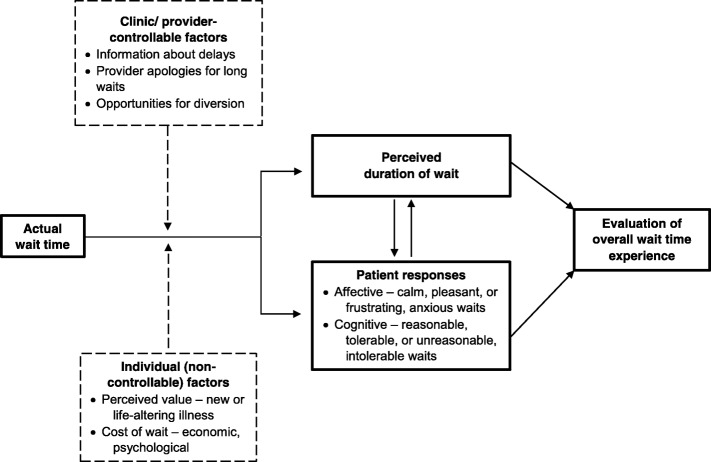
Results: Our study showed that patients' "willingness to wait" is the product of the actual wait time, individual factors, such as the perceived value of the visit and cost of a long wait, and clinic and provider factors. Analyses revealed key steps providers and clinics can take to improve the wait time experience. These include: 1) proactively informing patients of delays, 2) explicitly apologizing for delays, and 3) providing opportunities for diversion. Patients noted the importance of these steps in curtailing frustrations that may result from a long wait.
Conclusions: Our study highlights key steps cited by patients as having the potential to improve the wait time experience. These steps are practical and of particular interest to clinics, where waits are oftentimes inevitable.
Keywords: Longitudinal studies; Patient experience; Patient preference; Patient satisfaction; Patient-centered care; Physician-patient relations; Qualitative studies; Wait time.
Conflict of interest statement
The authors declare that they have no competing interests.
Figures
References
-
- Agency for Healthcare Research and Quality [http://www.ahrq.gov/cahps/surveys-guidance/cg/instructions/index.html]. Accessed 28 June 2019.
-
- National Health Service [https://gp-patient.co.uk/Files/Questionnaire2018.pdf]. Accessed 28 June 2019.
-
- Canadian Institute for Health Information [https://www.cihi.ca/sites/default/files/info_phc_patient_en.pdf]. Accessed 28 June 2019.
-
- Camacho F, Anderson R, Safrit A, Jones AS, Hoffmann P. The relationship between patient's perceived waiting time and office-based practice satisfaction. N C Med J. 2006;67(6):409–413. - PubMed
MeSH terms
Grants and funding
LinkOut - more resources
Full Text Sources
