


QTLs Associated with Resistance to Cardiomyopathy Syndrome in Atlantic Salmon
- PMID: 31287894
- PMCID: PMC6785937
- DOI: 10.1093/jhered/esz042
QTLs Associated with Resistance to Cardiomyopathy Syndrome in Atlantic Salmon
Abstract
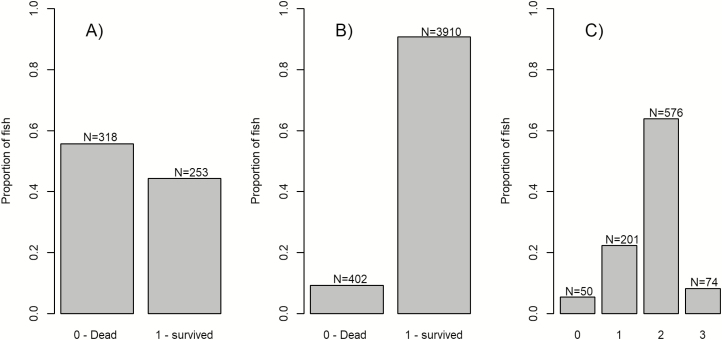
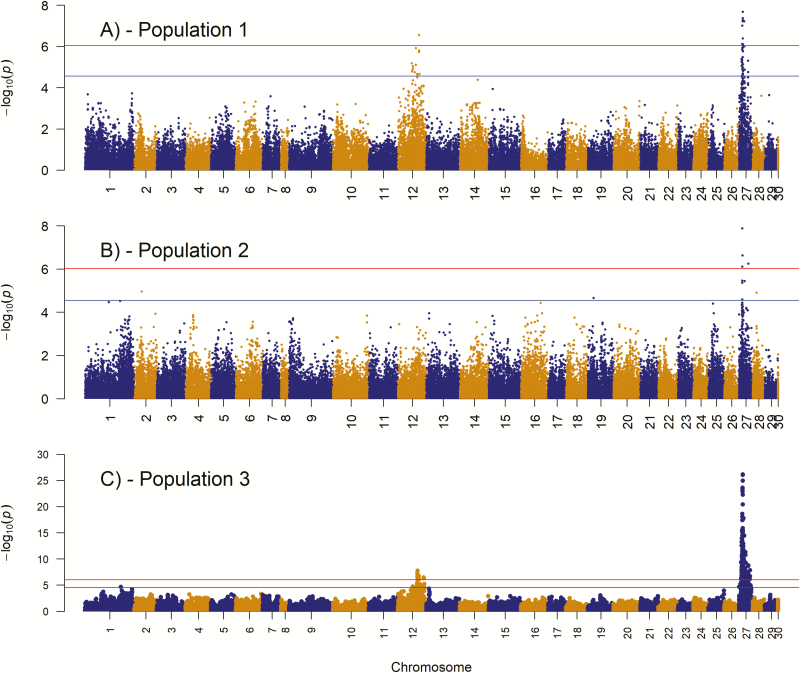
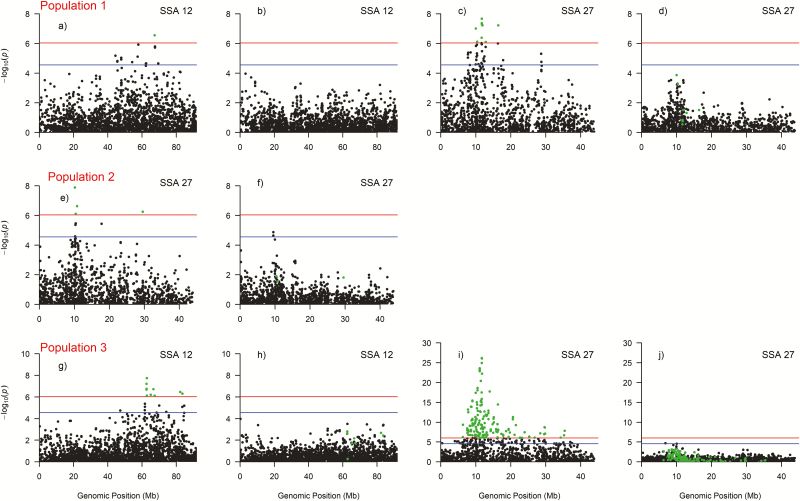
Cardiomyopathy syndrome (CMS) caused by piscine myocarditis virus is a major disease affecting the Norwegian Atlantic salmon industry. Three different populations of Atlantic salmon from the Mowi breeding program were used in this study. The first 2 populations (population 1 and 2) were naturally infected in a field outbreak, while the third population (population 3) went through a controlled challenged test. The aim of the study was to estimate the heritability, the genetic correlation between populations and perform genome-wide association analysis for resistance to this disease. Survival data from population 1 and 2 and heart atrium histology score data from population 3 was analyzed. A total of 571, 4312, and 901 fish from population 1, 2, and 3, respectively were genotyped with a noncommercial 55,735 Affymetrix marker panel. Genomic heritability ranged from 0.12 to 0.46 and the highest estimate was obtained from the challenge test dataset. The genetic correlation between populations was moderate (0.51-0.61). Two chromosomal regions (SSA27 and SSA12) contained single nucleotide polymorphisms associated with resistance to CMS. The highest association signal (P = 6.9751 × 10⁻²⁷) was found on chromosome 27. Four genes with functional roles affecting viral resistance (magi1, pi4kb, bnip2, and ha1f) were found to map closely to the identified quantitative trait loci (QTLs). In conclusion, genetic variation for resistance to CMS was observed in all 3 populations. Two important quantitative trait loci were detected which together explain half of the total genetic variance, suggesting strong potential application for marker-assisted selection and genomic predictions to improve CMS resistance.
Keywords: Atlantic salmon; QTL analysis; cardiomyopathy syndrome; field outbreak; genetic correlations; heritability.
© The American Genetic Association 2019.
Figures
References
-
- AquaGen AS 2015. Protection against CMS – Better heart health. Available from: https://aquagen.no/en/products/salmon-eggs/product-documentation/resista...
-
- Boyd JM, Malstrom S, Subramanian T, Venkatesh LK, Schaeper U, Elangovan B, D’Sa-Eipper C, Chinnadurai G. 1994. Adenovirus E1B 19 kDa and Bcl-2 proteins interact with a common set of cellular proteins. Cell. 79:341–351. - PubMed
Publication types
MeSH terms
LinkOut - more resources
Full Text Sources
Medical
