


The role of blood pressure in risk of ischemic and hemorrhagic stroke in type 1 diabetes
- PMID: 31288813
- PMCID: PMC6617855
- DOI: 10.1186/s12933-019-0891-4
The role of blood pressure in risk of ischemic and hemorrhagic stroke in type 1 diabetes
Abstract
Background: Hypertension is one of the strongest risk factors for stroke in the general population, while systolic blood pressure has been shown to independently increase the risk of stroke in type 1 diabetes. The aim of this study was to elucidate the association between different blood pressure variables and risk of stroke in type 1 diabetes, and to explore potential nonlinearity of this relationship.
Methods: We included 4105 individuals with type 1 diabetes without stroke at baseline, participating in the nationwide Finnish Diabetic Nephropathy Study. Mean age at baseline was 37.4 ± 11.9 years, median duration of diabetes 20.9 (interquartile range 11.5-30.4) years, and 52% were men. Office systolic blood pressure (SBP) and diastolic blood pressure (DBP) were measured. Based on these pulse pressure (PP) and mean arterial pressure (MAP) were calculated. Strokes were classified based on medical and autopsy records, as well as neuroimaging. Cox proportional hazard models were performed to study how the different blood pressure variables affected the risk of stroke and its subtypes.
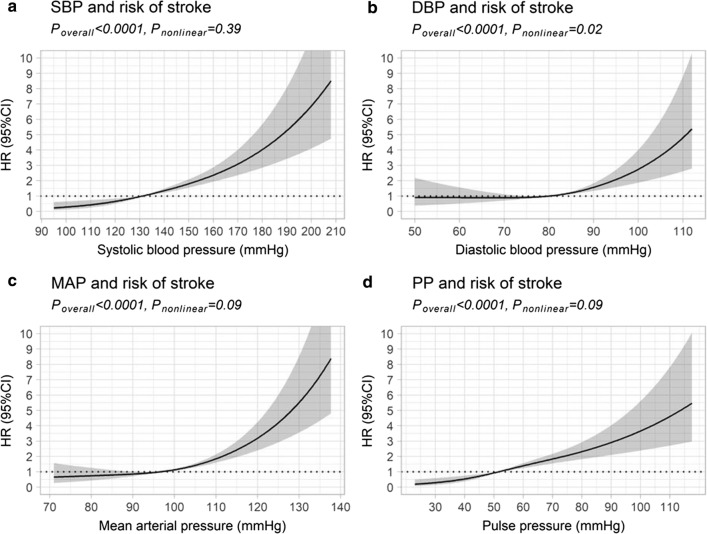
Results: During median follow-up time of 11.9 (9.21-13.9) years, 202 (5%) individuals suffered an incident stroke; 145 (72%) were ischemic and 57 (28%) hemorrhagic. SBP, DBP, PP, and MAP all independently increased the risk of any stroke. SBP, PP, and MAP increased the risk of ischemic stroke, while SBP, DBP, and MAP increased the risk of hemorrhagic stroke. SBP was strongly associated with stroke with a hazard ratio of 1.20 (1.11-1.29)/10 mmHg. When variables were modeled using restricted cubic splines, the risk of stroke increased linearly for SBP, MAP, and PP, and non-linearly for DBP.
Conclusions: The different blood pressure variables are all independently associated with increased risk of stroke in individuals with type 1 diabetes. The risk of stroke, ischemic stroke, and hemorrhagic stroke increases linearly at blood pressure levels less than the current recommended treatment guidelines.
Keywords: Blood pressure; Cerebrovascular disease; Hemorrhagic stroke; Hypertension; Ischemic stroke; Type 1 diabetes.
Conflict of interest statement
TT. has served on scientific advisory boards for Bayer, Boehringer Ingelheim, Lumosa Pharm, and Pfizer; T.T. has received speaker´s bureau from University of Donau (Austria). P.-H.G. has received research grants from Eli Lilly and Roche. He is an advisory board member for AbbVie, Astra Zeneca, Boehringer-Ingelheim, Cebix, Eli Lilly, Janssen, MSD, Medscape, Novartis, and Sanofi. He has also received speaker honorariums from Astra Zeneca, Boehringer-Ingelheim, Eli Lilly, Elo Water, Genzyme, MSD, Novartis, Novo Nordisk, and Sanofi. Other authors have no competing interests relevant to this paper.
Figures
References
-
- Lewington S, Clarke R, Qizilbash N, Peto R, Collins R, Prospective Studies Collaboration Age-specific relevance of usual blood pressure to vascular mortality: a meta-analysis of individual data for one million adults in 61 prospective studies. Lancet. 2002;360(9349):1903–1913. doi: 10.1016/S0140-6736(02)11911-8. - DOI - PubMed
-
- Bangalore S, Messerli FH, Franklin SS, Mancia G, Champion A, Pepine CJ. Pulse pressure and risk of cardiovascular outcomes in patients with hypertension and coronary artery disease: an INternational VErapamil SR-trandolapril STudy (INVEST) analysis. Eur Heart J. 2009;30(11):1395–1401. doi: 10.1093/eurheartj/ehp109. - DOI - PubMed
Publication types
MeSH terms
Substances
LinkOut - more resources
Full Text Sources
Medical
Molecular Biology Databases
Miscellaneous
