


Is maternal weight gain between pregnancies associated with risk of large-for-gestational age birth? Analysis of a UK population-based cohort
- PMID: 31289065
- PMCID: PMC6615839
- DOI: 10.1136/bmjopen-2018-026220
Is maternal weight gain between pregnancies associated with risk of large-for-gestational age birth? Analysis of a UK population-based cohort
Abstract
Objective: Maternal overweight and obesity during pregnancy increases the risk of large-for-gestational age (LGA) birth and childhood obesity. We aimed to investigate the association between maternal weight change between subsequent pregnancies and risk of having a LGA birth.
Design: Population-based cohort.
Setting: Routinely collected antenatal healthcare data between January 2003 and September 2017 at University Hospital Southampton, England.
Participants: Health records of women with their first two consecutive singleton live-birth pregnancies were analysed (n=15 940).
Primary outcome measure: Risk of LGA, recurrent LGA and new LGA births in the second pregnancy.
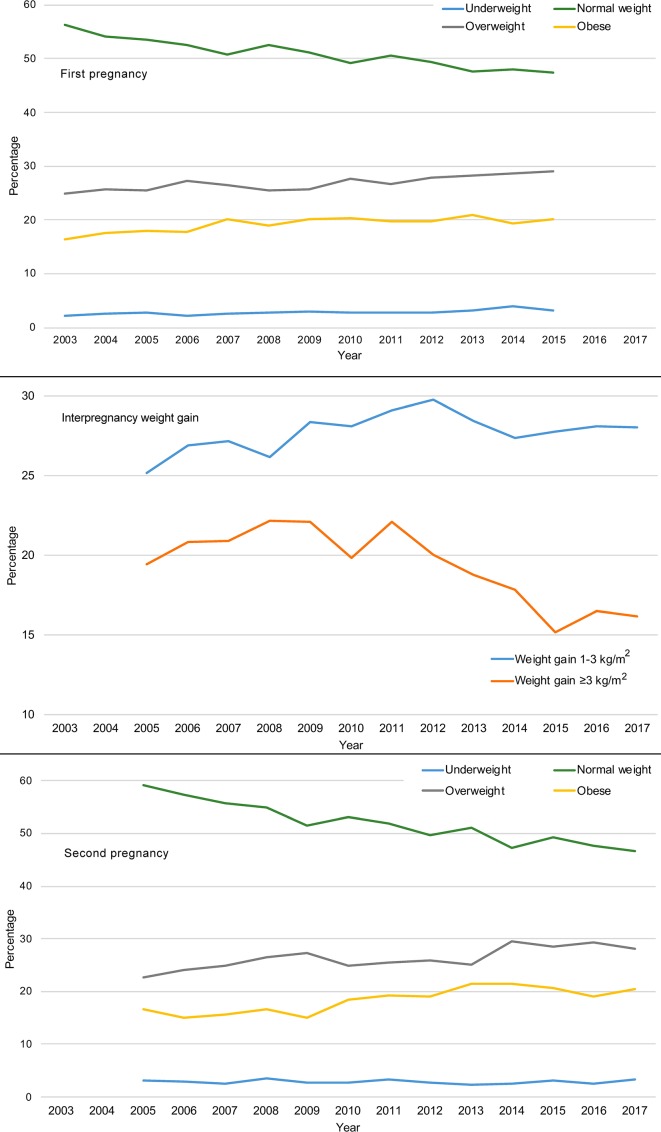
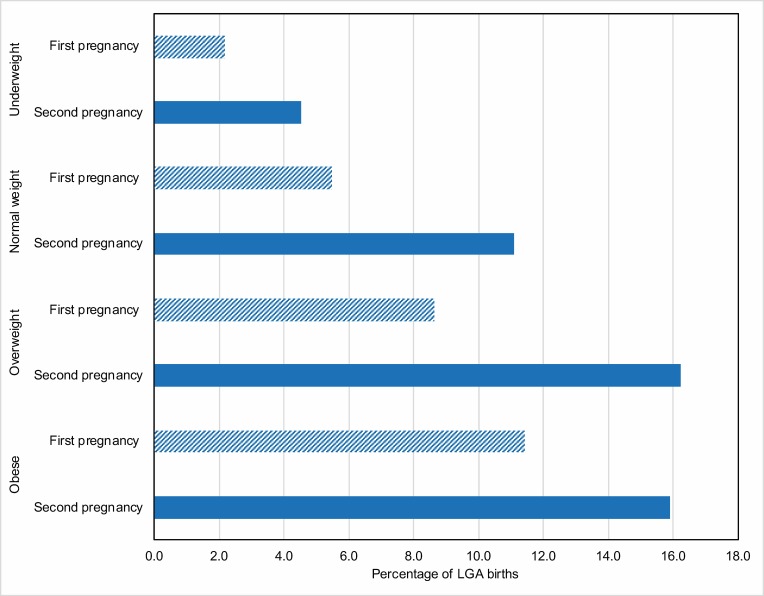
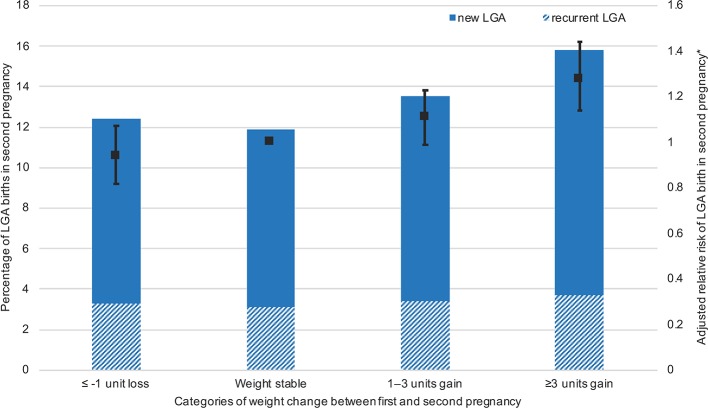
Results: Of the 15 940 women, 16.0% lost and 47.7% gained weight (≥1 kg/m2) between pregnancies. A lower proportion of babies born to women who lost ≥1 kg/m2 (12.4%) and remained weight stable between -1 and 1 kg/m2 (11.9%) between pregnancies were LGA compared with 13.5% and 15.9% in women who gained 1-3 and ≥3 kg/m2, respectively. The highest proportion was in obese women who gained ≥3 kg/m2 (21.2%). Overweight women had a reduced risk of recurrent LGA in the second pregnancy if they lost ≥1 kg/m2 (adjusted relative risk (aRR) 0.69, 95% CI 0.48 to 0.97) whereas overweight women who gained ≥3 kg/m2 were at increased risk of new LGA after having a non-LGA birth in their first pregnancy (aRR 1.35, 95% CI 1.05 to 1.75). Normal-weight women who gained weight were also at increased risk of new LGA in the second pregnancy (aRR 1.26, 95% CI 1.06 to 1.50 with gain of 1-3 kg/m2 and aRR 1.34, 95% CI 1.09 to 1.65 with gain of ≥3 kg/m2).
Conclusions: Losing weight after an LGA birth was associated with a reduced LGA risk in the next pregnancy in overweight women, while interpregnancy weight gain was associated with an increased new LGA risk. Preventing weight gain between pregnancies is an important measure to achieve better maternal and offspring outcomes.
Keywords: large-for-gestational age; obesity; pregnancy; pregnancy outcome; weight gain.
© Author(s) (or their employer(s)) 2019. Re-use permitted under CC BY. Published by BMJ.
Conflict of interest statement
Competing interests: None declared.
Figures
References
-
- Surkan PJ, Hsieh CC, Johansson AL, et al. Reasons for increasing trends in large for gestational age births. Obstet Gynecol 2004;104:720–6. 10.1097/01.AOG.0000141442.59573.cd - DOI - PubMed
Publication types
MeSH terms
Grants and funding
LinkOut - more resources
Full Text Sources
Medical
