Review
. 2019 Aug;121(4):293-302.
doi: 10.1038/s41416-019-0509-3. Epub 2019 Jul 10.

Cancer-associated fibroblasts-heroes or villains?

Affiliations
Review

Cancer-associated fibroblasts-heroes or villains?

Krystyna A Gieniec et al. Br J Cancer. 2019 Aug.

Abstract

Cancer-associated fibroblasts (CAFs) were originally presumed to represent a homogeneous population uniformly driving tumorigenesis, united by their morphology and peritumoural location. Our understanding of CAFs has since been shaped by sophisticated in vitro and in vivo experiments, pathological association and, more recently, ablation, and it is now widely appreciated that CAFs form a group of highly heterogeneous cells with no single overarching marker. Studies have demonstrated that the CAF population contains different subtypes based on the expression of marker proteins with the capacity to promote or inhibit cancer, with their biological role as accomplices or adversaries dependent on many factors, including the cancer stage. So, while CAFs have been endlessly shown to promote the growth, survival and spread of tumours via improvements in functionality and an altered secretome, they are also capable of retarding tumorigenesis via largely unknown mechanisms. It is important to reconcile these disparate results so that the functions of, or factors produced by, tumour-promoting subtypes can be specifically targeted to improve cancer patient outcomes. This review will dissect out CAF complexity and CAF-directed cancer treatment strategies in order to provide a case for future, rational therapies.


Conflict of interest statement

The authors declare no competing interests.

Figures

Fig. 1
Fig. 1
Roles of CAFs in tumorigenesis. Tumour cells and the surrounding fibroblasts or CAFs communicate to generate a microenvironment that either promotes or suppresses tumorigenesis. Normal fibroblasts can be stimulated to become CAFs by the tumour, however, the biological programmes that determine their skew towards a tumour-promoting or tumour-suppressing subtype remain unknown. The tumour-promoting subtypes aid tumour growth, survival and spread both directly and indirectly, through other tumour-associated stromal cell types. Both normal fibroblasts and CAFs have been shown to inhibit or retard tumorigenesis, but the mechanisms are relatively unknown
Fig. 2
Fig. 2
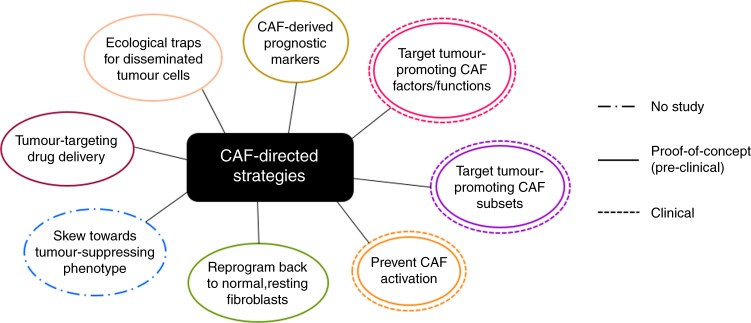
CAF-directed cancer therapies. Outlined are several preclinical and clinical approaches aimed at targeting CAFs in an attempt to impede tumorigenesis. Ideally, for full efficacy, these strategies will be used in conjunction with drugs that target tumours

References

    1. Koliaraki V, Pallangyo CK, Greten FR, Kollias G. Mesenchymal cells in colon cancer. Gastroenterology. 2017;152:964–979. doi: 10.1053/j.gastro.2016.11.049. - DOI - PubMed
    1. Kalluri R. The biology and function of fibroblasts in cancer. Nat. Rev. Cancer. 2016;16:582–598. doi: 10.1038/nrc.2016.73. - DOI - PubMed
    1. Coussens LM, Werb Z. Inflammation and cancer. Nature. 2001;420:860–867. doi: 10.1038/nature01322. - DOI - PMC - PubMed
    1. Dvorak HF. Tumors: wounds that do not heal. Similarities between tumor stroma generation and wound healing. N. Engl. J. Med. 1986;315:1650–1659. doi: 10.1056/NEJM198612253152606. - DOI - PubMed
    1. Calon A, Lonardo E, Berenguer-Llergo A, Espinet E, Hernando-Momblona X, Iglesias M, et al. Stromal gene expression defines poor-prognosis subtypes in colorectal cancer. Nat. Genet. 2015;47:320–329. doi: 10.1038/ng.3225. - DOI - PubMed

Publication types