


Factors Associated With Antibiotic Prescribing and Outcomes for Pediatric Pneumonia in the Emergency Department
- PMID: 31290801
- PMCID: PMC6946906
- DOI: 10.1097/PEC.0000000000001892
Factors Associated With Antibiotic Prescribing and Outcomes for Pediatric Pneumonia in the Emergency Department
Abstract
Objectives: Chest radiographs (CXRs) are often performed in children with respiratory illness to inform the decision to prescribe antibiotics. Our objective was to determine the factors associated with clinicians' plans to treat with antibiotics prior to knowledge of CXR results and the associations between preradiograph plans with antibiotic prescription and return to medical care.
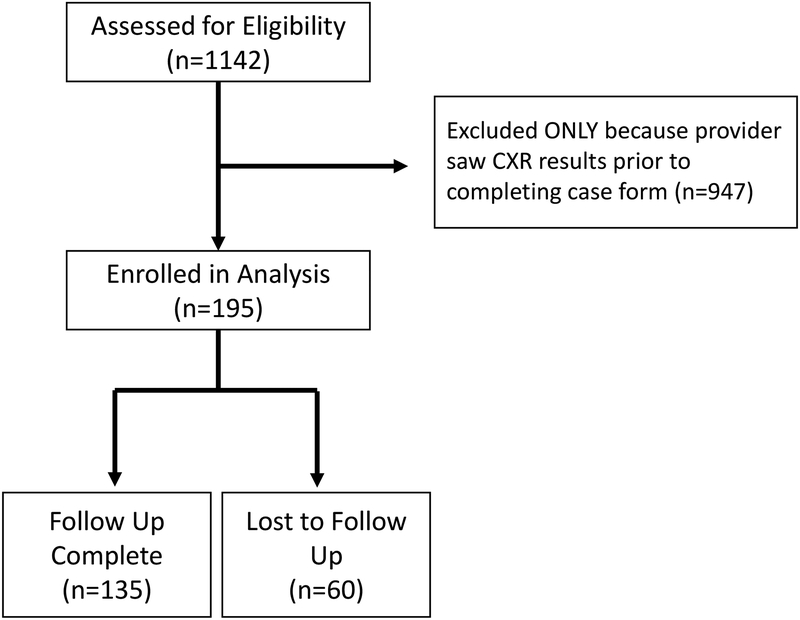
Methods: Previously healthy children aged 3 months to 18 years with a CXR for suspected pneumonia were enrolled in a prospective cohort study in the emergency department. Our primary outcomes were antibiotic prescription or administration in the emergency department and medical care sought within 7 to 15 days after discharge. Inverse probability treatment weighting was used to limit bias due to treatment selection. Inverse probability treatment weighting was included in a logistic regression model estimating the association between the intention to give antibiotics and outcomes.
Results: Providers planned to prescribe antibiotics prior to CXR in 68 children (34.9%). There was no difference in the presence of radiographic pneumonia between those with and without a plan for antibiotics. Children who had a plan for antibiotics were more likely to receive antibiotics than those without (odds ratio [OR], 6.39; 95% confidence interval [CI], 3.7-11.0). This association was stronger than the association between radiographic pneumonia and antibiotic receipt (OR, 3.49; 95% CI, 1.98-6.14). Children prescribed antibiotics were more likely to seek care after discharge than children who were not (OR, 1.85; 95% CI, 1.13-3.05).
Conclusions: Intention to prescribe antibiotics based on clinical impression was the strongest predictor of antibiotic prescription in our study. Prescribing antibiotics may lead to subsequent medical care after controlling for radiographic pneumonia.
Copyright © 2019 Wolters Kluwer Health, Inc. All rights reserved.
Conflict of interest statement
Disclosure: The authors declare no conflict of interest.
References
-
- Alpern ER, Stanley RM, Gorelick MH, et al. Epidemiology of a Pediatric Emergency Medicine Research Network. Pediatr Emerg Care. 2006;22:11. - PubMed
-
- Bradley JS, Byington CL, Shah SS, et al. The management of community-acquired pneumonia in infants and children older than 3 months of age: clinical practice guidelines by the Pediatric Infectious Diseases Society and the Infectious Diseases Society of America. Clin Infect Dis. 2011;53:e25–76. - PMC - PubMed
-
- Rambaud-Althaus C, Althaus F, Genton B, et al. Clinical features for diagnosis of pneumonia in children younger than 5 years: a systematic review and meta-analysis. Lancet Infect Dis. 2015;15:439–50. - PubMed
MeSH terms
Substances
Grants and funding
LinkOut - more resources
Full Text Sources
Medical
