Comparative Study
. 2019 Jul 10;20(1):569.
doi: 10.1186/s12864-019-5873-0.

Comparative proteomic analysis of Tibetan pig spermatozoa at high and low altitudes

Affiliations
Comparative Study

Comparative proteomic analysis of Tibetan pig spermatozoa at high and low altitudes

Yanling Zhao et al. BMC Genomics. .

Erratum in

Abstract

Background: To illuminate the mechanisms underlying the high-altitude tolerance of Tibetan pig spermatozoa, proteomes of spermatozoa from Tibetan pigs raised in high and low altitudes were compared using a tandem mass tag (TMT)-labeled quantitative proteomics approach.

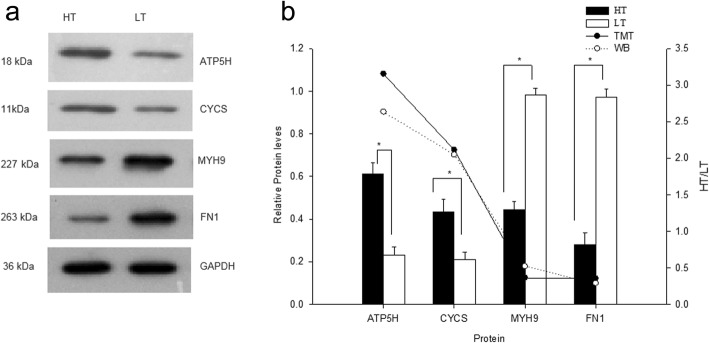
Results: A total of 77 differentially expressed proteins (DEPs) were identified. Gene Ontology (GO) analysis revealed DEPs that were predominantly associated with the actin cytoskeleton, the tricarboxylic acid (TCA) cycle, and adenosine triphosphate (ATP) metabolism, and were from 12 enriched Kyoto Encyclopedia of Genes and Genomes (KEGG) pathways. Three subnetworks were significantly enriched and 10 centric proteins were identified by protein-protein interaction (PPI) network analysis. Relative expression levels of the proteins (ATP5H, CYCS, MYH9 and FN1) were confirmed using Western blotting.

Conclusions: Our study is the first to use a tandem mass tag (TMT) approach to analyze Tibetan pig spermatozoa, and provides a foundation to understand the mechanisms underlying the reproductive adaptations of Tibetan pigs to high-altitude environments.

Keywords: Tibetan pig, spermatozoa, comparative proteomics, TMT, high-altitude adaptability.


Conflict of interest statement

The authors declare that they have no competing interests.

Figures
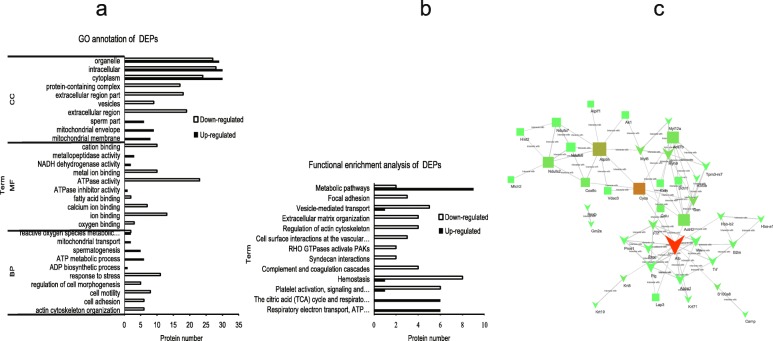
Fig. 1
Fig. 1
Bioinformatic analyses of differently expressed proteins (DEPs). a Gene ontology (GO) analysis of DEPs. b Functional enrichment analysis of DEPs. c Protein–protein interaction (PPI) network of DEPs from HT and LT pigs. The nodes represent DEPs, and the edges between the nodes indicate interactions between two connecting DEPs. The node colors indicate the betweenness of interaction the nodes: the color is redder, the betweenness is bigger, which means the influence is greater in the network. The node sizes indicate the degree of interaction between the nodes: the size is bigger, the degree is bigger, which means the stability is stronger in the network. The node shapes represent upregulated proteins (rectangle) or downregulated proteins (v). The degrees of edge thickness represent the protein–protein interaction scores
Fig. 2
Fig. 2
Western blot validation. a Western blot (WB) analysis of four proteins (ATP5H, CYCS, MYH9 and FN1). GAPDH was used as a loading control. b Statistical results of WB and quantitative comparisonon of TMT and WB on the four proteins. The bar chart shows statistical results of WB. The line chart represents quantitative comparisonon of TMT and WB on the four proteins. The data on WB expression levels are represented as means ± standard deviation (SD); *P < 0.05
Fig. 3
Fig. 3
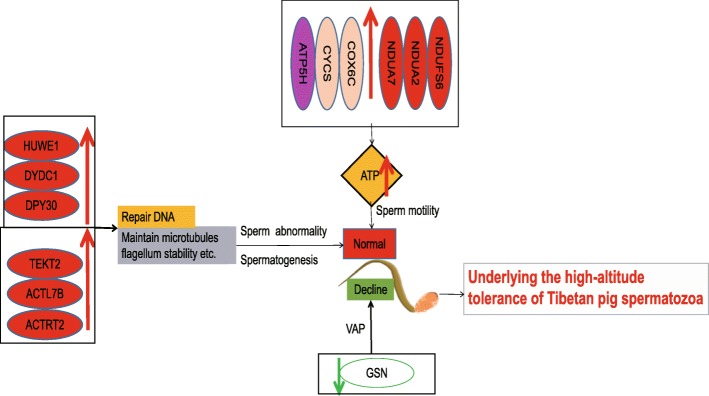
A model to present the putative mechanisms underlying the high-altitude tolerance of Tibetan pig spermatozoa. Ovals represent proteins, red arrows indicate proteins are upregulated, green arrows indicate proteins are downregulated

References

    1. Yang S, Zhang H, Mao H, Yan D, Lu S, Lian L, Zhao G, Yan Y, Deng W, Shi X, et al. The local origin of the Tibetan pig and additional insights into the origin of Asian pigs. PLoS One. 2011;6(12):e28215. doi: 10.1371/journal.pone.0028215. - DOI - PMC - PubMed
    1. Li M, Tian S, Jin L, Zhou G, Li Y, Zhang Y, Wang T, Yeung CK, Chen L, Ma J, et al. Genomic analyses identify distinct patterns of selection in domesticated pigs and Tibetan wild boars. Nat Genet. 2013;45(12):1431–1438. doi: 10.1038/ng.2811. - DOI - PubMed
    1. Beall CM. Two routes to functional adaptation: Tibetan and Andean high-altitude natives. Proc Natl Acad Sci U S A. 2007;104(Suppl 1):8655–8660. doi: 10.1073/pnas.0701985104. - DOI - PMC - PubMed
    1. Ge RL, Kubo K, Kobayashi T, Sekiguchi M, Honda T. Blunted hypoxic pulmonary vasoconstrictive response in the rodent Ochotona curzoniae (pika) at high altitude. Am J Phys. 1998;274(5 Pt 2):H1792–H1799. - PubMed
    1. Ai H, Huang L, Ren J. Genetic diversity, linkage disequilibrium and selection signatures in chinese and Western pigs revealed by genome-wide SNP markers. PLoS One. 2013;8(2):e56001. doi: 10.1371/journal.pone.0056001. - DOI - PMC - PubMed

Publication types

LinkOut - more resources