Emotional exhaustion among healthcare professionals: the effects of role ambiguity, work engagement and professional commitment
- PMID: 31292416
- PMCID: PMC6776181
- DOI: 10.23750/abm.v90i6-S.8481
Emotional exhaustion among healthcare professionals: the effects of role ambiguity, work engagement and professional commitment
Abstract
Background and aim: The study aims at identifying the antecedents and consequences of emotional exhaustion in health professionals and, particularly, examining the process that leads from a hindrance demand, like role ambiguity, to exhaustion and job satisfaction. Emotional exhaustion is a phenomenon that affect health professionals with negative consequence on job satisfaction, and literature has underlined that job demands could be may be a cause of this chronic stress. However, the relationship among job demands, work engagement and exhaustion has produced results not always converging.
Method: A self-report questionnaire was administered to 66 health professionals.
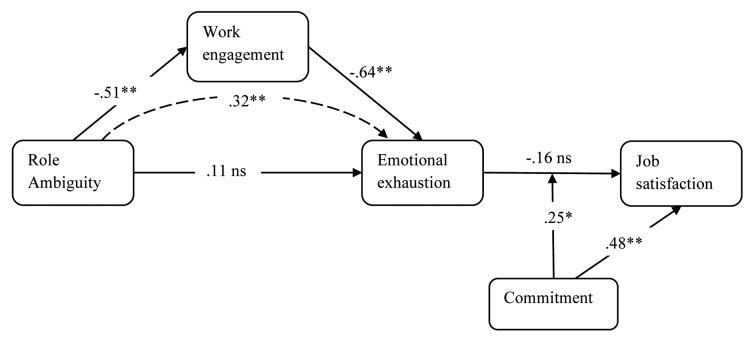
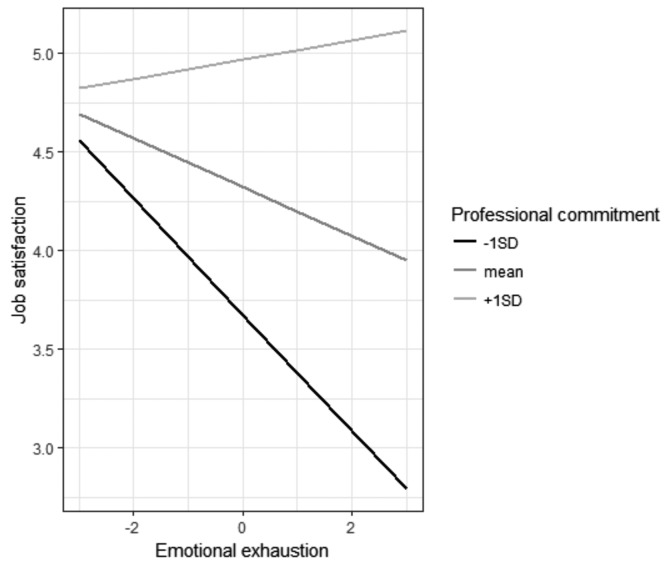
Results: The results showed that the effect of role ambiguity on emotional exhaustion was mediated by work engagement and the emotional exhaustion impairs job satisfaction when workers are not committed to their profession.
Conclusions: Role ambiguity represents a psychosocial risk factor that influence workers' wellbeing diminishing the level of motivation and this process leads to emotional exhaustion. However, professional commitment appears to be a resource that can protect professionals preventing a decrease in satisfaction. These findings suggest that human resource management should remove hindrance stressors and enhance the mission of Healthcare Professionals in order to increase employees' work engagement and prevent exhaustion.
Conflict of interest statement
Each author declares that he or she has no commercial associations (e.g. consultancies, stock ownership, equity interest, patent/licensing arrangement etc.) that might pose a conflict of interest in connection with the submitted article
Figures
References
-
- Cao X, Chen L, Tian L, Diao Y. The effect of perceived organisational support on burnout among community health nurses in China: The mediating role of professional self-concept. J Nurs Manag. 2016;24(1):E77–E86. doi: 10.1111/jonm.12292. - PubMed
-
- Sun JW, Bai HY, Li JH, Lin PZ, Zhang HH, Cao FL. Predictors of occupational burnout among nurses: a dominance analysis of job stressors. J Clin Nurs. 2017;26(23-24):4286–4292. doi: 10.1111/jocn.13754. - PubMed
-
- Tunc T, Kutanis RO. Role conflict, role ambiguity, and burnout in nurses and physicians at a university hospital in Turkey. Nurs Heal Sci. 2009;11(4):410–416. doi: 10.1111/j.1442-2018.2009.00475.x. - PubMed
-
- Maslach C, Schaufeli WB, Leiter MP. Job burnout. Annu Rev Physiol. 2001;(52):397–422. doi: 10.1146/annurev.psych.52.1.397. - PubMed
-
- Maslach C, Leiter MP. Early Predictors of Job Burnout and Engagement. J Appl Psychol. 2008;93(3):498–512. doi: 10.1037/0021-9010.93.3.498. - PubMed
MeSH terms
LinkOut - more resources
Full Text Sources