


Liver Graft-Versus-Host Disease is associated with poor survival among allogeneic hematopoietic stem cell transplant recipients
- PMID: 31292984
- PMCID: PMC8422561
- DOI: 10.1002/ajh.25575
Liver Graft-Versus-Host Disease is associated with poor survival among allogeneic hematopoietic stem cell transplant recipients
Abstract
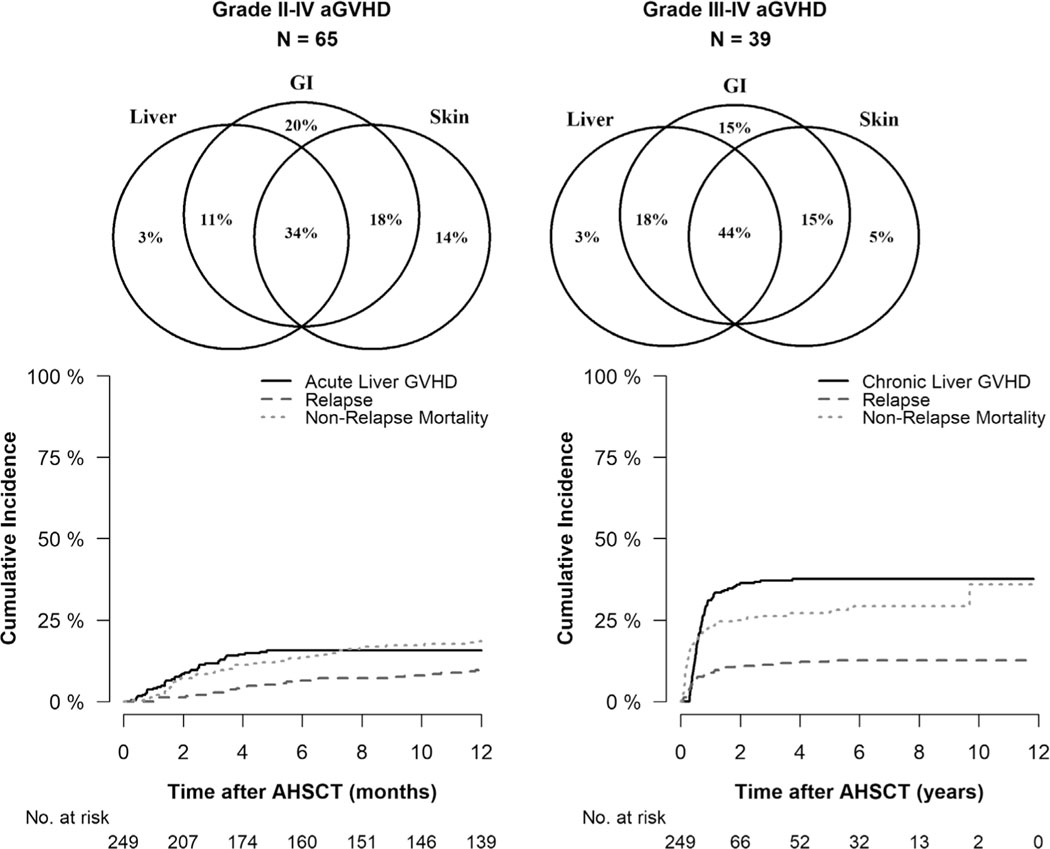
Liver Graft-versus-host disease (GVHD) is common in patients with post-transplant liver dysfunction following allogeneic hematopoietic stem cell transplantation (AHSCT). Oftentimes, the diagnosis is made clinically, and liver biopsy is deferred. Our objective was to evaluate the risk factors and clinical outcomes of liver GVHD among patients who developed post-transplant liver dysfunction. Additionally, we evaluated the feasibility of liver biopsy in this population. We compared outcomes between liver GVHD and a "non-liver GVHD" group, which consisted of other etiologies of post-transplant liver dysfunction. Between January 2003 and December 2010, 249 patients developed post-transplant liver dysfunction following AHSCT: 124 patients developed liver GVHD and 125 were in the "non-liver GVHD" group. The incidence of acute and chronic liver GVHD at one year was 15.7% and 31.0%, respectively. The competing risk analysis revealed full intensity conditioning regimen (Hazard ratio [HR], 1.76; P = .008) and related donor (HR, 1.68; P = .004) as independent risk factors for liver GVHD. The time-varying covariate Cox regression analysis with competing risk event, demonstrated that liver GVHD was independently associated with higher non-relapse mortality, and adverse relapse-free and overall survival. A total of 112 liver biopsies were performed in 100 patients. No major complications were observed. Liver biopsy confirmed prebiopsy hypotheses in 49% of cases, and led to treatment modification in 49% of patients. Our study shows that liver GVHD is associated with adverse survival. Liver biopsy is safe and often helps directing care in this setting.
© 2019 Wiley Periodicals, Inc.
Conflict of interest statement
CONFLICT OF INTEREST
None.
Figures
References
-
- Ho GT, Parker A, MacKenzie JF, Morris AJ, Stanley AJ. Abnormal liver function tests following bone marrow transplantation: aetiology and role of liver biopsy. Eur J Gastroenterol Hepatol. 2004;16(2):157–162. - PubMed
-
- Tomas JF, Pinilla I, Garcia-Buey ML, et al. Long-term liver dysfunction after allogeneic bone marrow transplantation: clinical features and course in 61 patients. Bone Marrow Transplant. 2000;26(6):649–655. - PubMed
-
- Kim BK, Chung KW, Sun HS, et al. Liver disease during the first post-transplant year in bone marrow transplantation recipients: retrospective study. Bone Marrow Transplant. 2000;26(2):193–197. - PubMed
-
- Strasser SI, Sullivan KM, Myerson D, et al. Cirrhosis of the liver in long-term marrow transplant survivors. Blood. 1999;93(10):3259–3266. - PubMed
-
- El-Sayed MH, El-Haddad A, Fahmy OA, Salama II, Mahmoud HK. Liver disease is a major cause of mortality following allogeneic bone-marrow transplantation. Eur J Gastroenterol Hepatol. 2004;16(12):1347–1354. - PubMed