


Clinical characteristics of young patients with early Barrett's neoplasia
- PMID: 31293342
- PMCID: PMC6603815
- DOI: 10.3748/wjg.v25.i24.3069
Clinical characteristics of young patients with early Barrett's neoplasia
Abstract
Background: Esophageal adenocarcinoma (EAC) and high-grade dysplasia (HGD) may appear in young patients with Barrett's esophagus (BE). However, characteristics of Barrett's-related neoplasia in this younger population remain unknown.
Aim: To identify clinical characteristics that differ between young and old patients with early-stage Barrett's-related neoplasia.
Methods: We conducted a retrospective analysis of a prospectively maintained database comprised of consecutive patients with early-stage EAC (pT1) and HGD at a tertiary-referral center between 2001 and 2017. Baseline characteristics, drug and risk factor exposures, clinicopathological staging of EAC/HGD and treatment outcomes [complete eradication of neoplasia (CE-N), complete eradication of intestinal metaplasia (CE-IM), recurrence of neoplasia and recurrence of intestinal metaplasia] were retrieved. Multivariate analyses were performed to identify factors that differed significantly between older and younger (≤ 50 years) patients.
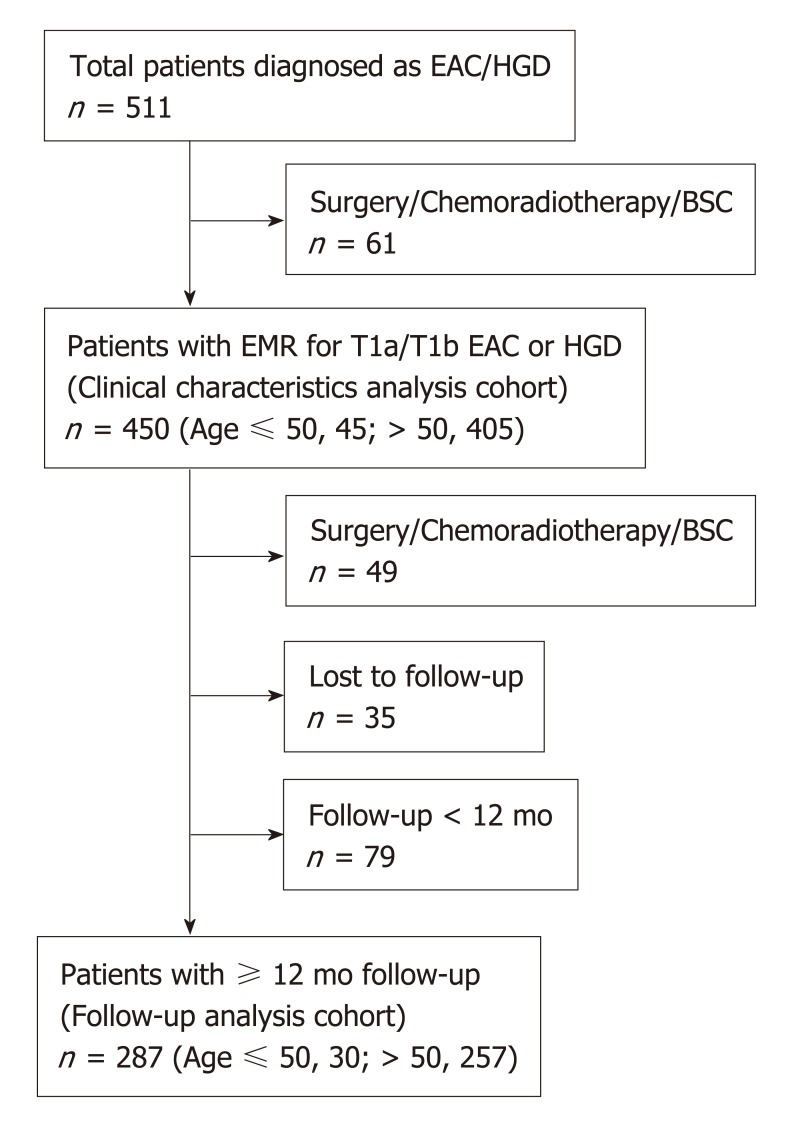
Results: We identified 450 patients with T1 EAC and HGD (74% and 26%, respectively); 45 (10%) were ≤ 50 years. Compared to the older group, young patients were more likely to present with ongoing gastroesophageal reflux disease (GERD) symptoms (55% vs 38%, P = 0.04) and to be obese (body mass index > 30, 48% vs 32%, P = 0.04). Multivariate logistic regression analysis showed that young patients were significantly more likely to have ongoing GERD symptoms [odds ratio (OR) 2.00, 95% confidence interval (CI) 1.04-3.85, P = 0.04] and to be obese (OR 2.06, 95%CI 1.07-3.98, P = 0.03) whereas the young group was less likely to have a smoking history (OR 0.39, 95%CI 0.20-0.75, P < 0.01) compared to the old group. However, there were no significant differences regarding tumor histology, CE-N, CE-IM, recurrence of neoplasia and recurrence of intestinal metaplasia (mean follow-up, 44.3 mo).
Conclusion: While guidelines recommend BE screening in patients > 50 years of age, younger patients should be considered for screening endoscopy if they suffer from obesity and GERD symptoms.
Keywords: Barrett’s Esophagus; Esophageal adenocarcinoma; Gastroesophageal reflux disease; Guideline; High-grade dysplasia; Obesity; Young patient.
Conflict of interest statement
Conflict-of-interest statement: All authors declare no conflicts-of-interest related to this article.
Figures
References
-
- Hameeteman W, Tytgat GN, Houthoff HJ, van den Tweel JG. Barrett's esophagus: Development of dysplasia and adenocarcinoma. Gastroenterology. 1989;96:1249–1256. - PubMed
-
- National Cancer Institute. SEER Cancer Stat Facts: Esophageal Cancer. Bethesda, MD: National Cancer Institute, 2016. Available from: https://seer.cancer.gov/statfacts/html/esoph.html.
-
- Weusten B, Bisschops R, Coron E, Dinis-Ribeiro M, Dumonceau JM, Esteban JM, Hassan C, Pech O, Repici A, Bergman J, di Pietro M. Endoscopic management of Barrett's esophagus: European Society of Gastrointestinal Endoscopy (ESGE) Position Statement. Endoscopy. 2017;49:191–198. - PubMed
-
- ASGE Standards of Practice Committee. Evans JA, Early DS, Fukami N, Ben-Menachem T, Chandrasekhara V, Chathadi KV, Decker GA, Fanelli RD, Fisher DA, Foley KQ, Hwang JH, Jain R, Jue TL, Khan KM, Lightdale J, Malpas PM, Maple JT, Pasha SF, Saltzman JR, Sharaf RN, Shergill A, Dominitz JA, Cash BD; Standards of Practice Committee of the American Society for Gastrointestinal Endoscopy. The role of endoscopy in Barrett's esophagus and other premalignant conditions of the esophagus. Gastrointest Endosc. 2012;76:1087–1094. - PubMed
MeSH terms
Supplementary concepts
LinkOut - more resources
Full Text Sources
Medical
