. 2019 Jun 25:10:682.
doi: 10.3389/fphys.2019.00682. eCollection 2019.

New Insights Into the Circadian Rhythm and Its Related Diseases

Affiliations

New Insights Into the Circadian Rhythm and Its Related Diseases

Yanling Xie et al. Front Physiol. .

Abstract

Circadian rhythms (CR) are a series of endogenous autonomous oscillators generated by the molecular circadian clock which acting on coordinating internal time with the external environment in a 24-h daily cycle. The circadian clock system is a major regulatory factor for nearly all physiological activities and its disorder has severe consequences on human health. CR disruption is a common issue in modern society, and researches about people with jet lag or shift works have revealed that CR disruption can cause cognitive impairment, psychiatric illness, metabolic syndrome, dysplasia, and cancer. In this review, we summarized the synchronizers and the synchronization methods used in experimental research, and introduced CR monitoring and detection methods. Moreover, we evaluated conventional CR databases, and analyzed experiments that characterized the underlying causes of CR disorder. Finally, we further discussed the latest developments in understanding of CR disruption, and how it may be relevant to health and disease. Briefly, this review aimed to synthesize previous studies to aid in future studies of CR and CR-related diseases.

Keywords: circadian rhythm; disorder; influence factors; rhythm monitoring; synchronization.


Figures
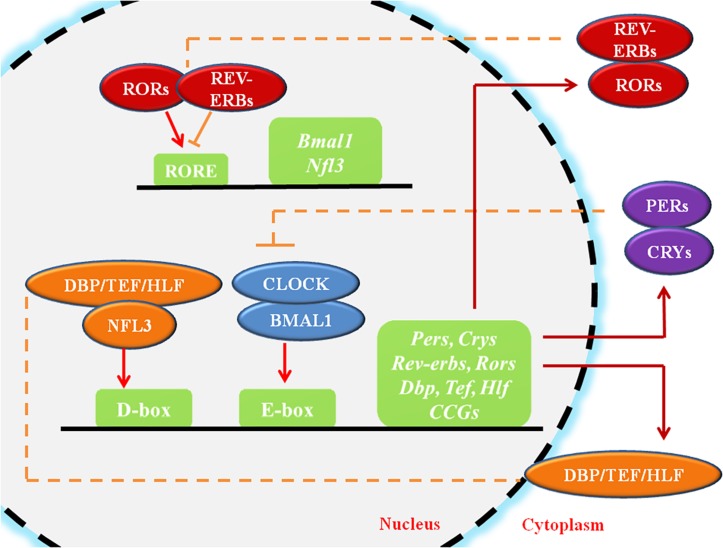
FIGURE 1
FIGURE 1
The molecular mechanism of circadian rhythms. CLOCK and BMAL1 activate the cis-acting element E-box to initiate the transcription of downstream genes such as Pers and Crys, while the accumulated PER and CRY proteins, in turn, bind to CLOCK/BMAL1 and switch them from an activated state to an inhibited state, suppressing the transcriptional activation of downstream genes. ROR/REV-ERB and DBP (TEF, HLF)/E4BP4, acting on other cis-acting elements such as RORE and D-box, participating in the regulation of the core feedback loop. CCGs refer to the clock-controlled genes. The circles represent proteins, the squares represent genes or clock-related elements, the red arrows represent transcriptional activation, and the orange lines with horizontal bars represent transcriptional inhibition.
FIGURE 2
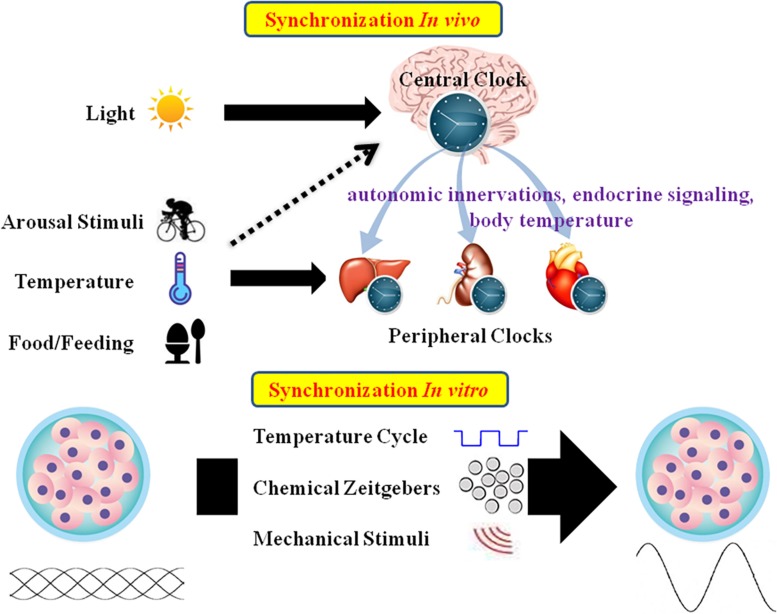
FIGURE 2
Schematic summary of in vivo and in vitro circadian synchronization. In vivo, the photic zeitgeber mainly entrains the central clock, which regulates the peripheral clocks through the internal timing cues including autonomic innervations, endocrine signaling and body temperature; the non-photic zeitgebers including arousal stimuli, temperature and food mainly entrain the peripheral clocks. In vitro, the circadian oscillations of cells or explants can be synchronized by temperature cycles, chemical factors (such as Dex, Fsk, or horse serum) and mechanical stimuli.

References

    1. Acosta-Galvan G., Yi C. X., van der Vliet J., Jhamandas J. H., Panula P., Angeles-Castellanos M., et al. (2011). Interaction between hypothalamic dorsomedial nucleus and the suprachiasmatic nucleus determines intensity of food anticipatory behavior. Proc. Natl. Acad. Sci. U.S.A. 108 5813–5818. 10.1073/pnas.1015551108 - DOI - PMC - PubMed
    1. Adamovich Y., Ladeuix B., Golik M., Koeners M. P., Asher G. (2017). Rhythmic oxygen levels reset circadian clocks through HIF1alpha. Cell Metab. 25 93–101. 10.1016/j.cmet.2016.09.014 - DOI - PubMed
    1. Akiyama M., Yuasa T., Hayasaka N., Horikawa K., Sakurai T., Shibata S. (2004). Reduced food anticipatory activity in genetically orexin (hypocretin) neuron-ablated mice. Eur. J. Neurosci. 20 3054–3062. 10.1111/j.1460-9568.2004.03749.x - DOI - PubMed
    1. Albrecht U. (2012). Timing to perfection: the biology of central and peripheral circadian clocks. Neuron 74 246–260. 10.1016/j.neuron.2012.04.006 - DOI - PubMed
    1. Albrecht U., Foster R. G. (2002). Placing ocular mutants into a functional context: a chronobiological approach. Methods 28 465–477. 10.1016/s1046-2023(02)00266-9 - DOI - PubMed

LinkOut - more resources