Review
. 2019 Jun 26;11(6):297-321.
doi: 10.4252/wjsc.v11.i6.297.

Physical energies to the rescue of damaged tissues

Affiliations
Review

Physical energies to the rescue of damaged tissues

Federica Facchin et al. World J Stem Cells. .

Abstract

Rhythmic oscillatory patterns sustain cellular dynamics, driving the concerted action of regulatory molecules, microtubules, and molecular motors. We describe cellular microtubules as oscillators capable of synchronization and swarming, generating mechanical and electric patterns that impact biomolecular recognition. We consider the biological relevance of seeing the inside of cells populated by a network of molecules that behave as bioelectronic circuits and chromophores. We discuss the novel perspectives disclosed by mechanobiology, bioelectromagnetism, and photobiomodulation, both in term of fundamental basic science and in light of the biomedical implication of using physical energies to govern (stem) cell fate. We focus on the feasibility of exploiting atomic force microscopy and hyperspectral imaging to detect signatures of nanomotions and electromagnetic radiation (light), respectively, generated by the stem cells across the specification of their multilineage repertoire. The chance is reported of using these signatures and the diffusive features of physical waves to direct specifically the differentiation program of stem cells in situ, where they already are resident in all the tissues of the human body. We discuss how this strategy may pave the way to a regenerative and precision medicine without the needs for (stem) cell or tissue transplantation. We describe a novel paradigm based upon boosting our inherent ability for self-healing.

Keywords: Damaged tissues; Electric fields; Electromagnetic fields; Electromagnetic radiation; Mechanical forces; Photobiomodulation; Physical energies; Stem cells.


Conflict of interest statement

Conflict-of-interest statement: No potential conflicts of interest.

Figures
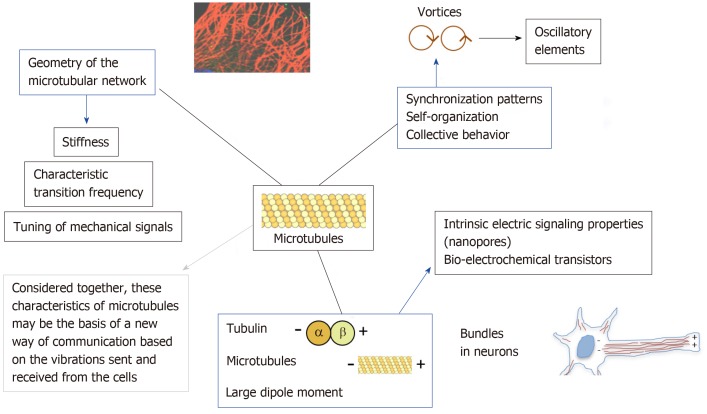
Figure 1
Figure 1
Cellular microtubules: A network of oscillators that sync and swarm. Microtubules are emerging as major players in crucial cellular activities, on the basis of a number of interrelated characteristics. These include: (A) The transfer of mechanical waves, changing their stiffness, and the transmission of longitudinal and lateral momentum on the basis of the frequency of their oscillation and the geometry afforded by their timely 3D assembly and disassembly within the cells; (B) The onset and propagation of electric fields and signaling, depending upon the large dipole moment of tubulin, developing both electrostatic polarity and functional directionality, and upon the lateral arrangement of tubulin dimers to create nanopores, interspersing the microtubular wall, and generating cation-selective oscillatory electrical currents; (C) The generation of bundles, as shown in brain microtubules, behaving as bio-electrochemical transistors forming nonlinear electrical transmission lines; (D) The ability to resonate mechanically in the presence of electromagnetic fields of defined frequencies, retaining memory states coupled with conductivity states, like a memory switch device; and (E) The property of synchronizing their oscillatory pattern and swarming into vortices, affecting the vibrational features of signaling peptides moving across the microtubular network by the aid of molecular motor machines, thus modulating biomolecular recognition patterning.
Figure 2
Figure 2
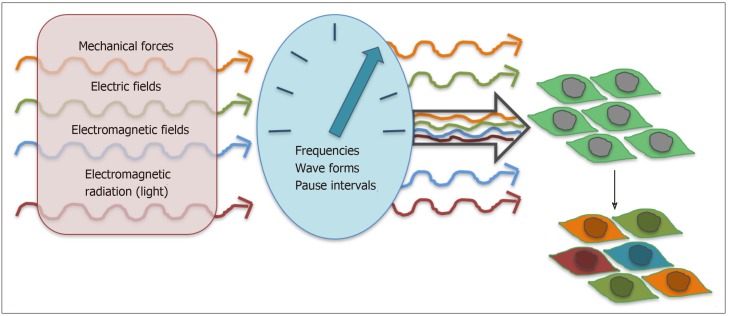
(Stem) cells as sensors and transducers of physical energies. A growing number of signaling molecules inside and outside the cell has been shown to behave as mechanosensors/transducers and chromophores (see details in the text). These players modulate complex dynamics controlling multifaceted responses, including proliferation, migration, and differentiation.
Figure 3
Figure 3
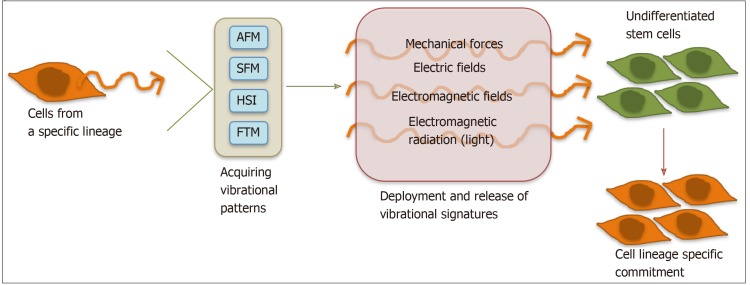
Harvesting and releasing vibrational signatures to afford commitment of undifferentiated stem cells towards targeted fates. Atomic force microscopy, terahertz field microscopy, scanning tunneling microscopy, and hyperspectral imaging can be used to harvest detailed oscillatory patterns, including mechanical, electric, and light waves. Computer analysis is then performed to acquire vibrational signatures from the investigated patterns. Ad hoc designed transducers are finally developed to provide high-fidelity and timely release of the acquired signatures onto undifferentiated (stem) cells to prime their lineage specific commitment. AFM: Atomic force microscopy; STM: Scanning tunneling microscopy; HIS: Hyperspectral imaging; TFM: Terahertz field microscopy.

References

    1. Segura-Valdez ML, Agredano-Moreno LT, Zamora-Cura AL, Lara-Martínez R, Jiménez-García LF. Visualization of internal in situ cell structure by atomic force microscopy. Histochem Cell Biol. 2018;150:521–527. - PubMed
    1. Cosgrove DJ. Nanoscale structure, mechanics and growth of epidermal cell walls. Curr Opin Plant Biol. 2018;46:77–86. - PubMed
    1. Amarouch MY, El Hilaly J, Mazouzi D. AFM and FluidFM Technologies: Recent Applications in Molecular and Cellular Biology. Scanning. 2018;2018:7801274. - PMC - PubMed
    1. Sharma S, LeClaire M, Gimzewski JK. Ascent of atomic force microscopy as a nanoanalytical tool for exosomes and other extracellular vesicles. Nanotechnology. 2018;29:132001. - PubMed
    1. Sahu S, Ghosh S, Fujita D, Bandyopadhyay A. Live visualizations of single isolated tubulin protein self-assembly via tunneling current: effect of electromagnetic pumping during spontaneous growth of microtubule. Sci Rep. 2014;4:7303. - PMC - PubMed