


doi: 10.1039/c9sc00561g.
eCollection 2019 Jun 7.
Tuning ligand field strength with pendent Lewis acids: access to high spin iron hydrides
Affiliations
- PMID: 31293738
- PMCID: PMC6553361
- DOI: 10.1039/c9sc00561g
Item in Clipboard
Tuning ligand field strength with pendent Lewis acids: access to high spin iron hydrides
Chem Sci.
.
Abstract
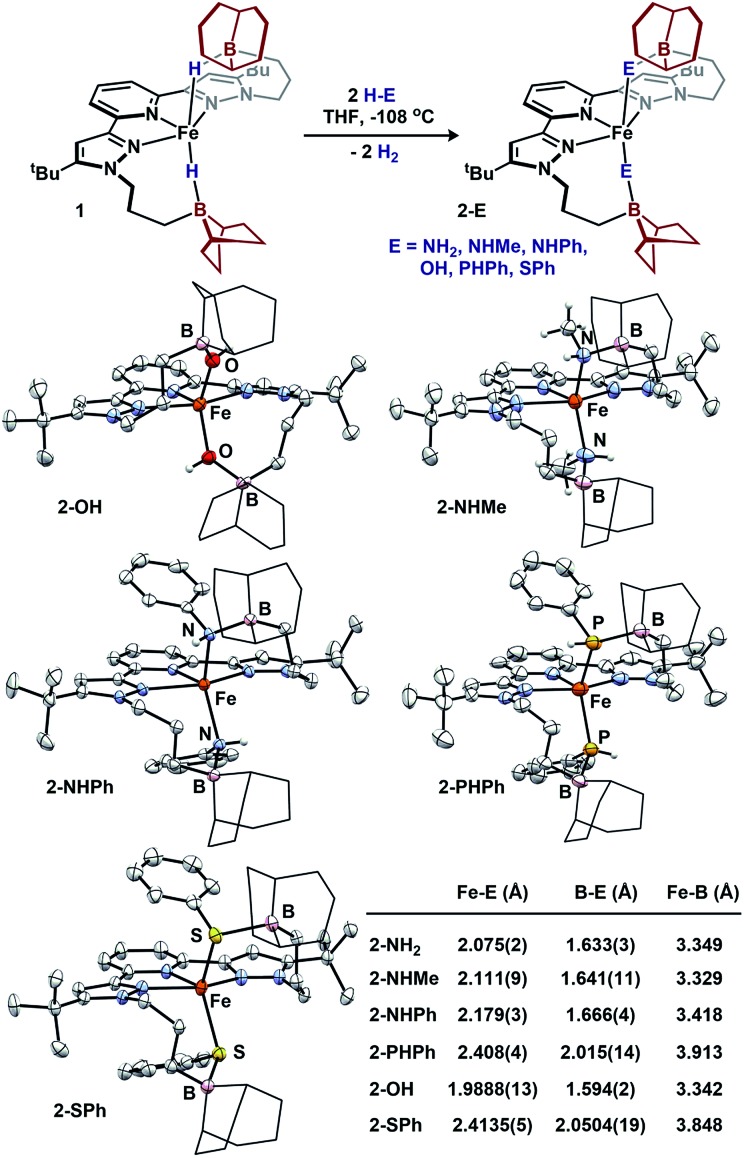
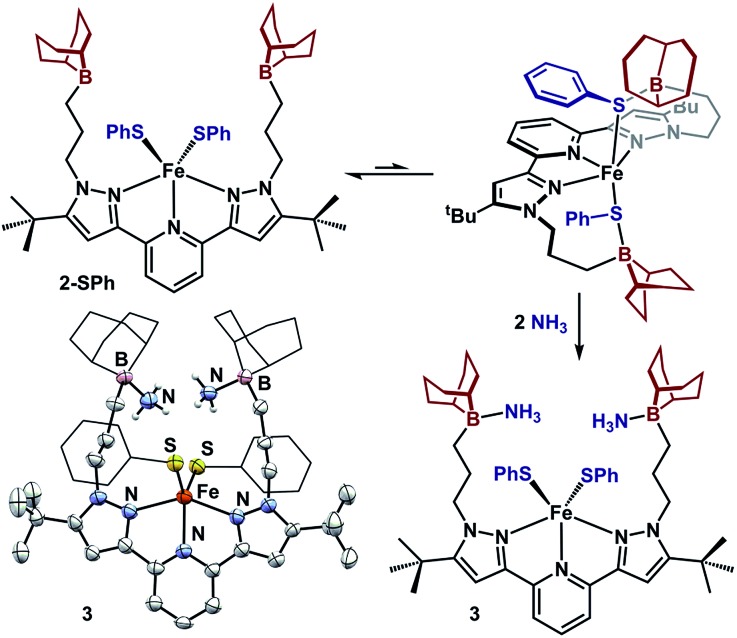
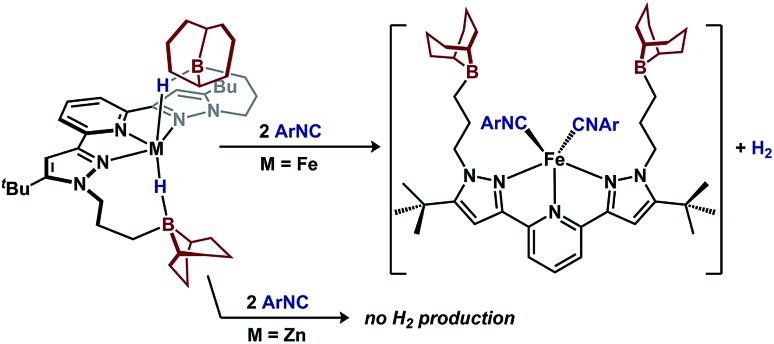
Geometrically flexible 9-borabicyclo[3.3.1]nonyl units within the secondary coordination sphere enable isolation of high-spin Fe(ii)-dihydrides stabilized by boron-hydride interactions and a rare example of an isolable S = 3/2 reduction product. The borane-capped Fe(ii)-dihydride: (1) rapidly deprotonates E-H (E = N, O, P, S) bonds to afford borane-stabilized Fe adducts and (2) releases H2 upon exposure to π-acids. The Lewis acids provide an avenue for redox-leveling in analogy to the near constant operating potential for N2 reduction in nitrogenase.
Figures


References
-
- Dai H., Guan H. Isr. J. Chem. 2017;57:1170–1203.
- Prokopchuk D. E., Chambers G. M., Walter E. D., Mock M. T., Bullock R. M. J. Am. Chem. Soc. 2019;141:1871–1876. - PubMed
-
- Igarashi R. Y., Laryukhin M., Dos Santos P. C., Lee H.-I., Dean D. R., Seefeldt L. C., Hoffman B. M. J. Am. Chem. Soc. 2005;127:6231–6241. - PubMed
-
- Jablonskytė A., Wright J. A., Fairhurst S. A., Peck J. N. T., Ibrahim S. K., Oganesyan V. S., Pickett C. J. J. Am. Chem. Soc. 2011;133:18606–18609. - PubMed
- Wang W., Nilges M. J., Rauchfuss T. B., Stein M. J. Am. Chem. Soc. 2013;135:3633–3639. - PubMed
- Kinney R. A., Saouma C. T., Peters J. C., Hoffman B. M. J. Am. Chem. Soc. 2012;134:12637–12647. - PMC - PubMed
- Smith J. M., Lachicotte R. J., Holland P. L. J. Am. Chem. Soc. 2003;125:15752–15753. - PubMed
- Rittle J., McCrory C. C. L., Peters J. C. J. Am. Chem. Soc. 2014;136:13853–13862. - PMC - PubMed
-
- Dahl E. W., Kiernicki J. J., Zeller M., Szymczak N. K. J. Am. Chem. Soc. 2018;140:10075–10079. - PMC - PubMed
- Dahl E. W., Dong H. T., Szymczak N. K. Chem. Commun. 2018;54:892–895. - PMC - PubMed
- Moore C. M., Szymczak N. K. Chem. Commun. 2015;51:5490–5492. - PubMed
- Tutusaus O., Ni C., Szymczak N. K. J. Am. Chem. Soc. 2013;135:3403–3406. - PubMed
- Dahl E. W., Szymczak N. K. Angew. Chem., Int. Ed. 2016;55:3101–3105. - PMC - PubMed
Grants and funding
LinkOut - more resources
Full Text Sources
Research Materials
Miscellaneous
