Editorial
doi: 10.21037/jtd.2019.01.66.
Minimal invasive extracorporeal circulation (MiECC): the state-of-the-art in perfusion
Affiliations
- PMID: 31293801
- PMCID: PMC6586580
- DOI: 10.21037/jtd.2019.01.66
Item in Clipboard
Editorial
Minimal invasive extracorporeal circulation (MiECC): the state-of-the-art in perfusion
J Thorac Dis.
2019 Jun.
No abstract available
Conflict of interest statement
Conflicts of Interest: The authors have no conflicts of interest to declare.
Figures
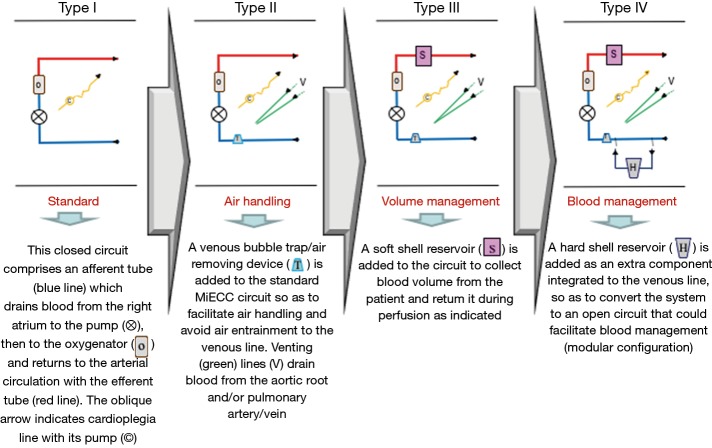
Established classification of MiECC circuits (3). X, pump; O, oxygenator; C, cardioplegia; T, bubble-trap/air removing device; V, vent (aortic/pulmonary); S, soft-bag/reservoir; H, hard-shell/reservoir; MiECC, minimal invasive extracorporeal circulation.
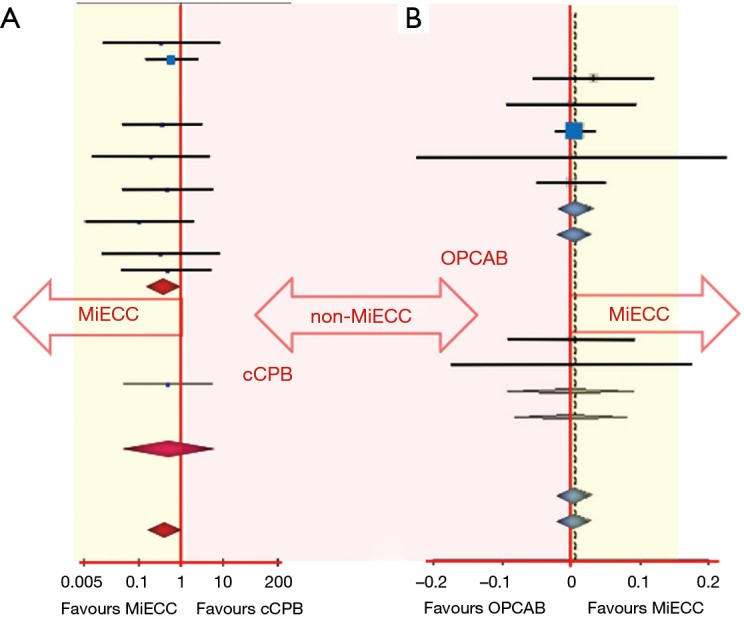
Schematic combined forest plots for mortality based to the largest meta-analyses [modified from (7,16)] comparing MiECC vs. cCPB (A) and MiECC vs. OPCAB (B). Results from RCTs consistently show survival benefit in favour of MiECC, that is significant in (A), while not reaching statistical significance in (B). It is obvious that the non-MiECC statistical section (red zone) has no RCT, while all studies in both meta-analyses lie within the MiECC sections (yellow zones). MiECC, minimal invasive extracorporeal circulation; cCPB, conventional cardiopulmonary bypass; OPCAB, off-pump coronary artery bypass grafting; RCT, randomized controlled trial.
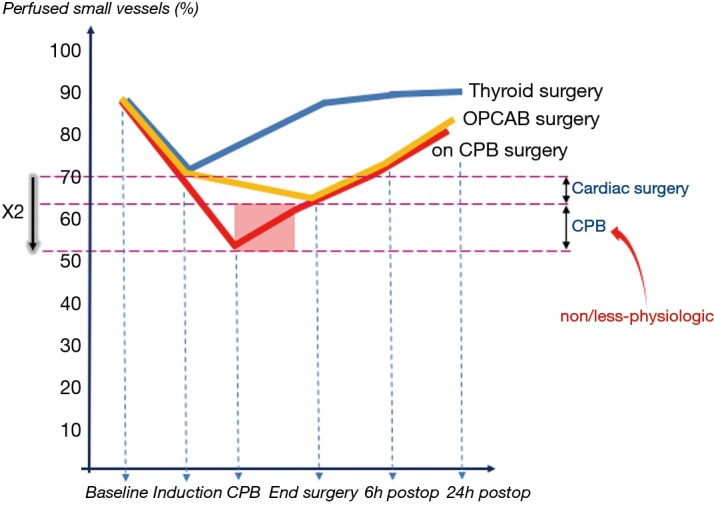
Schematic effect of cardiac surgery on microcirculation [modified from (20)]. Evolution of the proportion of perfused small vessels in patients undergoing non-cardiac (thyroid) surgery (blue line), cardiac surgery under cardiopulmonary bypass (CPB; red line) and without CPB (OPCAB; yellow line). There is a common trend towards impaired microcirculation during induction of anaesthesia in all groups. Cardiac surgery further impairs microcirculation, which is more pronounced (doubled) in the CPB group (red box) rendering any procedure as non/less physiologic. This effect persists for almost 24 h after surgery. MiECC significantly reduces this effect and renders on-pump cardiac surgery a “more physiologic” procedure (simulating off-pump surgery). CPB, cardiopulmonary bypass; MiECC, minimal invasive extracorporeal circulation; OPCAB, off-pump coronary artery bypass grafting.
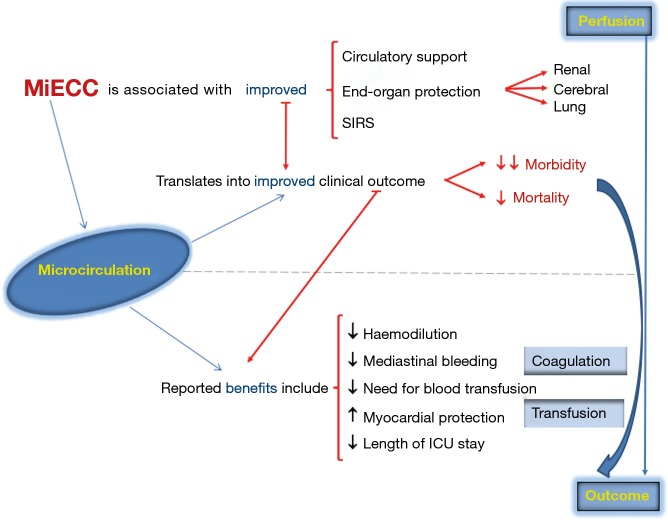
Schematic representation of the pathophysiologic pathway that leads from preserved microcirculation to improved clinical outcome with MiECC use. MiECC, minimal invasive extracorporeal circulation; ICU, intensive care unit; SIRS, systemic inflammatory response syndrome.
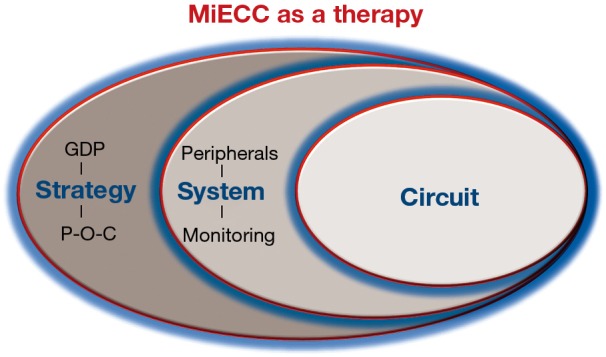
MiECC as a therapy: diagram of the pathway for advancing MiECC from a CPB circuit to initially system that includes peripherals and real-time in-line monitoring, and ultimately to strategy, which incorporates goal-directed perfusion (GDP) and point-of-care (POC) heparin/protamine and coagulation management that involve all disciplines of the cardiac surgical team. MiECC, minimal invasive extracorporeal circulation; CPB, cardiopulmonary bypass.
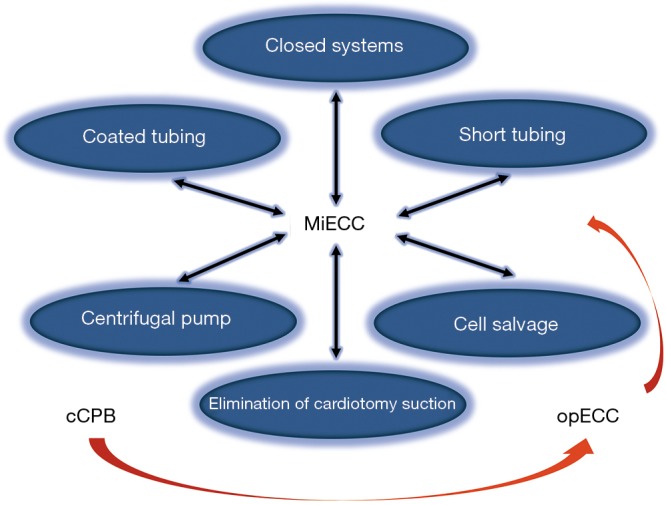
MiECC integrates all advances in CPB technology in one circuit (the major 6 of them are shown in the scheme), while “optimized” circuits (opECC) are custom-made and use some of the components from the illustrated technological milieu so as to improve perfusion from conventional CPB (cCPB). MiECC, minimal invasive extracorporeal circulation; CPB, cardiopulmonary bypass.
References
-
- Brian BF. The engineering of cardiopulmonary bypass. In: Mongero LB, Beck JR. editors. On bypass: Advanced perfusion techniques. New Jersey: Humana Press Inc, 2008:1-28.
-
- Anastasiadis K, Murkin J, Antonitsis P, et al. Use of minimal invasive extracorporeal circulation in cardiac surgery: principles, definitions and potential benefits. A position paper from the Minimal invasive Extra-Corporeal Technologies international Society (MiECTiS). Interact Cardiovasc Thorac Surg 2016;22:647-62. 10.1093/icvts/ivv380 - DOI - PMC - PubMed
Publication types
LinkOut - more resources
Full Text Sources
Medical