Parotid Gland Tumors: 2-Year Prospective Clinicopathological Study
- PMID: 31293936
- PMCID: PMC6585209
- DOI: 10.4103/ams.ams_179_18
Parotid Gland Tumors: 2-Year Prospective Clinicopathological Study
Abstract
Context: Parotid gland tumors account for 80% of all salivary gland neoplasms. Most parotid masses are operated on before obtaining the final histological diagnosis, which complicates the management of the facial nerve damage during parotid surgery.
Aims: The aim of this study is to analyze the age- and gender-wise incidence of parotid gland tumors, the incidence of various types of tumors, to assess their clinical modes of presentation, the efficacy of treatment, and to evaluate the complications ensuing therein, because of intervention.
Settings and design: The present study was conducted in the Department of Oral and Maxillofacial Surgery, A. B. Shetty Memorial Institute of Dental Sciences and Justice K. S. Hegde Charitable Hospital, Nitte University, Mangalore.
Subjects and methods: A clinicopathological study of parotid gland tumors was undertaken in a tertiary care hospital. Patients with parotid swelling were clinically evaluated, followed by fine-needle aspiration cytology (FNAC). Surgery was planned and performed based on the tumor location and FNAC report. Patients were followed up for postoperative complications.
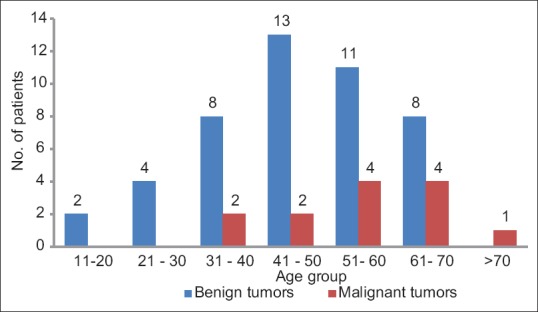
Results: The study comprised 59 patients with parotid gland tumors. The age range of the patient affected was between 18 and 75 years. Benign tumors are more common than malignant tumor in the ratio of 3.5:1. Slow progressively parotid swelling was the common presenting complaint. Superficial parotidectomy was the most common surgery (69.49%) performed. The most common postoperative complication encountered was transient facial palsy (22.03%). Benign tumors were more common (77.97%). The most common benign tumor was pleomorphic adenoma, and malignant tumor was mucoepidermoid carcinoma.
Conclusions: The incidence of parotid salivary gland tumors is increasing in recent years. Parotidectomy is safe procedure for treating parotid tumors. Transient facial palsy is the most common postoperative complication, which is reduced in superficial parotidectomy.
Keywords: Facial nerve palsy; histopathology; parotid gland tumors; parotidectomy.
Conflict of interest statement
There are no conflicts of interest.
Figures
References
-
- Parkin DM, Whelan SL, Ferlay J. IARC Scientific Publication No. 143. Vol. 7. Lyon: International Agency for Research on Cancer; 1997. Cancer Incidence in Five Continents.
-
- Ellis Gray L, Auclair Paul L, Gnepp Douglas R. 2nd ed. Vol. 25. Philadelphia: W. B. Saunders; 1991. Surgical Pathology of the Salivary Glands; pp. 61–91.
-
- Witt RL. The significance of the margin in parotid surgery for pleomorphic adenoma. Laryngoscope. 2002;112:2141–54. - PubMed
-
- Smith WP, Langdon JD. Disorders of the salivary glands. In: Russell RG, Williams NS, Bulstrode CJ, editors. Bailey and Love's Short Practice of Surgery. 24th ed. Ch. 51. London: Arnold; 2004. pp. 718–38.
-
- Eveson JW, Cawson RA. Salivary gland tumours. A review of 2410 cases with particular reference to histological types, site, age and sex distribution. J Pathol. 1985;146:51–8. - PubMed