Review
. 2019 May 23;3(3):331-339.
doi: 10.1002/rth2.12217. eCollection 2019 Jul.

The contact pathway and sepsis

Affiliations
Review

The contact pathway and sepsis

Vikram Raghunathan et al. Res Pract Thromb Haemost. .

Abstract

The contact pathway factors XI (FXI) and XII (FXII) have been demonstrated to be largely dispensable for hemostasis, as their absence results in a mild to absent bleeding diathesis. A growing body of literature, however, suggests that the contact pathway contributes to the pathologic host response to certain infectious organisms that produces the often-fatal syndrome known as sepsis. The contact pathway factors serve as a central node connecting inflammation to coagulation, and may offer a potentially safe therapeutic target to mitigate the morbidity and mortality associated with sepsis. Herein, we summarize published in vivo and in vitro data that have explored the roles of the contact pathway in sepsis, and discuss potential clinical applications of novel FXI- and FXII-inhibiting drugs currently under investigation.

Keywords: contact activation; factor XI; factor XII; kallikrein‐kinin system; sepsis.


Figures
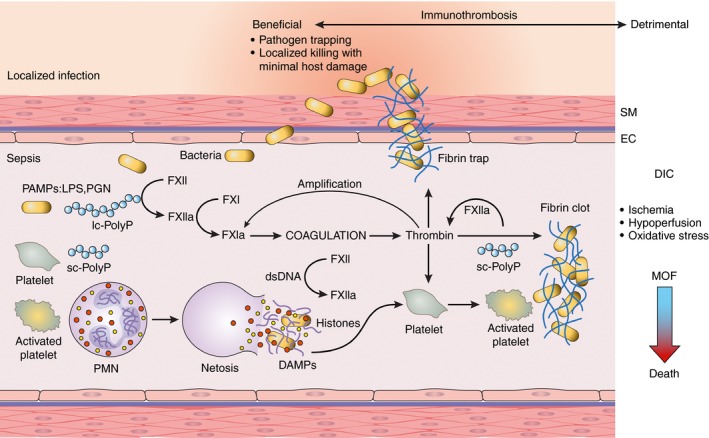
Figure 1
Figure 1
Bacteria‐induced contact activation leading to immunothrombosis and DIC. The coagulation factor XII (FXII) is activated by live bacteria and bacterial wall–derived pathogen‐associated molecular patterns (PAMPS), such as lipopolysaccharides (LPS) for gram‐negative or peptidoglycan (PGN) for gram‐positive bacteria or bacteria‐produced long‐chain polyphosphates (lc‐PolyP). Activation of FXII leads to thrombin generation, platelet activation, and fibrin formation, which in concert trap and contain pathogens. Activated platelets promote neutrophils to release their nuclear contents to form extracellular traps (netosis) as part of the routes of pathogen clearance; NETs are also potent platelet activators and cytotoxic to the host cells. Histones and double‐stranded DNA (dsDNA) act as damage‐associated pattern molecules (DAMPs) that together with platelet‐derived short‐chain polyphosphates (sc‐polyPs) contribute to contact activation via direct and indirect mechanisms. Failing the redundant pathways of pathogen clearance offered by the immune and coagulation systems, immunothrombosis can result in widespread microvascular thrombosis termed disseminated intravascular coagulation (DIC) followed by consumptive coagulopathy and bleeding. Thrombosis within the microvasculature of vital organs leads to ischemia, hypoperfusion, and oxidative stress, thus impairing organ function and leading to multiple organ failure (MOF). When more than two organs fail, death is the most likely outcome

References

    1. Fleischmann C, Scherag A, Adhikari NK, Hartog CS, Tsaganos T, Schlattmann P, et al. Assessment of global incidence and mortality of hospital‐treated sepsis. Current estimates and limitations. Am J Respir Crit Care Med. 2016;193:259–72. - PubMed
    1. Singer M, Deutschman CS, Seymour CW, Shankar‐Hari M, Annane D, Bauer M, et al. The third international consensus definitions for sepsis and septic shock (Sepsis‐3). JAMA. 2016;315:801–10. - PMC - PubMed
    1. Li X, Ma X. The role of heparin in sepsis: much more than just an anticoagulant. Br J Haematol. 2017;179:389–98. - PubMed
    1. Levi M, van der Poll T. Recombinant human activated protein C: current insights into its mechanism of action. Crit Care. 2007;11(suppl 5):S3. - PMC - PubMed
    1. Bernard GR, Vincent J‐L, Laterre P‐F, LaRosa SP, Dhainaut J‐F, Lopez‐Rodriguez A, et al. Efficacy and safety of recombinant human activated protein C for severe sepsis. N Engl J Med. 2001;344:699–709. - PubMed
