


Timing of surgery and adjuvant radiation therapy for sinonasal malignancies: Effect of surgical approach
- PMID: 31294897
- PMCID: PMC6742559
- DOI: 10.1002/hed.25873
Timing of surgery and adjuvant radiation therapy for sinonasal malignancies: Effect of surgical approach
Abstract
Background: Timely postoperative radiation therapy (RT) within 50 days of surgery for head and neck cancers provides a survival advantage.
Methods: Using the National Cancer Database, we performed a propensity score-matched analysis comparing patients undergoing open or endoscopic surgery for squamous cell carcinoma (SCC) of the nasal cavity and paranasal sinuses from 2010 to 2015.
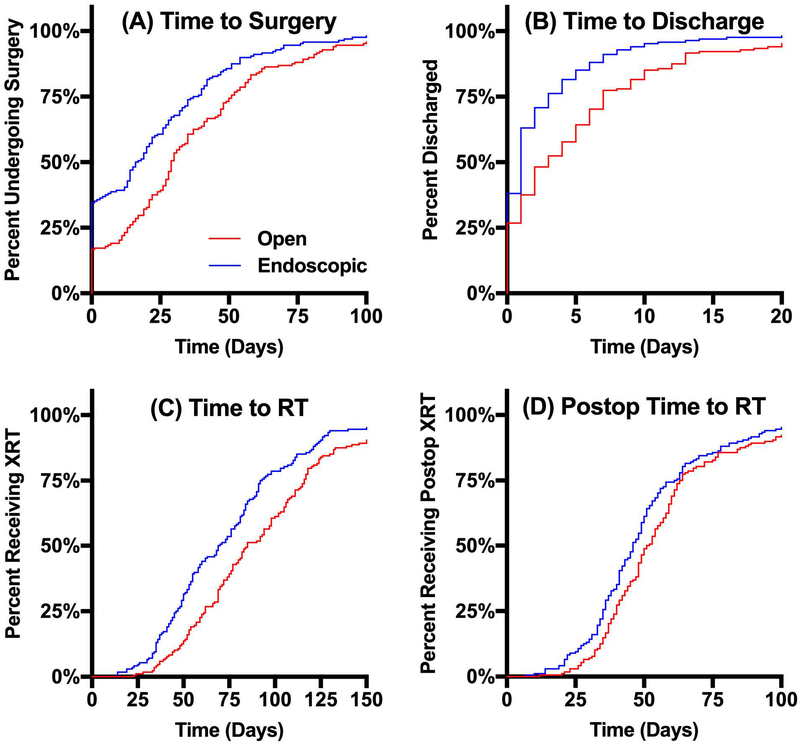
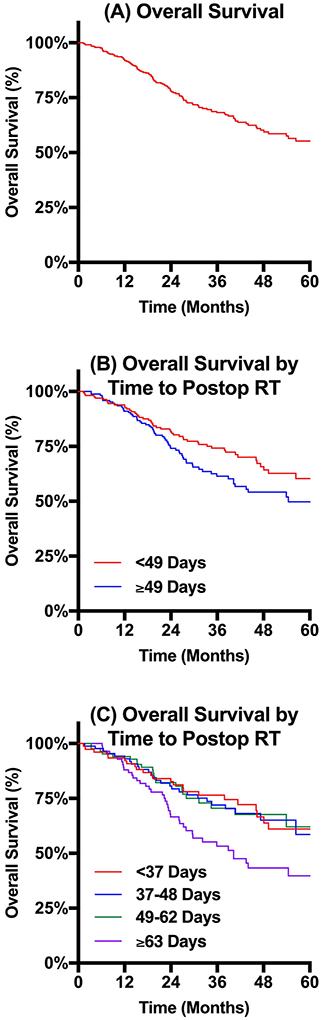
Results: Among 168 pairs, patients undergoing endoscopic surgery had shorter time to surgery (24.2 vs 36.7 days, P < .001) and shorter postoperative time to RT (PTTR, 51.2 vs 58.4 days, P = .02). On multivariable linear regression, endoscopic surgery predicted shorter PTTR (β = -7.6, P = .01). Using the Kaplan-Meier method, patients in the longest PTTR quartile had decreased overall survival (OS; Q1 vs Q4, 3-year OS 76.5% vs 53.3%, P = .007), a durable finding when adjusted for covariates (Q1 vs Q4, HR 0.50, P = .008).
Conclusions: Patients undergoing endoscopic surgery for sinonasal SCC experience shorter PTTR. Shorter PTTR is associated with extended OS.
Keywords: National Cancer Database; overall survival; postoperative time to radiation therapy; sinonasal squamous cell carcinoma; time to surgery.
© 2019 Wiley Periodicals, Inc.
Conflict of interest statement
Figures
References
-
- Osguthorpe JD, Richardson M. Frontal sinus malignancies. Otolaryngol Clin North Am. 2001;34(1):269–281. - PubMed
-
- Kilic S, Shukla PA, Marchiano EJ, et al. Malignant Primary Neoplasms of the Nasal Cavity and Paranasal Sinus. Curr Otorhinolaryngol Rep. 2016;4(4):249–258.
-
- Kilic S, Kilic SS, Baredes S, Liu JK, Eloy JA. Survival, Morbidity, and Quality-of-Life Outcomes for Sinonasal and Ventral Skull Base Malignancies. Otolaryngol Clin North Am. 2017;50(2):467–480. - PubMed
-
- Lee CH, Hur DG, Roh H-J, et al. Survival rates of sinonasal squamous cell carcinoma with the new AJCC staging system. Arch Otolaryngol Head Neck Surg. 2007;133(2):131–134. - PubMed
-
- Ansa B, Goodman M, Ward K, et al. Paranasal sinus squamous cell carcinoma incidence and survival based on Surveillance, Epidemiology, and End Results data, 1973 to 2009. Cancer. 2013;119(14):2602–2610. - PubMed
Publication types
MeSH terms
Grants and funding
LinkOut - more resources
Full Text Sources
Other Literature Sources
Medical
Research Materials
