


Ibrutinib Plus Venetoclax in Relapsed/Refractory Chronic Lymphocytic Leukemia: The CLARITY Study
- PMID: 31295041
- PMCID: PMC6879312
- DOI: 10.1200/JCO.19.00894
Ibrutinib Plus Venetoclax in Relapsed/Refractory Chronic Lymphocytic Leukemia: The CLARITY Study
Erratum in
-
Errata.J Clin Oncol. 2020 May 10;38(14):1644. doi: 10.1200/JCO.20.00411. J Clin Oncol. 2020. PMID: 32375017 Free PMC article. No abstract available.
Abstract
Purpose: The treatment of chronic lymphocytic leukemia (CLL) has been revolutionized by targeted therapies that either inhibit proliferation (ibrutinib) or reactivate apoptosis (venetoclax). Both significantly improve survival in CLL and replace chemoimmunotherapy for many patients. However, individually, they rarely lead to eradication of measurable residual disease (MRD) and usually are taken indefinitely or until progression. We present the CLARITY trial that combined ibrutinib with venetoclax to eradicate detectable CLL with the intention of stopping therapy.
Patients and methods: CLARITY is a phase II trial that combined ibrutinib with venetoclax in patients with relapsed or refractory CLL. The primary end point was eradication of MRD after 12 months of combined therapy. Key secondary end points were response by International Workshop on CLL criteria, safety, and progression-free and overall survival.
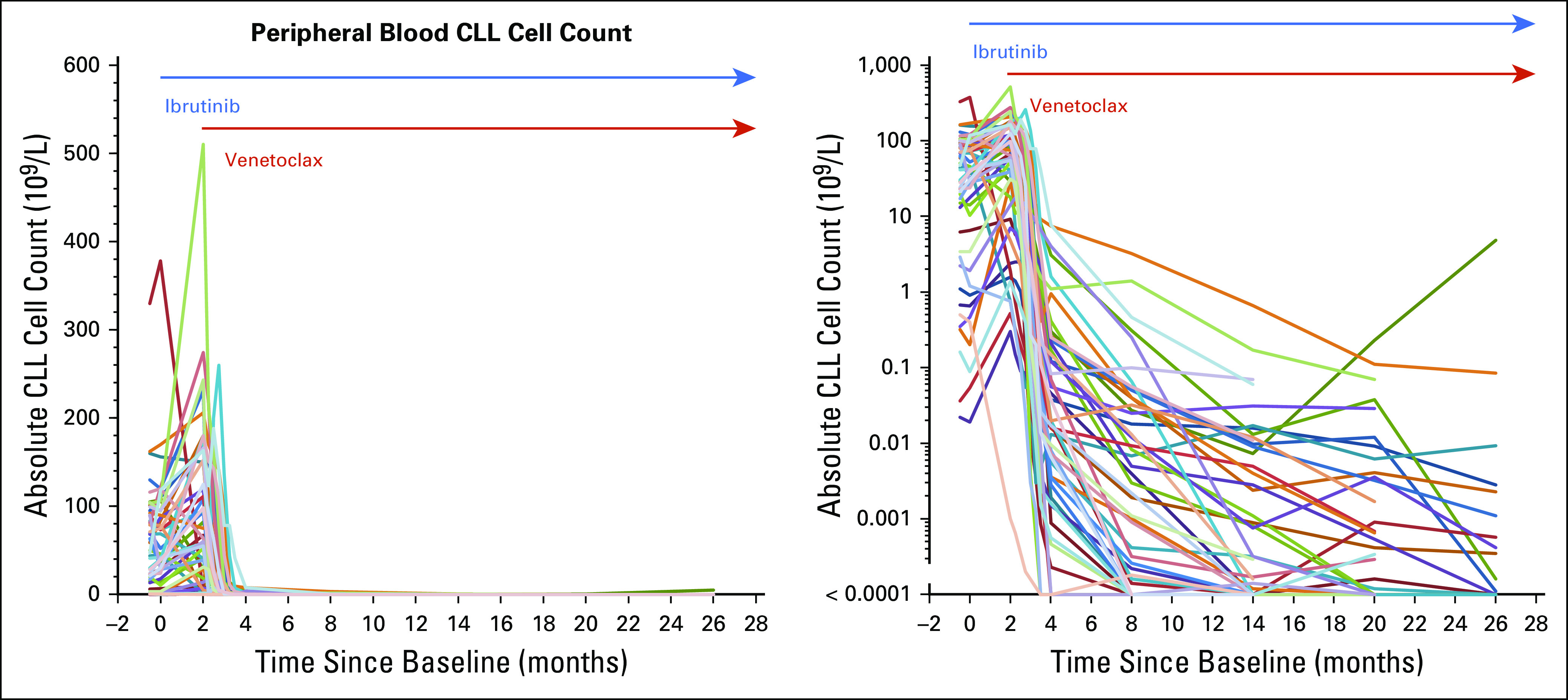
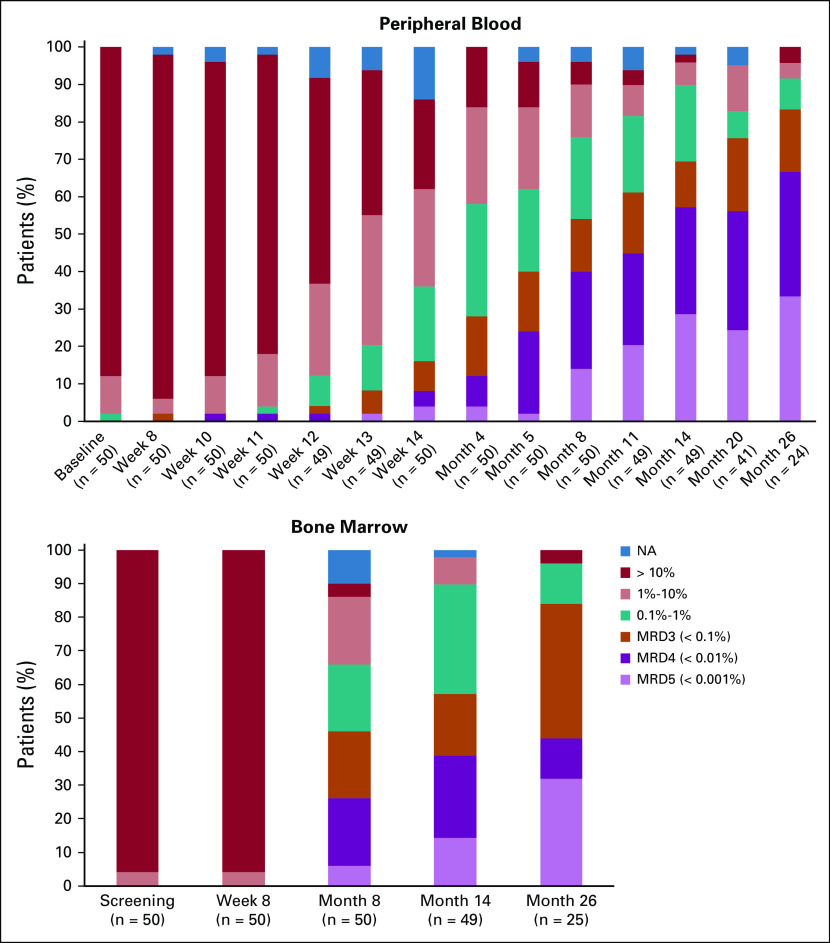
Results: In 53 patients after 12 months of ibrutinib plus venetoclax, MRD negativity (fewer than one CLL cell in 10,000 leukocytes) was achieved in the blood of 28 (53%) and the marrow of 19 (36%). Forty-seven patients (89%) responded, and 27 (51%) achieved a complete remission. After a median follow-up of 21.1 months, one patient progressed, and all patients were alive. A single case of biochemical tumor lysis syndrome was observed. Other adverse effects were mild and/or manageable and most commonly were neutropenia or GI events.
Conclusion: The combination of ibrutinib plus venetoclax was well tolerated in patients with relapsed or refractory CLL. There was a high rate of MRD eradication that led to the cessation of therapy in some patients. The progression-free and overall survival rates are encouraging for relapsed and refractory CLL.
Figures
Comment in
-
Can Combination Targeted Therapy Bring About Another Paradigm Shift in Chronic Lymphocytic Leukemia?J Clin Oncol. 2019 Oct 20;37(30):2711-2713. doi: 10.1200/JCO.19.01718. Epub 2019 Aug 28. J Clin Oncol. 2019. PMID: 31461378 No abstract available.
References
-
- Haematological Malignancy Research Network: Incidence, 2018. https://www.hmrn.org/statistics/incidence.
-
- Shanafelt TD, Byrd JC, Call TG, et al. Narrative review: Initial management of newly diagnosed, early-stage chronic lymphocytic leukemia. Ann Intern Med. 2006;145:435–447. - PubMed
-
- Eichhorst B, Fink A-M, Bahlo J, et al. First-line chemoimmunotherapy with bendamustine and rituximab versus fludarabine, cyclophosphamide, and rituximab in patients with advanced chronic lymphocytic leukaemia (CLL10): An international, open-label, randomised, phase 3, non-inferiority trial. Lancet Oncol. 2016;17:928–942. - PubMed
-
- Goede V, Fischer K, Busch R, et al. Obinutuzumab plus chlorambucil in patients with CLL and coexisting conditions. N Engl J Med. 2014;370:1101–1110. - PubMed
Publication types
MeSH terms
Substances
Associated data
Grants and funding
LinkOut - more resources
Full Text Sources
Other Literature Sources
