Review
. 2019 Jul 10;20(14):3394.
doi: 10.3390/ijms20143394.

Th17 Cells and the IL-23/IL-17 Axis in the Pathogenesis of Periodontitis and Immune-Mediated Inflammatory Diseases

Affiliations
Review

Th17 Cells and the IL-23/IL-17 Axis in the Pathogenesis of Periodontitis and Immune-Mediated Inflammatory Diseases

Kübra Bunte et al. Int J Mol Sci. .

Abstract

Innate immunity represents the semi-specific first line of defense and provides the initial host response to tissue injury, trauma, and pathogens. Innate immunity activates the adaptive immunity, and both act highly regulated together to establish and maintain tissue homeostasis. Any dysregulation of this interaction can result in chronic inflammation and autoimmunity and is thought to be a major underlying cause in the initiation and progression of highly prevalent immune-mediated inflammatory diseases (IMIDs) such as psoriasis, rheumatoid arthritis, inflammatory bowel diseases among others, and periodontitis. Th1 and Th2 cells of the adaptive immune system are the major players in the pathogenesis of IMIDs. In addition, Th17 cells, their key cytokine IL-17, and IL-23 seem to play pivotal roles. This review aims to provide an overview of the current knowledge about the differentiation of Th17 cells and the role of the IL-17/IL-23 axis in the pathogenesis of IMIDs. Moreover, it aims to review the association of these IMIDs with periodontitis and briefly discusses the therapeutic potential of agents that modulate the IL-17/IL-23 axis.

Keywords: Crohn’s disease; Sjögren syndrome; Th17 cells; cytokines; interleukin-17; interleukin-23; periodontitis; psoriasis; rheumatoid arthritis; systemic lupus erythematosus; type 1 diabetes mellitus; ulcerative colitis.


Conflict of interest statement

The authors declare no conflict of interest.

Figures
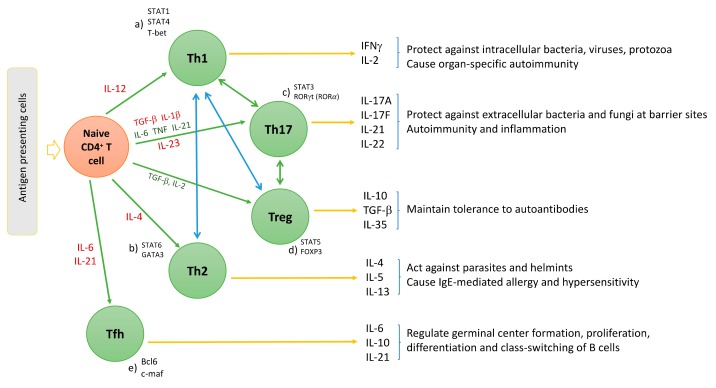
Figure 1
Figure 1
Differentiation of naïve CD4+ cells into Th1, Th2, Th17, regulatory T cells (Treg), and follicular helper T (Tfh) cells. IL-12 leads to Th1-, IL-4 leads to Th2-, TGFβ leads to Treg-differentiation. Th17 cells differentiation is initiated by IL-1β, TGFβ, and further stimulated by TNF, IL-6, and IL-21; Th17 cells are maintained and expanded by IL-23. The transcription factors that governs Th cell subset differentiation are different, (a) STAT1, STAT4, and T-bet drive Th1; (b) STAT6 and GATA3 drive Th2; (c) STAT3 and RORγt (RORα, in the absence of RORγt) manage Th17 cell; (d) FOXP3 and STAT5 govern Treg cell differentiation; and (e) Bcl6 and c-maf are the regulators of Tfh cells differentiation.
Figure 2
Figure 2
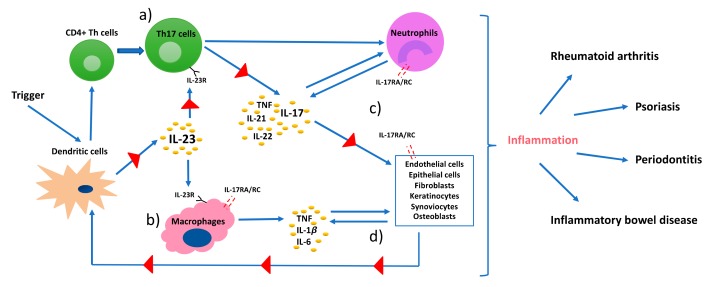
A pathophysiology model of immune-mediated inflammatory diseases. Dendritic cells (DCs) are triggered by a stimulus, such as environmental stress or infection, present the antigen that leads to differentiation of CD4+ helper T cells, and release IL-23. IL-23 stimulates the production of proinflammatory cytokines, such as TNF, IL-1β, and IL-17 from (a) Th17 cells, and IL-6 from (b) macrophages and DCs. (c) IL-17 interacts with IL-17RA/RC complex on receptor carrying cells. These cells further produce inflammatory mediators that regulate functionality of DCs and create a self-sustaining feedback loop via IL-23 (d).
Figure 3
Figure 3
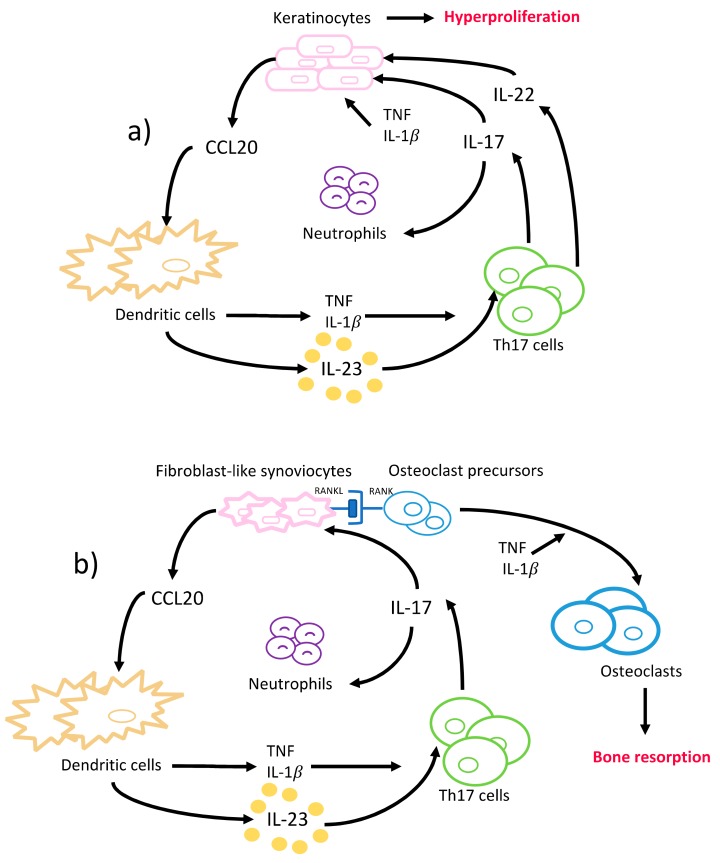
A simplified model of Th17 cells and the cytokines involved in the pathogenesis of (a) psoriasis and (b) rheumatoid arthritis. This figure can also be interpreted as a model of pathogenesis of gingival, periodontal, and oral mucosal inflammatory diseases, where cells such as gingival fibroblasts, keratinocytes, and epithelial cells are involved.
Figure 4
Figure 4
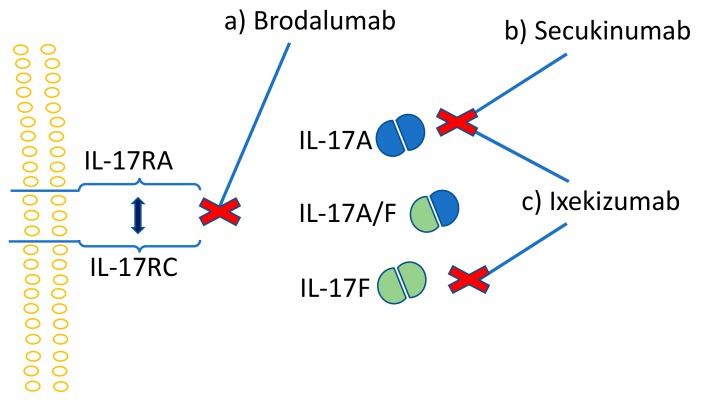
IL-17 cytokine inhibitors; (a) brodalumab, with affinity to IL-17RA/RC receptor complex, (b) secukinumab, with affinity to IL-17A, and (c) ixekizumab, with affinity to both IL-17A and IL-17F, interrupt the intracellular signaling by inhibiting the interaction between IL-17 and its receptor.

References

    1. Riera Romo M., Perez-Martinez D., Castillo Ferrer C. Innate immunity in vertebrates: An overview. Immunology. 2016;148:125–139. doi: 10.1111/imm.12597. - DOI - PMC - PubMed
    1. Rubartelli A., Lotze M.T. Inside, outside, upside down: Damage-associated molecular-pattern molecules (DAMPs) and redox. Trends Immunol. 2007;28:429–436. doi: 10.1016/j.it.2007.08.004. - DOI - PubMed
    1. Janeway C.A., Jr. How the immune system works to protect the host from infection: A personal view. Proc. Natl. Acad. Sci. USA. 2001;98:7461–7468. doi: 10.1073/pnas.131202998. - DOI - PMC - PubMed
    1. Nicholson L.B. The immune system. Essays Biochem. 2016;60:275–301. doi: 10.1042/EBC20160017. - DOI - PMC - PubMed
    1. Feghali C.A., Wright T.M. Cytokines in acute and chronic inflammation. Front. Biosci. 1997;2:d12–d26. - PubMed

MeSH terms

LinkOut - more resources