Usefulness of Oblique Lateral Interbody Fusion at L5-S1 Level Compared to Transforaminal Lumbar Interbody Fusion
- PMID: 31295977
- PMCID: PMC7671784
- DOI: 10.3340/jkns.2018.0215
Usefulness of Oblique Lateral Interbody Fusion at L5-S1 Level Compared to Transforaminal Lumbar Interbody Fusion
Abstract
Objective: The use of oblique lateral interbody fusion at the L5-S1 level (OLIF51) is increasing, but no study has directly compared OLIF51 and transforaminal lumbar interbody fusion (TLIF) at the L5-S1 level. We evaluated the usefulness of OLIF51 by comparing clinical and radiologic outcomes with those of TLIF at the same L5-S1 level.
Methods: We retrospectively reviewed and compared 74 patients who underwent OLIF51 (OLIF51 group) and 74 who underwent TLIF at the L5-S1 level (TLIF51 group). Clinical outcomes were assessed with the visual analogue scale for back pain and leg pain and the Oswestry Disability Index. Mean disc height (MDH), foraminal height (FH), disc angle (DA), fusion rate, and subsidence rate were measured for radiologic outcomes.
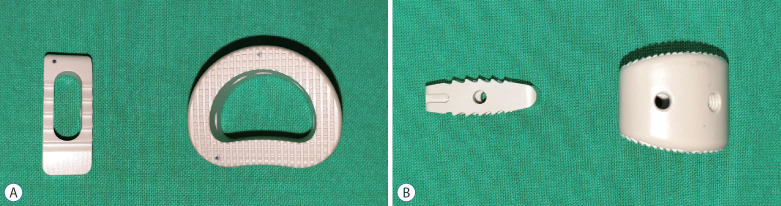
Results: The OLIF51 group used significantly higher, wider, and larger-angled cages than the TLIF51 group (p<0.001). The postoperative MDH and FH were significantly greater in the OLIF51 group than in the TLIF51 group (p<0.001). The postoperative DA was significantly larger in the OLIF51 group than in the TLIF51 group by more than 10º (p<0.001). The fusion rate was 81.1% and 87.8% at postoperative 6 months in the OLIF51 and TLIF51 groups, respectively, and the TLIF51 group showed a higher fusion rate (p<0.05). The subsidence rate was 16.2% and 25.3% in the OLIF51 and TLIF51 groups, respectively, and the OLIF51 group showed a lower subsidence rate (p<0.05).
Conclusion: OLIF51 was more effective for the indirect decompression of foraminal stenosis, providing strong mechanical support with a larger cage, and making a greater lordotic angle with a high-angle cage than with TLIF.
Keywords: Lumbar vertebrae, Instrumentation; Minimally invasive surgical procedures.; Spinal fusion.
Conflict of interest statement
No potential conflict of interest relevant to this article was reported.
Figures
References
-
- Bridwell KH, Lenke LG, McEnery KW, Baldus C, Blanke K. Anterior fresh frozen structural allografts in the thoracic and lumbar spine. Do they work if combined with posterior fusion and instrumentation in adult patients with kyphosis or anterior column defects? Spine (Phila Pa 1976) 1995;20:1410–1418. - PubMed
-
- Busche-McGregor M, Naiman J, Grice A. Analysis of lumbar lordosis in an asymptomatic population of young adults. J Can Chiropr Assoc. 1981;25:58–64.
-
- Chung NS, Jeon CH, Lee HD. Use of an alternative surgical corridor in oblique lateral interbody fusion at the L5-S1 segment: a technical report. Clin Spine Surg. 2018;31:293–296. - PubMed
-
- Cutler AR, Siddiqui S, Mohan AL, Hillard VH, Cerabona F, Das K. Comparison of polyetheretherketone cages with femoral cortical bone allograft as a single-piece interbody spacer in transforaminal lumbar interbody fusion. J Neurosurg Spine. 2006;5:534–539. - PubMed
-
- Davis TT, Hynes RA, Fung DA, Spann SW, MacMillan M, Kwon B, et al. Retroperitoneal oblique corridor to the L2-S1 intervertebral discs in the lateral position: an anatomic study. J Neurosurg Spine. 2014;21:785–793. - PubMed
LinkOut - more resources
Full Text Sources
Miscellaneous