


Growth of extremely low birth weight infants at a tertiary hospital in a middle-income country
- PMID: 31296173
- PMCID: PMC6621939
- DOI: 10.1186/s12887-019-1568-6
Growth of extremely low birth weight infants at a tertiary hospital in a middle-income country
Abstract
Background: Survival of extremely low birth weight (ELBW; birth weight less than 1000 g) infants has improved significantly since the 1990s. Consequently, growth monitoring in ELBW infants has gained more relevance.
Methods: We conducted this study to describe the growth of ELBW infants at a tertiary hospital, to audit macronutrient intake and explore the association of prematurity complications with growth. This was a retrospective study on 92 ELBW infants born at Charlotte Maxeke Johannesburg Academic Hospital. The association between good growth (regaining birth weight in 21 days or less and subsequent growth velocity > 15 g/kg/day) and complications of prematurity was explored.
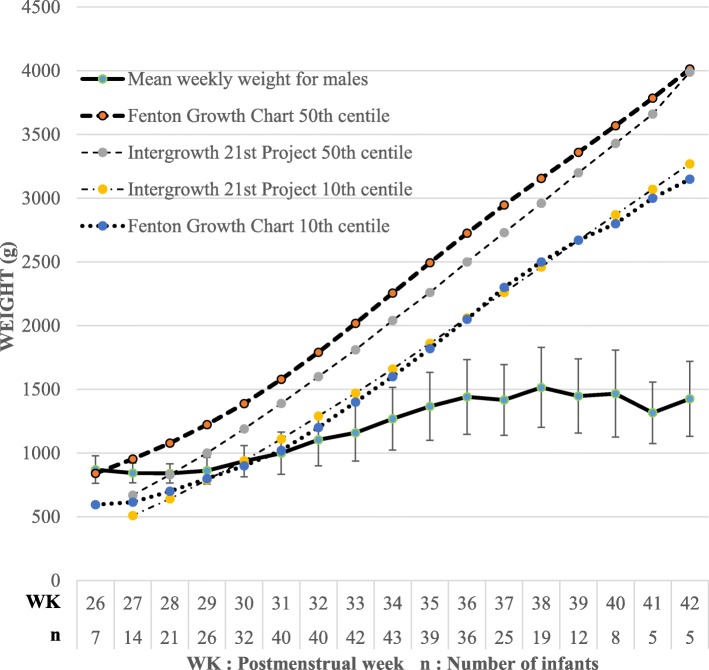
Results: Only 11infants (13%) had a discharge weight above the 10th centile when the Fenton growth chart was used compared to 20 infants (22.4%) when the Intergrowth 21st Project growth standard was used. The mean weight velocity was 13.5 g/kg/day and the mean number of days to regain birth weight was 18.2 days. Factors associated with poor growth were late-onset sepsis, persistent patent ductus arteriosus, continuous positive airway pressure for more than 2 days, invasive ventilation, oxygen on day 28 and being kept nil per os. Protein and caloric intake correlate positively with growth velocity. Unlike the Fenton Growth Charts, use of the Intergrowth 21st Project growth standards revealed the association between neonatal factors and poor growth.
Conclusion: Growth outcome in infants is poor at 36 weeks postmenstrual age at our institution. Intergrowth 21st Project growth standards were superior to Fenton Growth Charts, however a multicentre study is required before adoption.
Keywords: Extremely low birth weight; Growth; Neonate; Nutrition.
Conflict of interest statement
The authors declare that they have no competing interests.
Figures

References
-
- Kelleher KJ, Casey PH, Bradley RH, Pope SK, Whiteside L, Barrett KW, et al. Risk factors and outcomes for failure to thrive in low birth weight preterm infants. Pediatrics. 1993;91(5):941–948. - PubMed
MeSH terms
LinkOut - more resources
Full Text Sources
Medical
