


Associations of Perfluoroalkyl and Polyfluoroalkyl Substances With Incident Diabetes and Microvascular Disease
- PMID: 31296647
- PMCID: PMC6702604
- DOI: 10.2337/dc18-2254
Associations of Perfluoroalkyl and Polyfluoroalkyl Substances With Incident Diabetes and Microvascular Disease
Abstract
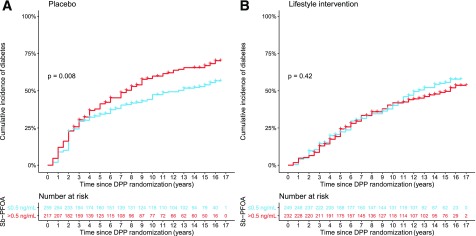
Objective: Perfluoroalkyl and polyfluoroalkyl substances (PFASs) are suspected endocrine disruptors widely detected across populations. We examine the extent to which PFASs are associated with diabetes incidence and microvascular disease. Secondarily, we tested whether a lifestyle intervention modifies associations and decreases concentrations.
Research design and methods: We analyzed data from a prospective cohort of 957 participants from the Diabetes Prevention Program (DPP) trial and Diabetes Prevention Program Outcomes Study (DPPOS). At baseline, participants were randomized to an intensive lifestyle intervention of diet, physical activity, and behavior modification or a placebo medication. We quantified plasma concentrations of six PFASs at baseline and 2 years after randomization. Participants were monitored for ∼15 years, repeatedly tested for diabetes, and evaluated for microvascular disease at the end of the follow-up.
Results: A doubling in baseline branched perfluorooctanoic acid concentration was associated with a 14% increase in diabetes risk for the placebo (hazard ratio [HR] 1.14, 95% CI 1.04, 1.25) but not in the lifestyle intervention group (HR 1.01, 95% CI 0.92, 1.11, P interaction = 0.11). Mean change in plasma baseline branched perfluorooctanoic acid concentration was greater for the placebo (0.96 ng/mL; 95% CI 0.71, 1.22) compared with the lifestyle intervention group (0.31 ng/mL; 95% CI 0.14, 0.48) 2 years after randomization. Each doubling in N-ethyl-perfluorooctane sulfonamido acetic acid was associated with 17% greater odds of prevalent microvascular disease (OR 1.17, 95% CI 1.05, 1.31), and a similar association was observed for perfluorodimethylhexane sulfonic acid (OR 1.18, 95% CI 1.04, 1.35), regardless of treatment.
Conclusions: Some plasma PFASs were associated with diabetes and microvascular disease. Our results suggest that exercise and diet may attenuate the diabetogenic association of PFASs.
Trial registration: ClinicalTrials.gov NCT00004992 NCT00038727.
© 2019 by the American Diabetes Association.
Figures
References
-
- Kannan K, Corsolini S, Falandysz J, et al. Perfluorooctanesulfonate and related fluorochemicals in human blood from several countries. Environ Sci Technol 2004;38:4489–4495 - PubMed
-
- Centers for Disease Control Prevention (CDC) Fourth National Report on Human Exposure to Environmental Chemicals, Updated Tables, March 2018, Atlanta, GA, U.S. Department of Health and Human Services, Centers for Disease Control Prevention (CDC), 2018
-
- D’eon JC, Mabury SA. Is indirect exposure a significant contributor to the burden of perfluorinated acids observed in humans? Environ Sci Technol 2011;45:7974–7984 - PubMed
