. 2019 Jul 12;365(6449):eaau4735.
doi: 10.1126/science.aau4735.

A sparse covarying unit that describes healthy and impaired human gut microbiota development

Affiliations

A sparse covarying unit that describes healthy and impaired human gut microbiota development

Arjun S Raman et al. Science. .

Abstract

Characterizing the organization of the human gut microbiota is a formidable challenge given the number of possible interactions between its components. Using a statistical approach initially applied to financial markets, we measured temporally conserved covariance among bacterial taxa in the microbiota of healthy members of a Bangladeshi birth cohort sampled from 1 to 60 months of age. The results revealed an "ecogroup" of 15 covarying bacterial taxa that provide a concise description of microbiota development in healthy children from this and other low-income countries, and a means for monitoring community repair in undernourished children treated with therapeutic foods. Features of ecogroup population dynamics were recapitulated in gnotobiotic piglets as they transitioned from exclusive milk feeding to a fully weaned state consuming a representative Bangladeshi diet.


Conflict of interest statement

J.I.G. is a co-founder of Matatu Inc., a company characterizing the role of diet-by-microbiota interactions in animal health. W.A.P. serves as a consultant to TechLab Inc., a company that makes diagnostic tests for enteric infections and has served as a consultant for Perrigo Nutritionals LLC, which produces infant formula.

Figures
None
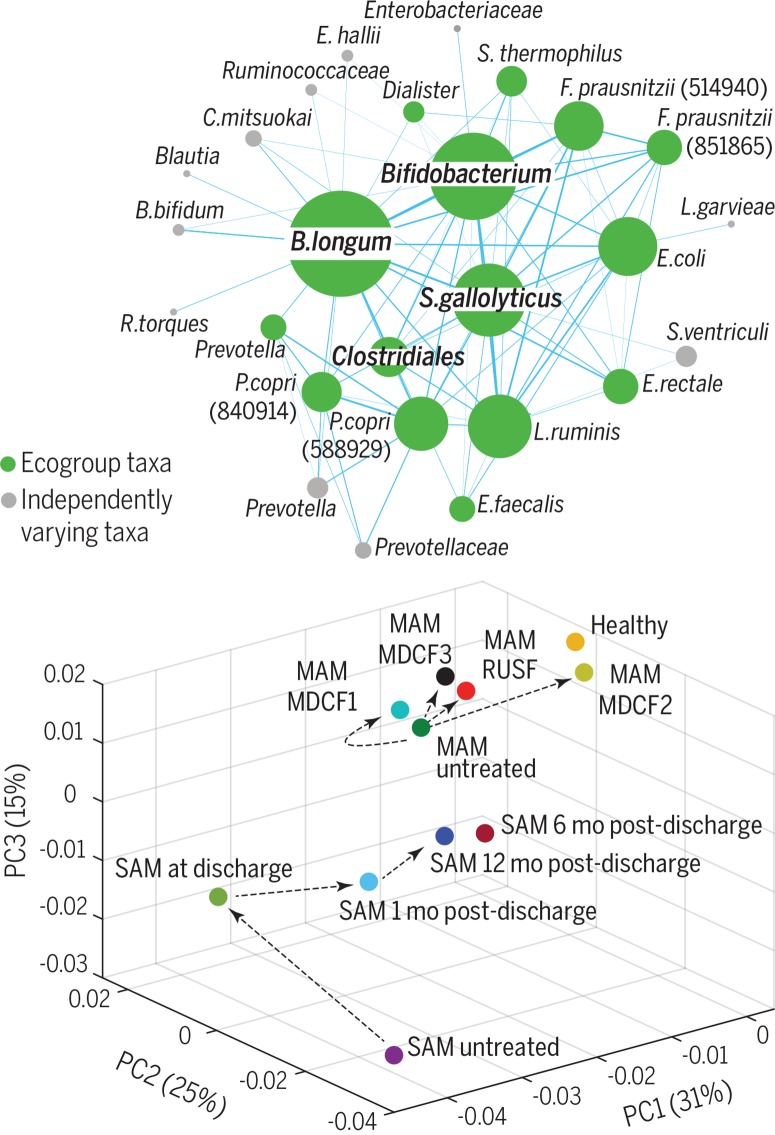
Ecogroup as a concise description of microbiota form. (Top) Network diagram of covarying taxa where node (taxon) color indicates ecogroup (green) or nonecogroup (gray), node size indicates number of mutually covarying taxa, and connection between nodes indicates covariance between two taxa. (Bottom) Measuring the representation of ecogroup taxa reveals that children with SAM treated with standard therapeutic foods have an ecogroup profile similar to that of children with untreated MAM, indicating persistent perturbations in their gut community relative to healthy children. In contrast, children with MAM treated with a therapeutic food designed to target the microbiota (MDCF-2) have an ecogroup profile that overlaps nearly entirely with that of healthy children.
Fig. 1
Fig. 1
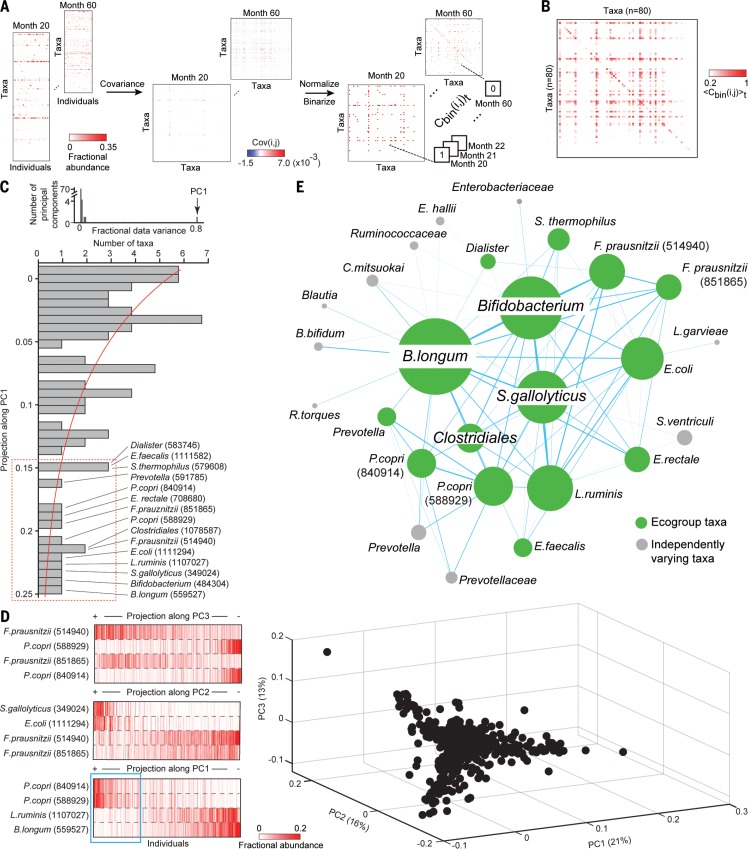
Defining a sparse, consistently covarying network of bacterial taxa (“ecogroup”) in healthy Bangladeshi children. (A) Workflow. Left: 16S rDNA sequencing of fecal microbiota samples collected monthly from healthy members of the birth cohort from postnatal months 20 to 60. For each month, a matrix is created where rows are taxa and columns are fecal samples of individuals. Center: Taxon-taxon covariance matrices for each month are calculated. Right: Monthly taxon-taxon covariance matrices are normalized relative to the maximum monthly covariance value. If a normalized monthly covariance value for a given (i, j) taxon-taxon pair is within the top or bottom 10% of all monthly covariance values, it is converted to a “1”; otherwise it is assigned a “0”. This binarized covariance matrix is defined as Cbini,j. Concatenating Cbini,j for all months creates a three-dimensional matrix, (Cbini,j)t.(B) Temporally conserved taxon-taxon covariance matrix. The binarized covariance values for each (i, j) pair of taxa in (Cbini,j)t are averaged over all months to give a temporally weighted covariance value for each taxon-taxon pair (Cbini,jt). In the limit that two taxa always covary with each other, Cbini,jt = 1. If two taxa never covary with each other, Cbini,jt = 0. The matrix shown illustrates sparse temporally conserved coupling, with many taxa showing no consistent covariance (Cbini,jt ≈ 0; white pixels) but a few exhibiting a high degree of conserved covariance (Cbini,jt≥ 0.5; deep red pixels). (C) Eigende-composition of temporally conserved covariance matrix. Note that 80% of the data variance in Cbini,jt can be represented by a single principal component. The histogram shows projections of taxa along PC1; data are fit to a generalized extreme value distribution (red line). Applying a 20% threshold to this distribution identifies 15 taxa that reproducibly covary over time. (D) Fecal samples from postnatal months 50 to 60 shown on a PCA space ordinated by the 15 taxa in (C). Heat maps illustrate the fractional abundance of taxa responsible for the variance along each principal component. The blue box shown in the left portion of the projection along PC1 highlights the subset of healthy children who have a high representation of P. copri relative to B. longum.(E) Graphical representation of the sparse covarying network of 15 taxa (green nodes). See text for details.
Fig. 2
Fig. 2
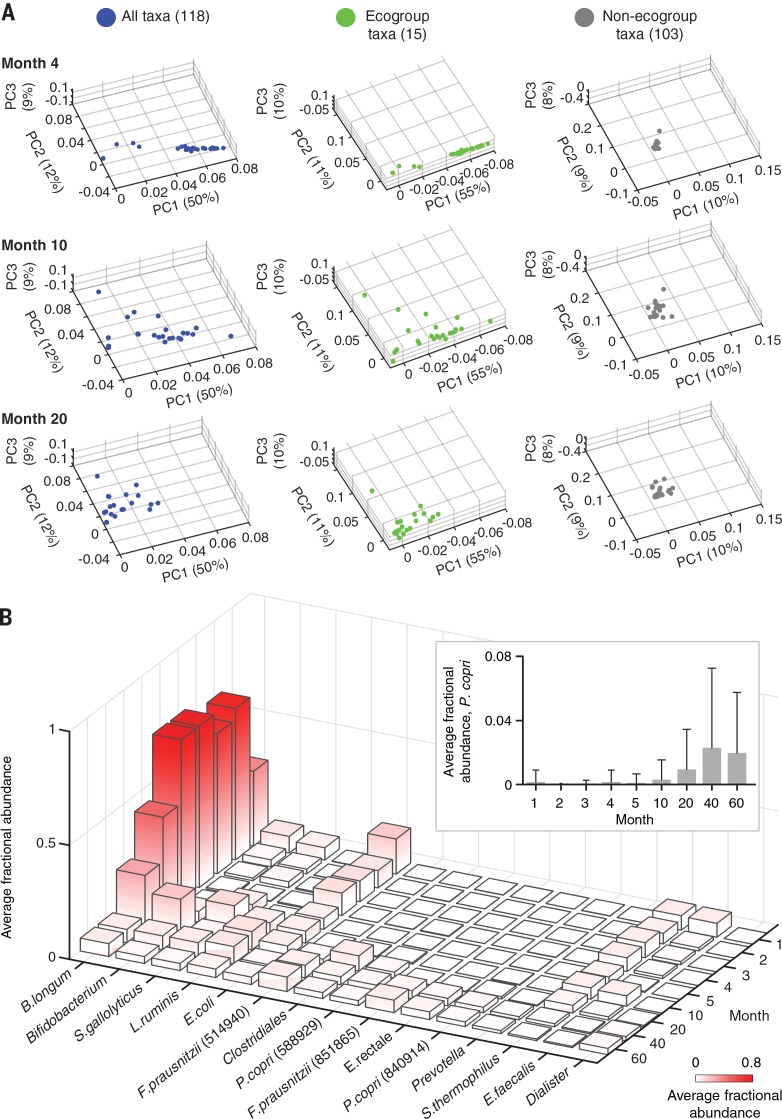
Characterizing healthy gut microbiota development in the Bangladeshi birth cohort. (A) PCA spaces were created. Each point in the spaces represents a fecal sample described by either all taxa present at a fractional abundance greater than 0.001 (0.1%) (118 taxa), ecogroup taxa (15), or non-ecogroup taxa (103). The spatial distribution of fecal samples in each PCA space is shown for the indicated postnatal months. (B) Bar graph illustrating average fractional abundance of ecogroup taxa as a function of postnatal month (see table S2E). Inset: Average fractional abundance (±SD) of P. copri as a function of time.
Fig. 3
Fig. 3
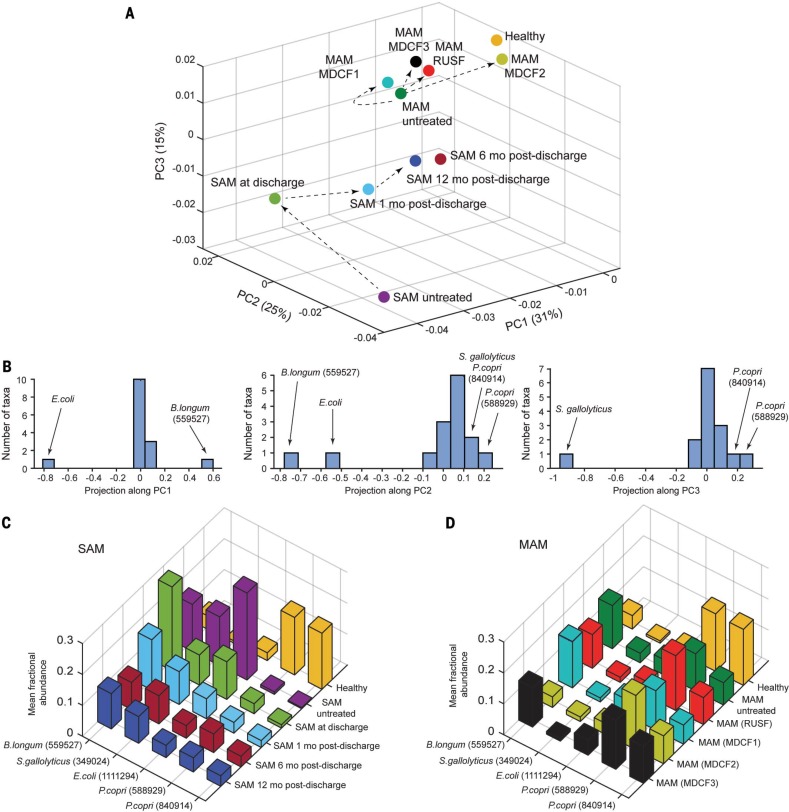
Ecogroup taxa define the response of the microbiota of children with SAM and MAM to various nutritional interventions. (A) Centroids of each indicated cohort are plotted on a PCA space. Arrows indicate the temporal progression of microbiota reconfiguration for children with SAM treated with conventional therapy and children with MAM treated with a RUSF or a MDCF. (B) Matrix decomposition of the axes shown in (A) highlights the taxa that are important for fecal sample variance observed along each principal component. (C and D) Average fractional abundance of ecogroup taxa identified in (B) in the fecal microbiota of members of the SAM and MAM cohorts as a function of treatment (see table S2G).
Fig. 4
Fig. 4
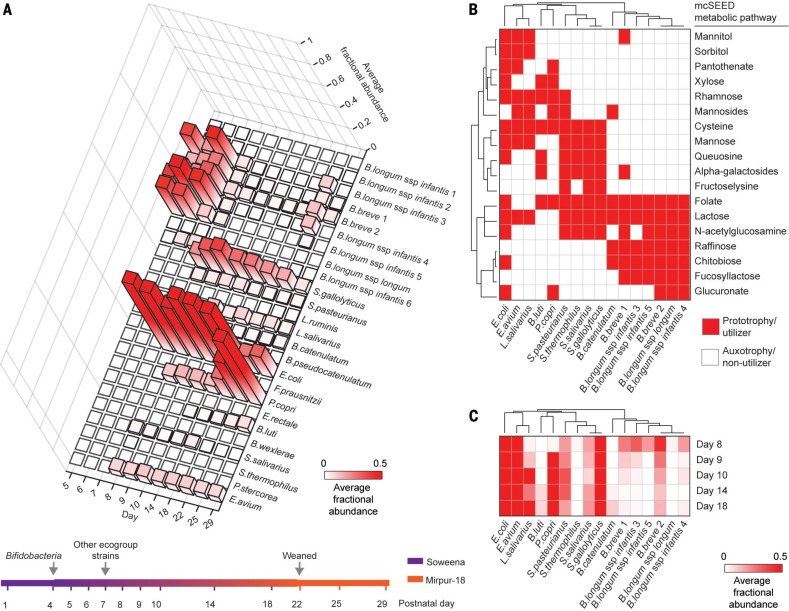
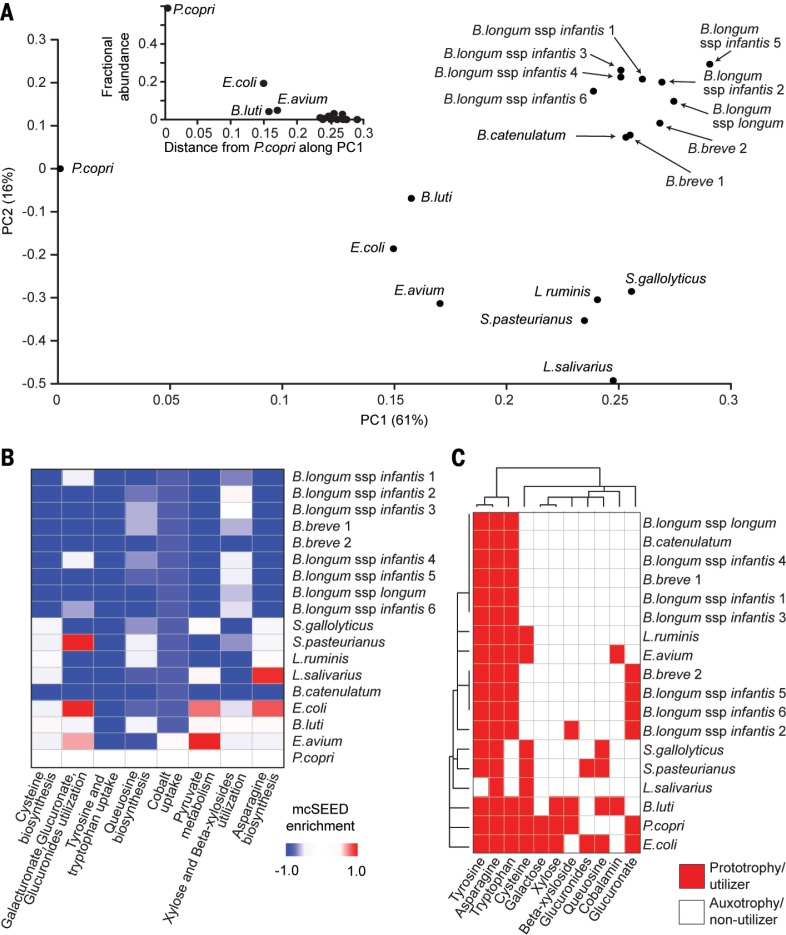
Distinguishing genomic features related to the fitness landscape of ecogroup strains in gnotobiotic piglets. (A) Average fractional abundances of strains plotted over time (see table S10). The summary of the experimental design shows when the various taxa were first introduced by gavage and how the diet changed over time. See fig. S13A for complete strain designations. (B) Genome features that distinguish among strains whose average fractional abundances in the fecal microbiota of piglets was ≥0.001 between postnatal days 8 and 22. These distinguishing features are mcSEED metabolic phenotypes color-coded according to whether they are predicted to endow the host strain with prototrophy for amino acids and B vitamins or the capacity to utilize the indicated carbohydrate. Strains are hierarchically clustered according to the representation of these metabolic pathways. (C) Heat map depicting the fractional representation of the strains shown in (B) at the indicated time points. Strains are hierarchically clustered according to the mcSEED metabolic phenotypes in (B). Note that the pattern of clustering defined by phenotypes also clusters strains by their fitness.
Fig. 5
Fig. 5
Distinguishing features of mcSEED metabolic module expression related to the fitness of ecogroup strains in weaned gnotobiotic piglets. See fig. S13A for full strain designations. (A) The transcriptomes of cecal community members were classified on the basis of gene assignments to 81 mcSEED metabolic modules (see count matrix in fig. S14B). Each strain is plotted on the first two principal components of the enrichment matrix in fig. S14B. The inset shows that fractional representation (fitness) of strains correlates with their expression profiles as judged by position along PC1. (B) Singular value decomposition (SVD, fig. S14C) identifies which among the 81 expressed metabolic modules most distinguish the indicated strains in the cecal community and Mirpur-18 diet contexts (fig. S14D). (C) Expressed discriminatory metabolic modules identified by SVD in (B) are shown as complete or incompletely represented in the genomes of the indicated strains by red pixels (predicted prototrophy for the amino acid or the ability to utilize the carbohydrate shown) or by white pixels (auxotrophy or the inability to utilize the carbohydrate). Strains and metabolic modules are hierarchically clustered.

Comment in

References

    1. Lidicker W. Z., Jr., A clarification of interactions in ecological systems. Bioscience 29, 375–377 (1979). doi: 10.2307/1307540 - DOI
    1. Faust K., Raes J., Microbial interactions: From networks to models. Nat. Rev. Microbiol. 10, 538–550 (2012). doi: 10.1038/nrmicro2832; pmid: - DOI - PubMed
    1. Layeghifard M., Hwang D. M., Guttman D. S., Disentangling interactions in the microbiome: A network perspective. Trends Microbiol. 25, 217–228 (2017). doi: 10.1016/j.tim.2016.11.008; pmid: - DOI - PMC - PubMed
    1. Ives A. R., Dennis B., Cottingham K. L., Carpenter S. R., Estimating community stability and ecological interactions from time-series data. Ecol. Monogr. 73, 301–330 (2003). doi: 10.1890/0012-9615(2003)073[0301:ECSAEI]2.0.CO;2 - DOI
    1. Hekstra D. R., Leibler S., Contingency and statistical laws in replicate microbial closed ecosystems. Cell 149, 1164–1173 (2012). doi: 10.1016/j.cell.2012.03.040; pmid: - DOI - PubMed

Publication types