Clustering and Switching Patterns in Semantic Fluency and Their Relationship to Working Memory in Mild Cognitive Impairment
- PMID: 31297135
- PMCID: PMC6609534
- DOI: 10.12779/dnd.2019.18.2.47
Clustering and Switching Patterns in Semantic Fluency and Their Relationship to Working Memory in Mild Cognitive Impairment
Abstract
Background and purpose: Semantic verbal fluency test is a neuropsychological assessment that can sensitively detect neuropathological changes. Considering its multifactorial features tapping various cognitive domains such as semantic memory, executive function, and working memory, it is necessary to examine verbal fluency performance in association with underlying cognitive functions. The objective of the current study was to investigate semantic fluency patterns of people with mild cognitive impairment (MCI) based on clustering and switching and their relationship with working memory.
Methods: Twenty-six individuals with MCI and 23 normal elderly adults participated in this study. A semantic verbal fluency test (animal version) was administered and the performance was analyzed using the following measures: number of correct words, cluster size, and number of switches. Scores of digit forward (DF) and backward span tasks were employed as working memory measures.
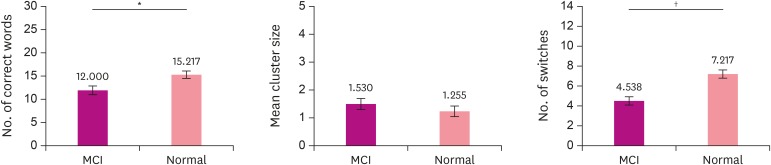
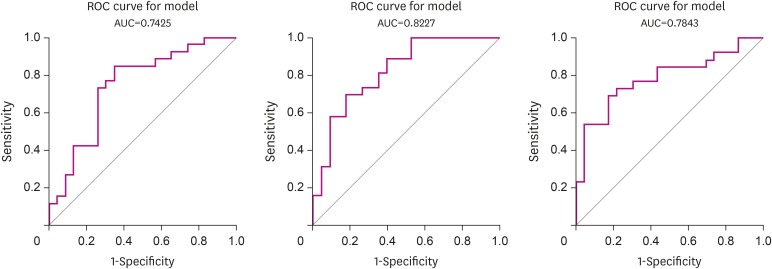
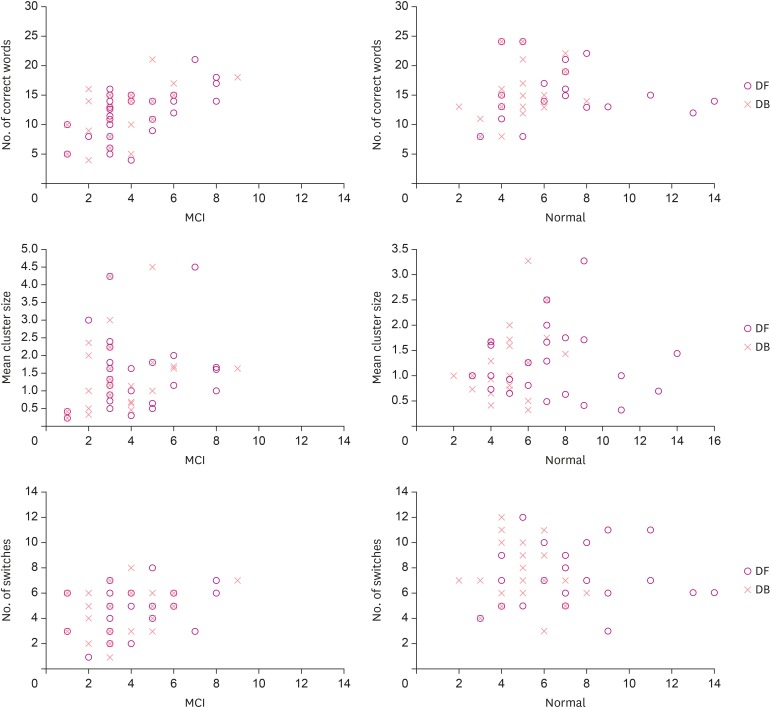
Results: Analyses of variance revealed significant group differences in the numbers of correct words and switches. Multivariate logistic regression and receiver-operating characteristic analyses showed that the number of switches more sensitively distinguished MCI existence than the number of correct words. Stepwise linear regression analysis showed that DF task and age significantly predicted the number of correct words while only the DF task significantly predicted the number of switches.
Conclusions: Decrement in semantic verbal fluency in MCI seems to be associated with impaired switching abilities. Working memory capacity might serve as the underlying cognitive factor related to decreased verbal fluency in MCI.
Keywords: Clustering; Mild Cognitive Impairment; Semantic Fluency; Switching; Working Memory.
Conflict of interest statement
Conflicts of Interest: The authors have no financial conflicts of interest.
Figures
References
-
- Morris JC. Mild cognitive impairment is early-stage Alzheimer disease: time to revise diagnostic criteria. Arch Neurol. 2006;63:15–16. - PubMed
-
- Petersen RC. Mild cognitive impairment as a diagnostic entity. J Intern Med. 2004;256:183–194. - PubMed
-
- Chertkow H. Mild cognitive impairment. Curr Opin Neurol. 2002;15:401–407. - PubMed
-
- Flicker C, Ferris SH, Reisberg B. Mild cognitive impairment in the elderly: predictors of dementia. Neurology. 1991;41:1006–1009. - PubMed
-
- Petersen RC, Doody R, Kurz A, Mohs RC, Morris JC, Rabins PV, et al. Current concepts in mild cognitive impairment. Arch Neurol. 2001;58:1985–1992. - PubMed
LinkOut - more resources
Full Text Sources
Miscellaneous