


Equivalency of the diagnostic accuracy of the PHQ-8 and PHQ-9: a systematic review and individual participant data meta-analysis
- PMID: 31298180
- PMCID: PMC6954991
- DOI: 10.1017/S0033291719001314
Equivalency of the diagnostic accuracy of the PHQ-8 and PHQ-9: a systematic review and individual participant data meta-analysis
Erratum in
-
Equivalency of the diagnostic accuracy of the PHQ-8 and PHQ-9: a systematic review and individual participant data meta-analysis - ERRATUM.Psychol Med. 2020 Dec;50(16):2816. doi: 10.1017/S0033291719002137. Epub 2019 Aug 19. Psychol Med. 2020. PMID: 31423953 No abstract available.
Abstract
Background: Item 9 of the Patient Health Questionnaire-9 (PHQ-9) queries about thoughts of death and self-harm, but not suicidality. Although it is sometimes used to assess suicide risk, most positive responses are not associated with suicidality. The PHQ-8, which omits Item 9, is thus increasingly used in research. We assessed equivalency of total score correlations and the diagnostic accuracy to detect major depression of the PHQ-8 and PHQ-9.
Methods: We conducted an individual patient data meta-analysis. We fit bivariate random-effects models to assess diagnostic accuracy.
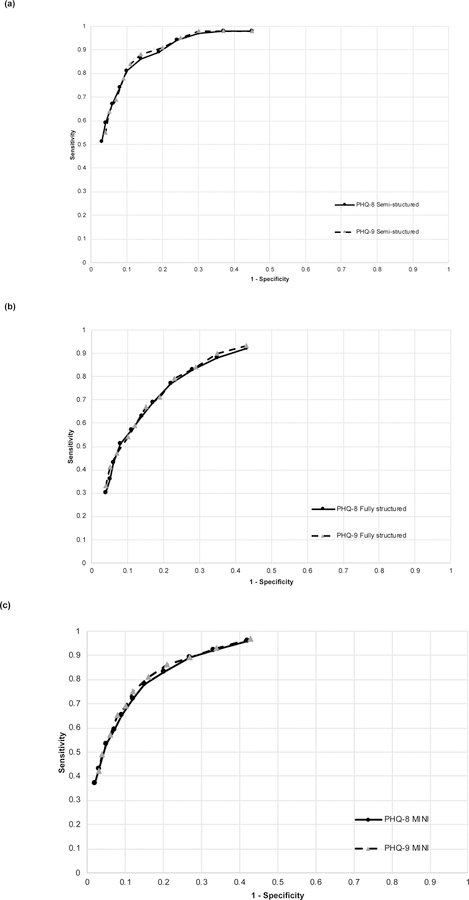
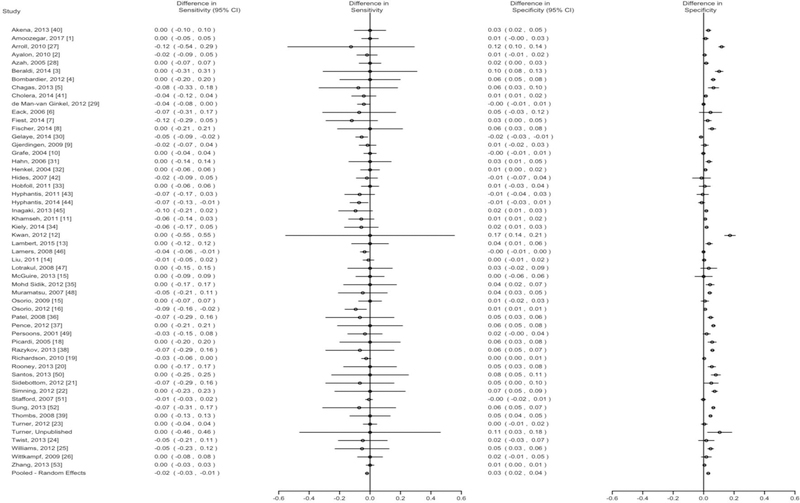
Results: 16 742 participants (2097 major depression cases) from 54 studies were included. The correlation between PHQ-8 and PHQ-9 scores was 0.996 (95% confidence interval 0.996 to 0.996). The standard cutoff score of 10 for the PHQ-9 maximized sensitivity + specificity for the PHQ-8 among studies that used a semi-structured diagnostic interview reference standard (N = 27). At cutoff 10, the PHQ-8 was less sensitive by 0.02 (-0.06 to 0.00) and more specific by 0.01 (0.00 to 0.01) among those studies (N = 27), with similar results for studies that used other types of interviews (N = 27). For all 54 primary studies combined, across all cutoffs, the PHQ-8 was less sensitive than the PHQ-9 by 0.00 to 0.05 (0.03 at cutoff 10), and specificity was within 0.01 for all cutoffs (0.00 to 0.01).
Conclusions: PHQ-8 and PHQ-9 total scores were similar. Sensitivity may be minimally reduced with the PHQ-8, but specificity is similar.
Keywords: Depression; PHQ-8; PHQ-9; diagnostic accuracy; individual participant data meta-analysis; meta-analysis; screening; systematic review.
Conflict of interest statement
Conflict of Interest.
Drs. Jetté and Patten declare that they received a grant, outside the submitted work, from the University of Calgary Hotchkiss Brain Institute, which was jointly funded by the Institute and Pfizer. Pfizer was the original sponsor of the development of the PHQ-9, which is now in the public domain. Dr. Chan is a steering committee member or consultant of Astra Zeneca, Bayer, Lilly, MSD and Pfizer. She has received sponsorships and honorarium for giving lectures and providing consultancy and her affiliated institution has received research grants from these companies. Dr. Hegerl declares that within the last three years, he was an advisory board member for Lundbeck and Servier; a consultant for Bayer Pharma; a speaker for Roche Pharma and Servier; and received personal fees from Janssen, all outside the submitted work. Dr. Inagaki declares that he has received a grant from Novartis Pharma, and personal fees from Meiji, Mochida, Takeda, Novartis, Yoshitomi, Pfizer, Eisai, Otsuka, MSD, Technomics, and Sumitomo Dainippon, all outside of the submitted work. All authors declare no other relationships or activities that could appear to have influenced the submitted work. No funder had any role in the design and conduct of the study; collection, management, analysis, and interpretation of the data; preparation, review, or approval of the manuscript; and decision to submit the manuscript for publication.
Figures
References
-
- Allaby M (2010). Screening for depression: A report for the UK National Screening Committee (Revised report) UK National Screening Committee: London, United Kingdom.
-
- American Psychiatric Association. (2013). Diagnostic and statistical manual of mental disorders (5th ed.). Arlington, VA: American Psychiatric Publishing.
-
- Barrera TL, Cummings JP, Armento M, Cully JA, Bush Amspoker A, Wilson NL, Mallen MJ, Shrestha S, Kunik ME, Stanley MA (2017). Telephone-delivered cognitive-behavioral therapy for older, rural veterans with depression and anxiety in home-based primary care. Clinical gerontologist 40, 114–123. - PubMed
-
- Brugha TS, Bebbington PE, Jenkins R (1999). A difference that matters: comparisons of structured and semi-structured psychiatric diagnostic interviews in the general population. Psychological Medicine 29, 1013–1020. - PubMed
-
- Canadian Agency for Drugs and Technologies in Health. (2016). PRESS – Peer review of electronic search strategies: 2015 Guideline explanation and elaboration (PRESS E&E) CADTH: Ottawa.
Publication types
MeSH terms
Grants and funding
- R36 HS018246/HS/AHRQ HHS/United States
- R34 MH072925/MH/NIMH NIH HHS/United States
- R01 MH069666/MH/NIMH NIH HHS/United States
- TL1 RR024135/RR/NCRR NIH HHS/United States
- F30 MH096664/MH/NIMH NIH HHS/United States
- RP-PG-0606-1142/DH_/Department of Health/United Kingdom
- FRN 83518/CIHR/Canada
- MR/J000914/1/MRC_/Medical Research Council/United Kingdom
- R01 MH073687/MH/NIMH NIH HHS/United States
- C0396/MRF_/MRF_/United Kingdom
- R01 HL079235/HL/NHLBI NIH HHS/United States
- R49 CE002093/CE/NCIPC CDC HHS/United States
- R34 MH084673/MH/NIMH NIH HHS/United States
- P30 DK050456/DK/NIDDK NIH HHS/United States
- T37 MD001449/MD/NIMHD NIH HHS/United States
- T32 GM007356/GM/NIGMS NIH HHS/United States
- K02 MH065919/MH/NIMH NIH HHS/United States
- R24 MH071604/MH/NIMH NIH HHS/United States
