. 2019 Aug 16;8(8):1838-1846.
doi: 10.1021/acssynbio.9b00142. Epub 2019 Jul 29.

Automated Design of Diverse Stand-Alone Riboswitches

Automated Design of Diverse Stand-Alone Riboswitches

Michelle J Wu et al. ACS Synth Biol. .

Abstract

Riboswitches that couple binding of ligands to conformational changes offer sensors and control elements for RNA synthetic biology and medical biotechnology. However, design of these riboswitches has required expert intuition or software specialized to transcription or translation outputs; design has been particularly challenging for applications in which the riboswitch output cannot be amplified by other molecular machinery. We present a fully automated design method called RiboLogic for such "stand-alone" riboswitches and test it via high-throughput experiments on 2875 molecules using RNA-MaP (RNA on a massively parallel array) technology. These molecules consistently modulate their affinity to the MS2 bacteriophage coat protein upon binding of flavin mononucleotide, tryptophan, theophylline, and microRNA miR-208a, achieving activation ratios of up to 20 and significantly better performance than control designs. By encompassing a wide diversity of stand-alone switches and highly quantitative data, the resulting ribologic-solves experimental data set provides a rich resource for further improvement of riboswitch models and design methods.

Keywords: RNA; computer-assisted design; high-throughput measurements; molecular design; riboswitch; thermodynamic model.


Conflict of interest statement

The authors declare no competing financial interest.

Figures
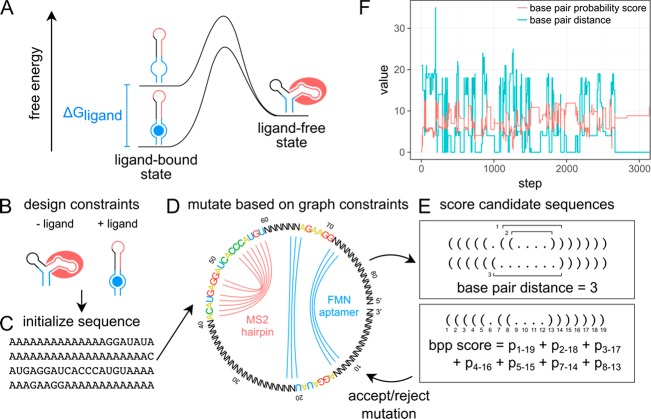
Figure 1
Figure 1
RiboLogic uses a graph representation and two scoring functions to design stand-alone riboswitches. (A) This energy diagram represents the thermodynamic model used, where the ligand-bound state is given an energetic bonus due to the chemical potential of the binding of the ligand. (B) A user specifies design constraints for a riboswitch of interest, e.g., the formation of the MS2 hairpin in the absence of a ligand and the nonformation of the hairpin in the absence of a ligand. (C) The sequence is initialized to all A’s except for known sequence constraints. (D) A graph representation is used to constrain the sequence space that is sampled by RiboLogic. In this example, the goal is to design a riboswitch whose formation of the MS2 RNA hairpin is modulated by the presence of the flavin mononucleotide (FMN) molecule. Bases connected by an arc are part of these secondary structure elements and are constrained to be complementary in sequence update. (E) Two scoring metrics are used to evaluate each design candidate. The base pair distance measures the number of base pairs that must be broken or formed to reach the target structure, while the base pair probability (bpp) score quantifies the probability of formation of each base pair in the target structure. (F) The scores change as expected during computational design, with the base pair distance decreasing and the base pair probability score increasing over optimization steps.
Figure 2
Figure 2
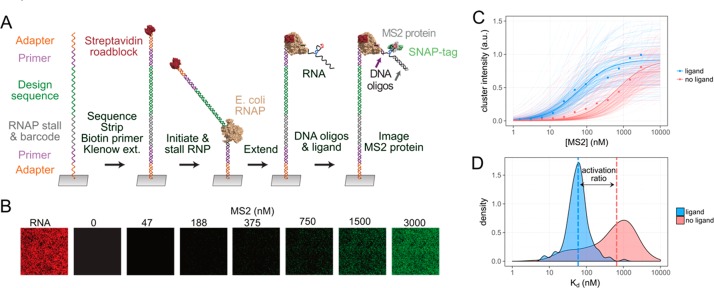
Functional tests of riboswitches using a high-throughput array. (A) Each cluster on the array initially contained a single species of ssDNA from a synthesized oligo pool. dsDNA was generated by Klenow extension with a biotinylated primer, and RNA was transcribed by RNA polymerase until being stalled at the streptavidin roadblock. (B) Fluorescently labeled MS2 protein was flowed in at varying concentrations to enable measurement of binding. (C) The array technology enables measurement of binding curves over tens or hundreds of replicate clusters for each design and solution condition. (D) The median over the distribution of fit Kd’s was used to estimate the activation ratio of switching. In this example of an ON switch, the activation ratio of 11 was measured over 172 independent clusters displaying the same switch.
Figure 3
Figure 3
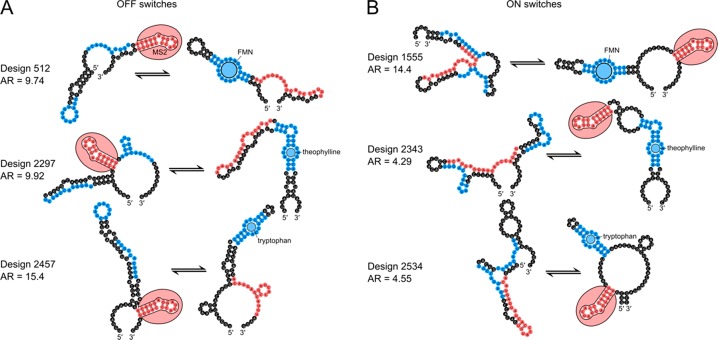
Top ligand-responsive riboswitch designs. (A) Predicted secondary structures for a top OFF switches show disruption of the MS2 hairpin (red) upon binding of FMN, theophylline, or tryptophan (blue). (B) Predicted secondary structures for top ON switches show formation of the MS2 hairpin (red) upon binding of FMN, theophylline, or tryptophan (blue).
Figure 4
Figure 4
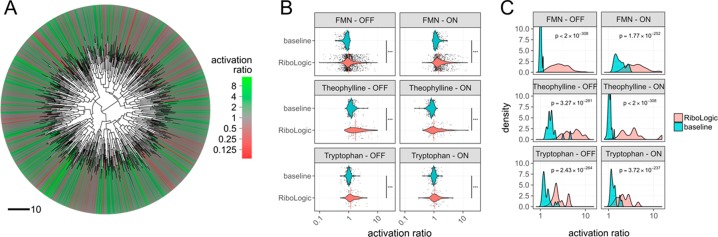
Design of ligand-responsive riboswitches. (A) Clustering of FMN switches based on the sum of base pair distances of predicted secondary structures reveals that RiboLogic designs with diverse structures achieve high activation ratios. (B) Distributions of experimentally measured activation ratios are shown for various types of designs, with medians shown as vertical lines. RiboLogic generally achieves significantly better activation ratios than baseline, as determined by a Wilcoxon rank-sum test (***p < 0.001). Baseline is the measured activation ratio for sequences made for other design problems. (C) In practice, several of the most promising designs would be experimentally screened to evaluate switch efficiency. To mimic this, we bootstrapped sets of ten designs and chose the design with the best activation ratio. The distributions of activation ratios for these best-of-ten designs were compared between RiboLogic and baseline. A best-of-ten strategy yields designs with significantly higher activation ratios than baseline.
Figure 5
Figure 5
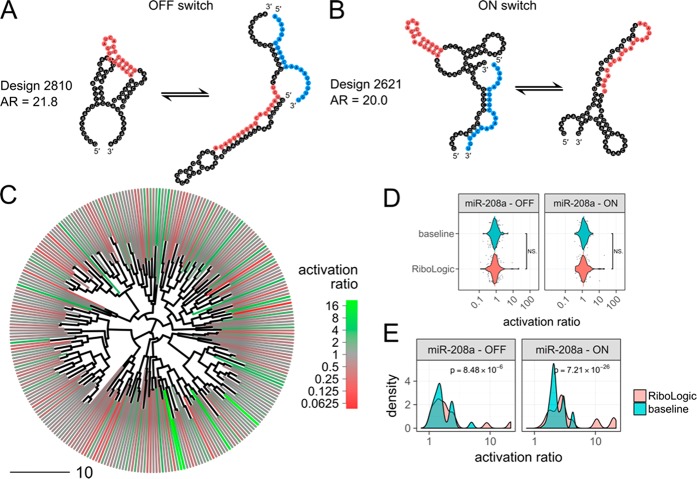
Design of miRNA-responsive riboswitches. (A) This OFF switch is predicted to form the MS2 hairpin (red) only in the absence of the miRNA (blue). (B) This ON switch is predicted to form the MS2 hairpin (red) only in the presence of the miRNA (blue). (C) Clustering of miRNA switches based on the base pair distance between predicted secondary structures in the absence of the miRNA reveals that RiboLogic designs with diverse structures achieve high activation ratios. (D) The distribution of experimentally measured activation ratios are shown as scatter and violin plots, with medians shown as horizontal lines. Across all design problems, there is no significant difference between RiboLogic and baseline designs, as determined by a Wilcoxon rank-sum test. (E) We conducted a best-of-ten analysis by bootstrapping sets of ten designs and choosing the design with the best activation ratio. The distributions of activation ratios for these best-of-ten designs were compared between RiboLogic and baseline. This analysis results in designs with significantly higher activation ratios, but the distributions remain similar, with the exception of a few high performaning designs.
Figure 6
Figure 6
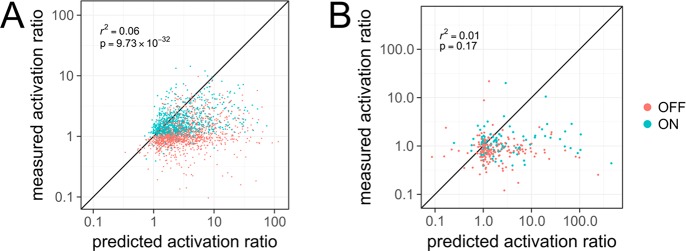
Comparison of predicted and measured activation ratios. (A) For small molecule riboswitches, the predicted activation ratio is somewhat correlated with measured activation ratio. (B) For miRNA riboswitches, the correlation between prediction and experiment is poor.

References

    1. Tucker B. J.; Breaker R. R. (2005) Riboswitches as Versatile Gene Control Elements. Curr. Opin. Struct. Biol. 15 (3), 342–348. 10.1016/j.sbi.2005.05.003. - DOI - PubMed
    1. Rodrigo G.; Landrain T. E.; Majer E.; Daròs J.-A.; Jaramillo A. (2013) Full Design Automation of Multi-State RNA Devices to Program Gene Expression Using Energy-Based Optimization. PLoS Comput. Biol. 9 (8), e1003172 10.1371/journal.pcbi.1003172. - DOI - PMC - PubMed
    1. Espah Borujeni A.; Mishler D. M.; Wang J.; Huso W.; Salis H. M. (2016) Automated Physics-Based Design of Synthetic Riboswitches from Diverse RNA Aptamers. Nucleic Acids Res. 44 (1), 1–13. 10.1093/nar/gkv1289. - DOI - PMC - PubMed
    1. Ceres P.; Garst A. D.; Marcano-Vela J. G.; Batey R. T. (2013) Modularity of Select Riboswitch Expression Platforms Enables Facile Engineering of Novel Genetic Regulatory Devices. ACS Synth. Biol. 2, 463. 10.1021/sb4000096. - DOI - PMC - PubMed
    1. Kellenberger C. A.; Wilson S. C.; Sales-Lee J.; Hammond M. C. (2013) RNA-Based Fluorescent Biosensors for Live Cell Imaging of Second Messengers Cyclic Di-GMP and Cyclic AMP-GMP. J. Am. Chem. Soc. 135 (13), 4906–4909. 10.1021/ja311960g. - DOI - PMC - PubMed

Publication types