


Relief Following Chronic Stress Augments Spreading Depolarization Susceptibility in Familial Hemiplegic Migraine Mice
- PMID: 31299346
- PMCID: PMC6731136
- DOI: 10.1016/j.neuroscience.2019.07.006
Relief Following Chronic Stress Augments Spreading Depolarization Susceptibility in Familial Hemiplegic Migraine Mice
Abstract
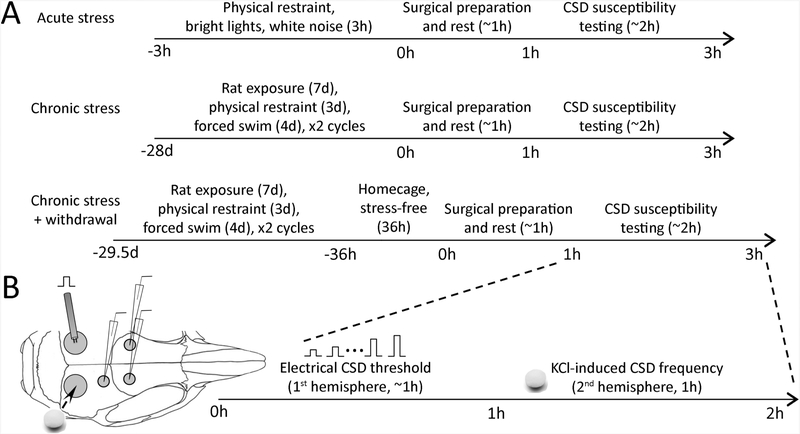
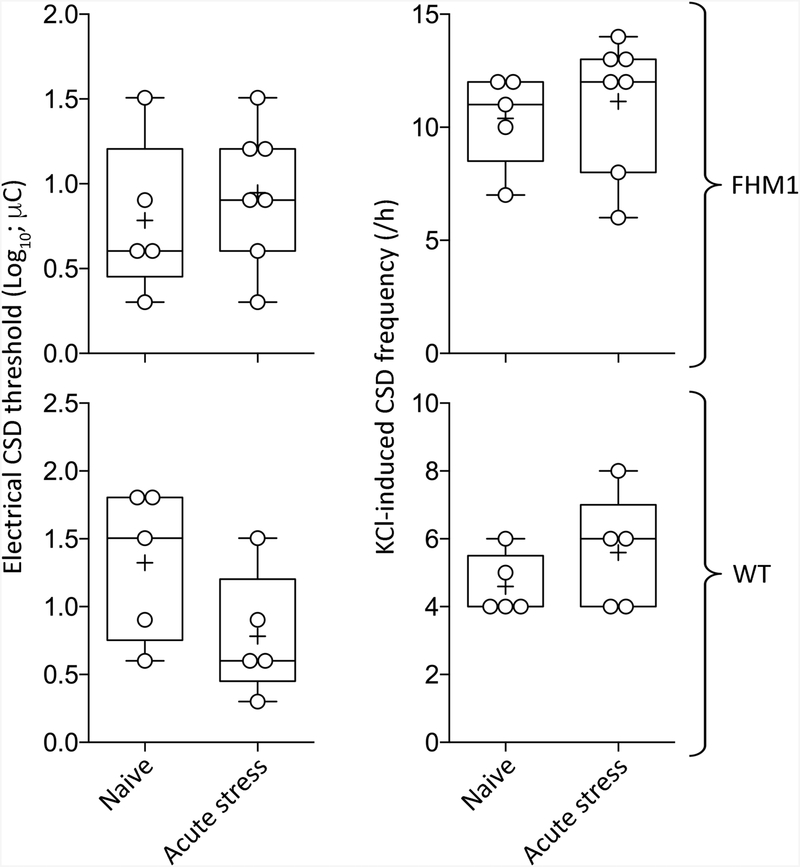
Cortical spreading depolarization (CSD) is the electrophysiological substrate of migraine aura, and a putative trigger of trigeminovascular activation and migraine headache. Many migraineurs report stress or relief after a stress triggers an attack. We tested whether various stress conditions might modulate CSD susceptibility and whether this is dependent on genetic factors. Male and female wild type and familial hemiplegic migraine type1 (FHM1) knock-in mice heterozygous for the S218L missense mutation were subjected to acute or chronic stress, or chronic stress followed by relief (36 h). Acute stress was induced by restraint and exposure to bright light and white noise (3 h). Chronic stress was induced for 28 days by two cycles of repeated exposure of mice to a rat (7 days), physical restraint (3 days), and forced swimming (3 days). Electrical CSD threshold and KCl-induced (300 mM) CSD frequency were determined in occipital cortex in vivo at the end of each protocol. Relief after chronic stress reduced the electrical CSD threshold and increased the frequency of KCl-induced CSDs in FHM1 mutants only. Acute or chronic stress without relief did not affect CSD susceptibility in either strain. Stress status did not affect CSD propagation speed, duration or amplitude. In summary, relief after chronic stress, but not acute or chronic stress alone, augments CSD in genetically susceptible mice. Therefore, enhanced CSD susceptibility may explain why, in certain patients, migraine attacks typically occur during a period of stress relief such as weekends or holidays.
Keywords: FHM1; acute stress; chronic stress; cortical spreading depolarization; stress relief; weekend migraine.
Copyright © 2019 IBRO. Published by Elsevier Ltd. All rights reserved.
Conflict of interest statement
DECLERATIONS OF INTEREST
None.
Figures

References
-
- Aldenhoff JB, Gruol DL, Rivier J, Vale W, and Siggins GR (1983). Corticotropin releasing factor decreases postburst hyperpolarizations and excites hippocampal neurons. Science 221, 875–7. - PubMed
-
- Alstadhaug KB, Salvesen R, and Bekkelund S (2007). Weekend migraine. Cephalalgia 27, 343–6. - PubMed
-
- Ayata C (2009). Spreading depression: from serendipity to targeted therapy in migraine prophylaxis. Cephalalgia 29,1095–114. - PubMed
-
- Ayata C (2010). Cortical spreading depression triggers migraine attack: pro. Headache 50, 725–30. - PubMed
-
- Ayata C (2013). Pearls and pitfalls in experimental models of spreading depression. Cephalalgia 33, 604–13. - PubMed
Publication types
MeSH terms
Grants and funding
LinkOut - more resources
Full Text Sources
Medical
Molecular Biology Databases
Miscellaneous
